
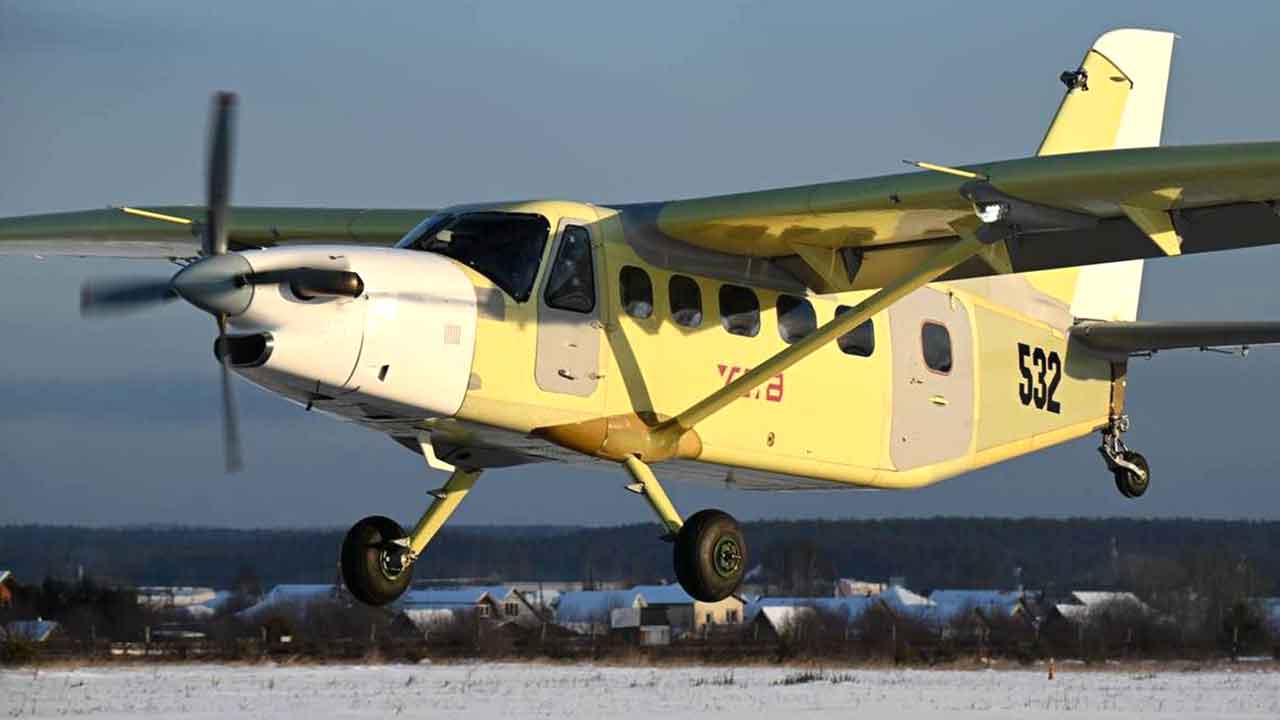
Yekaterinburg, December 24 – A prototype of the light multipurpose LMS-901 Baikal aircraft completed its first flight equipped with a fully domestic powerplant, combining the new VK-800 turboprop engine and the AV-901 propeller.
The test took place at the aerodrome of the Ural Civil Aviation Plant in Yekaterinburg, as part of the joint flight test program.
+ Click here to watch the video
During the inaugural flight with the new powerplant, the aircraft reached a speed of 210 km/h and an altitude of 400 meters. Prior to flight authorization, a full cycle of ground tests of the powerplant was conducted, including evaluation of engine stability across all planned operating modes, throttle response, operation of the engine emergency shutdown systems and the propeller emergency feathering system, as well as verification of fuel supply.
According to the test pilots, the flight proceeded normally. The aircraft demonstrated stability and good controllability within the established limits of center of gravity, speeds, and altitudes. The propulsion system operated without remarks, showing stable performance throughout the entire flight profile.

For the Deputy Minister of Industry and Trade of the Russian Federation, Gennady Abramenkov, the test represents a strategic milestone. According to him, the flight confirmed the feasibility of developing a fully Russian aircraft equipped with a national powerplant capable of meeting an important state demand: expanding connectivity and accessibility of air transport across the country, including hard-to-reach regions. Abramenkov also emphasized that engines in this power range had not been developed or produced domestically for several decades, making the achievement particularly significant for Russian aviation.
VK-800 engine and AV-901 propeller
Developed by Ural Works of Civil Aviation JSC, the VK-800 engine was designed to operate in harsh climatic conditions, a requirement considered critical for missions in the Arctic, the taiga, and mountainous areas. Maximum power ranges from 807 hp to 870 hp, depending on the application, and the design allows for further modernization with additional power increases, paving the way for its use in re-engining programs, including An-2 aircraft.
In addition to the LMS-901 Baikal, the VK-800 is planned to equip other projects, such as the UTS-800 trainer aircraft, the Russian-Belarusian regional aircraft LMS-192 Oswei, and the re-engining of L-410 aircraft currently in service.
The AV-901 propeller, in turn, is a single-acting reversible-pitch propeller with hydraulic control and a straight circuit. Capable of operating at up to 1,900 rpm, it supports power of up to 877 hp and provides an estimated maximum thrust of at least 15 kN (approximately 1,400 kgf). Manufactured entirely using domestic materials, the AV-901 has no direct analogues in Russia. Its reduced number of control units contributes to lower system weight and higher operational reliability. Digitally integrated with the VK-800 engine control, the propeller allows the powerplant to operate at maximum efficiency, reducing fuel consumption and improving aircraft controllability.

+ Japan completes tests of the Type 12 anti-ship missile with a 1,000 km range
Aircraft for remote regions
The LMS-901 Baikal is a nine-seat light multipurpose aircraft intended for local airlines. Designed to offer operational flexibility, the model features a spacious cargo cabin that can be quickly configured for passenger transport, cargo, mail, or medical evacuation missions. The goal of the program is to ensure reliable air connectivity for regions of Russia with limited airport infrastructure, especially in the Far East and the Far North.
With the first flight conducted using a national engine and propeller, the Baikal program advances toward certification of a fully Russian air platform, strengthening the country’s industrial autonomy in the light aircraft segment.
Source and images: minpromtorg.gov.ru. This content was created with the assistance of AI and reviewed by the editorial team.
