
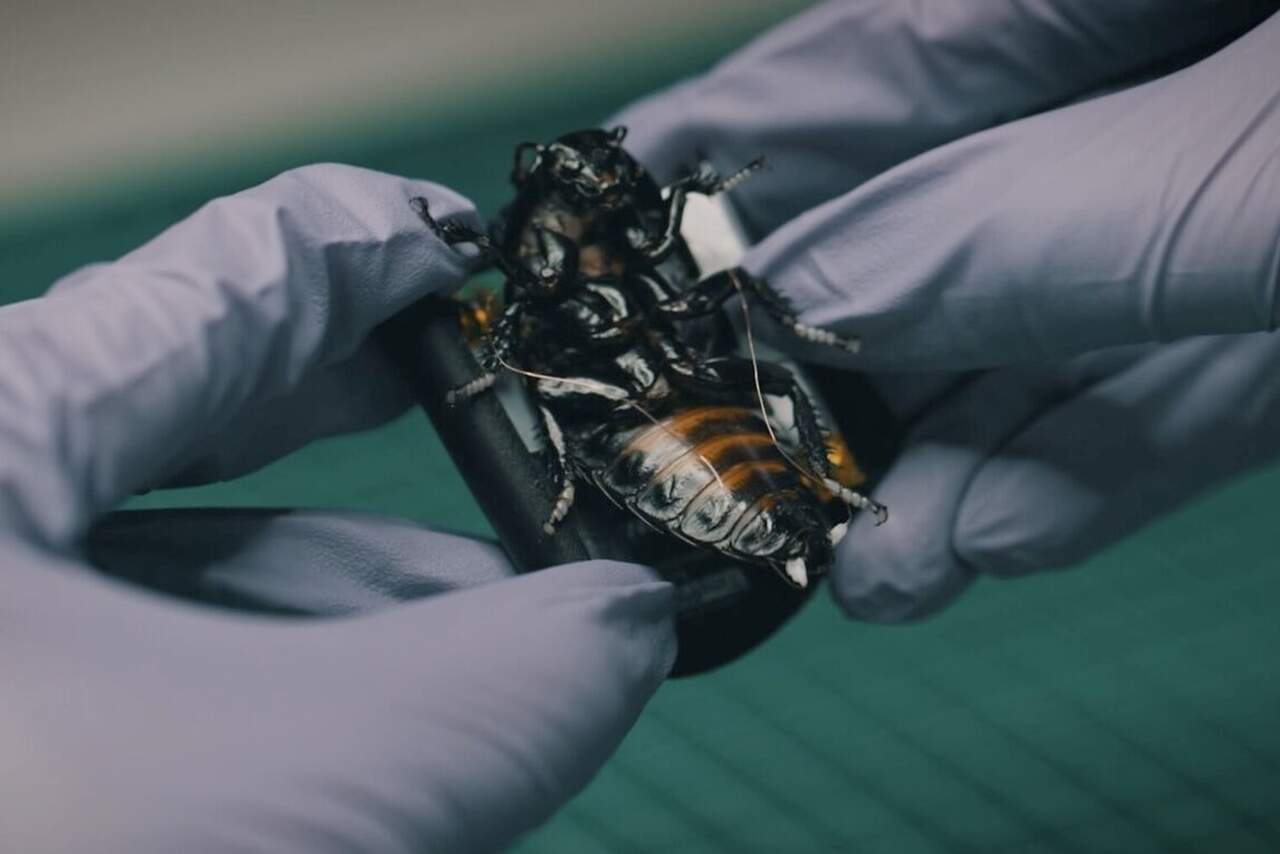
SWARM Biotactics, a German robotics startup, revealed that its bioelectronic swarms of cyborg insects have been field-tested and deployed with NATO customers, including the Bundeswehr.
The announcement was made last Wednesday (25) by the company’s chief executive officer, Stefan Wilhelm, who confirmed the operational progress of its programmable cyborg insect swarms developed for detection and reconnaissance missions.
According to Wilhelm, the capability did not exist a year ago and rapidly progressed from concept to operational deployment. Today, these systems are already in use by “paying NATO customers,” he said.
According to the company, the systems consist of living organisms controlled via bioelectronic neural interfaces, equipped with sensors, onboard artificial intelligence processing, and secure communication links.
Wilhelm said the platforms are capable of moving as coordinated units while carrying modular payloads designed for specific mission tasks.
“What you are seeing is real. Living organisms, controlled through bioelectronic neural interfaces, carrying sensors, edge AI, and secure communications. Moving as a coordinated unit. Scaling through breeding, not factories,” Wilhelm said in the statement.
The bio-robotic systems differ from conventional unmanned platforms by integrating biological mobility with electronic control systems. Rather than relying on mechanical propulsion, the approach leverages the natural locomotion of insects while adding digital command, sensing, and communication capabilities.
Such systems may offer advantages in confined or complex environments, where small size, low acoustic signature, and biological movement patterns allow access to areas that are difficult for traditional drones to reach.
The company emphasized that large-scale production depends on biological reproduction rather than conventional manufacturing lines. To date, the company has attracted approximately $15.36 million in investment to support development and expansion.
Efforts in the development of autonomous systems have largely focused on aerial drones and ground robotics, while biologically integrated platforms have remained mostly experimental.
While it stated that competing nations are already investing in bio-robotic research for military applications, the progress of SWARM Biotactics indicates a shift toward field validation and early operational adoption, rather than purely laboratory research.
Photo: SWARM Biotactics. This content was created with the help of AI and reviewed by the editorial team.
