
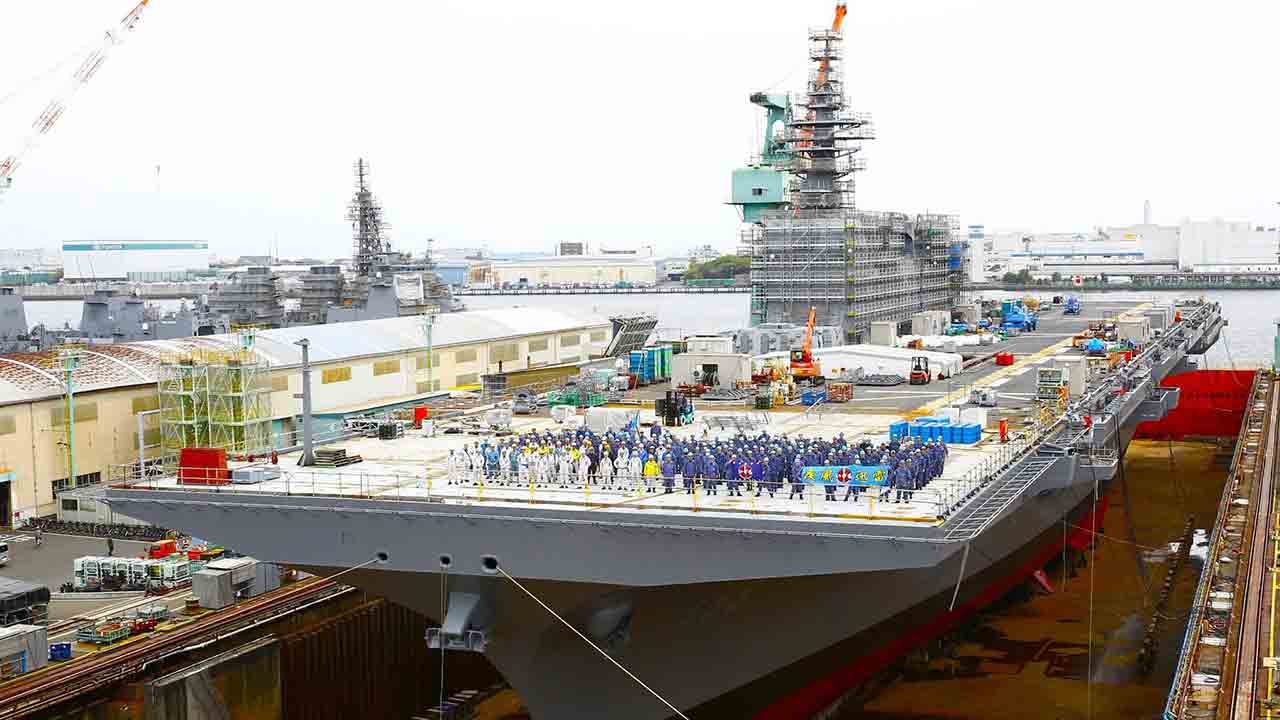
The second Izumo-class ship leaves dry dock with a redesigned bow, advancing Japan’s plan to adapt its helicopter carriers for operations with short takeoff and vertical landing aircraft
The Japanese shipbuilding company Japan Maritime United has completed the conversion of the helicopter carrier JS Izumo into an aircraft carrier, marking another important step in Japan’s naval modernization program. The information was released on the official page of the surface command of the Japan Maritime Self-Defense Force.
With this phase completed, the ship is now out of dry dock and shows visible structural changes. Among the main modifications is the redesign of the bow, which was widened to expand the usable area of the flight deck. The adaptation is intended to facilitate the operation of the F-35B Lightning II fighter jets, a short takeoff and vertical landing model that will be incorporated into Japan’s carrier-based capability.
Despite the progress, the JS Izumo is still expected to undergo additional repair and modernization work. According to the Japanese Ministry of Defense’s original plans, the full scope of the work is expected to be completed by 2027.
The ship’s modernization is part of a two-stage process carried out during regular technical inspections conducted every five years. The first phase was completed in June 2021 and included the application of heat-resistant coating on the flight deck, the installation of lights to support air operations, and the marking of a yellow parking line.
The second phase, which began on November 1, 2024, focused on deeper changes to the ship’s design. The main one was altering the shape of the bow to a more rectangular pattern, similar to the one adopted on JS Kaga, allowing more efficient operation of the F-35B.
The JS Izumo had already demonstrated practical compatibility with this type of aircraft on October 3, 2021, when it hosted tests with F-35B fighter jets from the United States Marine Corps. On that occasion, two aircraft from the Marines’ 242nd Fighter Attack Squadron, VMFA-242 “Bats,” based in Iwakuni, Japan, carried out vertical landings and short takeoffs on the ship’s deck.
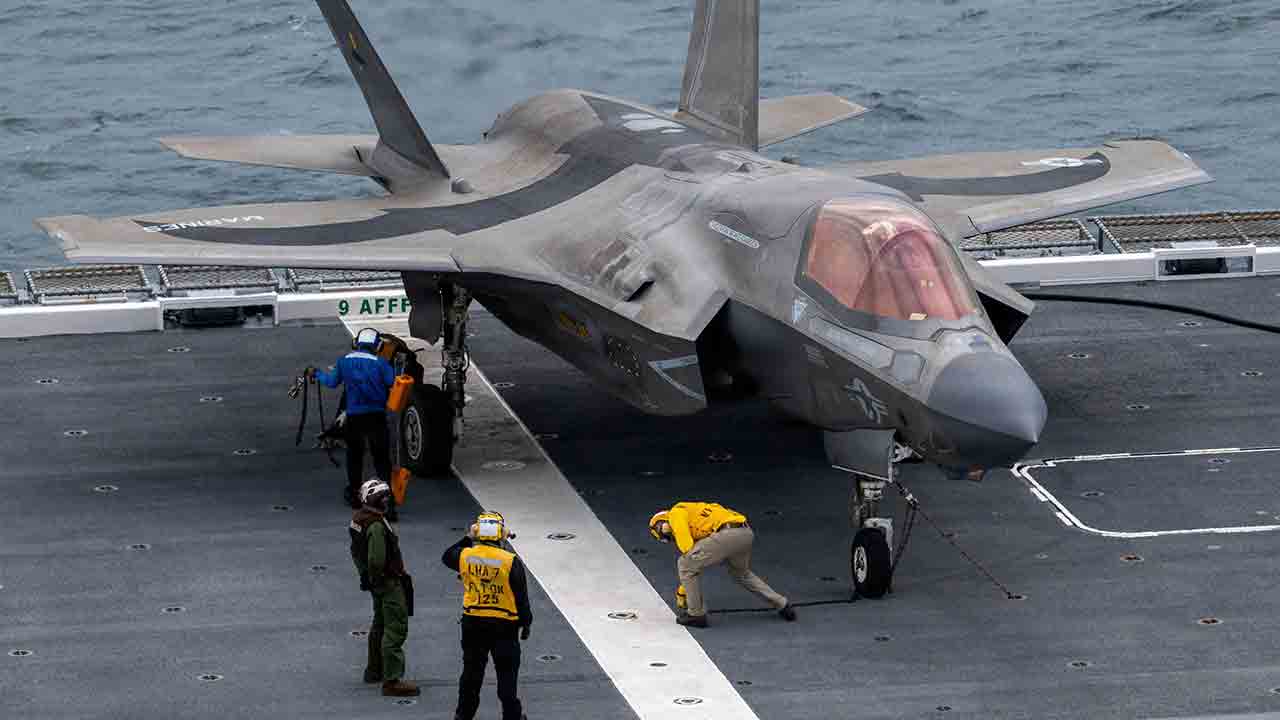
These tests were intended to verify the results of the first phase of modernization, especially the performance of the heat-resistant coating installed on the deck. This system is considered essential to withstand the extreme temperatures generated by the aircraft’s engines during vertical landing.
In parallel with the naval program, the Japanese Ministry of Defense also funded the restoration of the 202nd Tactical Fighter Squadron, which is expected to become the first unit of the Japan Air Self-Defense Force prepared to operate carrier-based aircraft. The Japanese government allocated US$125 million for the modernization of the JS Izumo.
The program follows the same development path applied to the JS Kaga, Izumo’s sister ship. In October 2024, Kaga underwent similar tests off the coast of California, already fitted with the new bow. During those trials, F-35B aircraft conducted night operations and maximum-load evaluations, further validating the new configuration.
The conversion of the Izumo-class ships reflects Japan’s growing commitment to expanding its maritime power projection capability and operating carrier-based fighter jets in an increasingly sensitive regional defense environment in the Indo-Pacific.
+ Ukraine creates new naval drone division
Source and images: Facebook @fleetsurfaceforce. This content was created with the help of AI and reviewed by the editorial team.
