
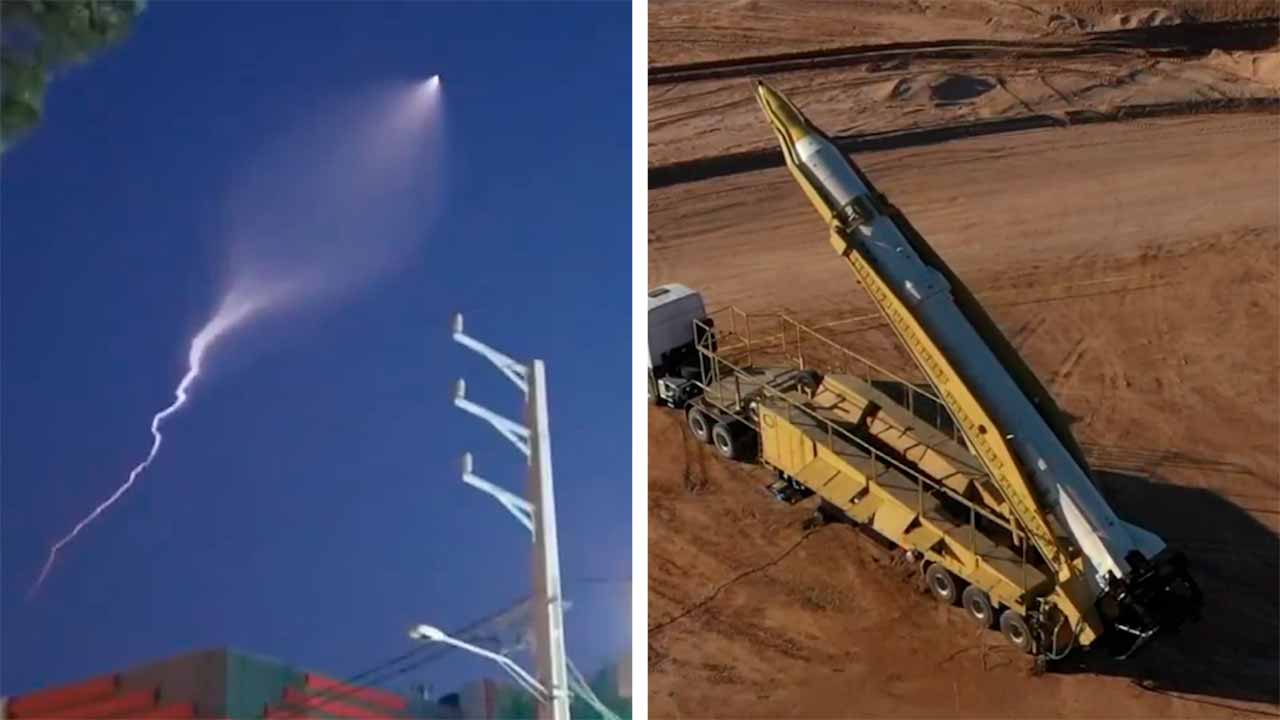
Iran has reportedly used the medium-range Sejjil ballistic missile in combat for the first time, in an attack targeting strategic locations inside Israeli territory. The information was released by Iran’s Tasnim News Agency, citing sources from the Islamic Revolutionary Guard Corps (IRGC).
+ Click here to watch the video
According to reports, Sejjil missiles — with an estimated range of 2,000 to 2,500 km — were launched on Wednesday night toward Israeli military and intelligence facilities, including Mossad headquarters, air bases, and Israel Defense Forces (IDF) command centers. Iranian sources claim the attack temporarily overwhelmed Israel’s air defense systems, allowing for brief control of the airspace.
What is the Sejjil missile?
The Sejjil is a domestically developed two-stage solid-fueled ballistic missile, allowing for faster launch times and lower detection rates compared to older liquid-fueled Shahab missiles. Its design is considered entirely Iranian, with no direct equivalents in foreign arsenals.
Its technical specifications include:
- Type: Long-range ballistic missile
- Propulsion: Two-stage, solid fuel
- Length: 17.5 meters
- Range: up to 2,500 km
- Payload: between 500 and 1,000 kg
- Navigation: Inertial system with a margin of error up to 50 meters
- Launch platforms: Mobile ground units and fixed stations

The missile was first tested in 2008, with more recent versions featuring improved accuracy and range. Its capabilities place it among Iran’s key strategic delivery systems, capable of reaching targets across the Middle East and even parts of southeastern Europe.
Despite confirmation of the Sejjil-2 launch, there is still no public evidence that the missile actually struck Israeli territory. Experts suggest the projectile may have been intercepted in flight by systems such as Israel’s Arrow 3 or the U.S.-made THAAD, possibly over Jordanian or Iraqi airspace.
If confirmed, the operational use of the Sejjil would mark a new phase in the technological and strategic escalation between Iran and Israel, with potential implications for the region’s military balance.
Sources and images: Telegram @Irna_en | Telegram @Tasnimnews. This content was created with the help of AI and reviewed by the editorial team.
