

The United States Air Force has officially approved production of the T-7A Red Hawk, an advanced training aircraft developed by Boeing in partnership with Saab.
The decision was made after the program reached the Milestone C mark on April 23, 2026, a stage that authorizes the move into the initial production phase. With this, the U.S. Air Force will proceed with a US$219 million contract for the first 14 aircraft, as well as spare parts, ground support equipment and training provided by Boeing Defense, Space & Security.

The start of production represents a symbolic moment for U.S. military aviation. More than the arrival of a new aircraft, the T-7A marks the beginning of the gradual replacement of the veteran Northrop T-38 Talon, used for more than six decades in pilot training.
Replacement of the T-38 Talon

The T-38 Talon has trained generations of U.S. military aviators since the 1960s. Now, the Red Hawk takes on the mission of preparing pilots for a far more complex operational environment, shaped by fourth-, fifth- and future sixth-generation fighters, as well as modern bombers and advanced digital systems.
The T-7A is expected to begin replacing the T-38 within Air Education and Training Command, AETC, starting in 2027. The Air Force also expects to achieve initial operational capability for the new training system in the same year.
According to the U.S. Air Force, the T-7A is the service’s first aircraft designed and built using fully digital methods, an approach intended to accelerate development, facilitate production and reduce maintenance challenges throughout the aircraft’s life cycle.
Program calls for 351 aircraft
The U.S. Air Force’s full plan calls for the acquisition of 351 T-7A Red Hawk aircraft and 46 ground-based training simulators, which will be distributed across five AETC bases over the next decade.
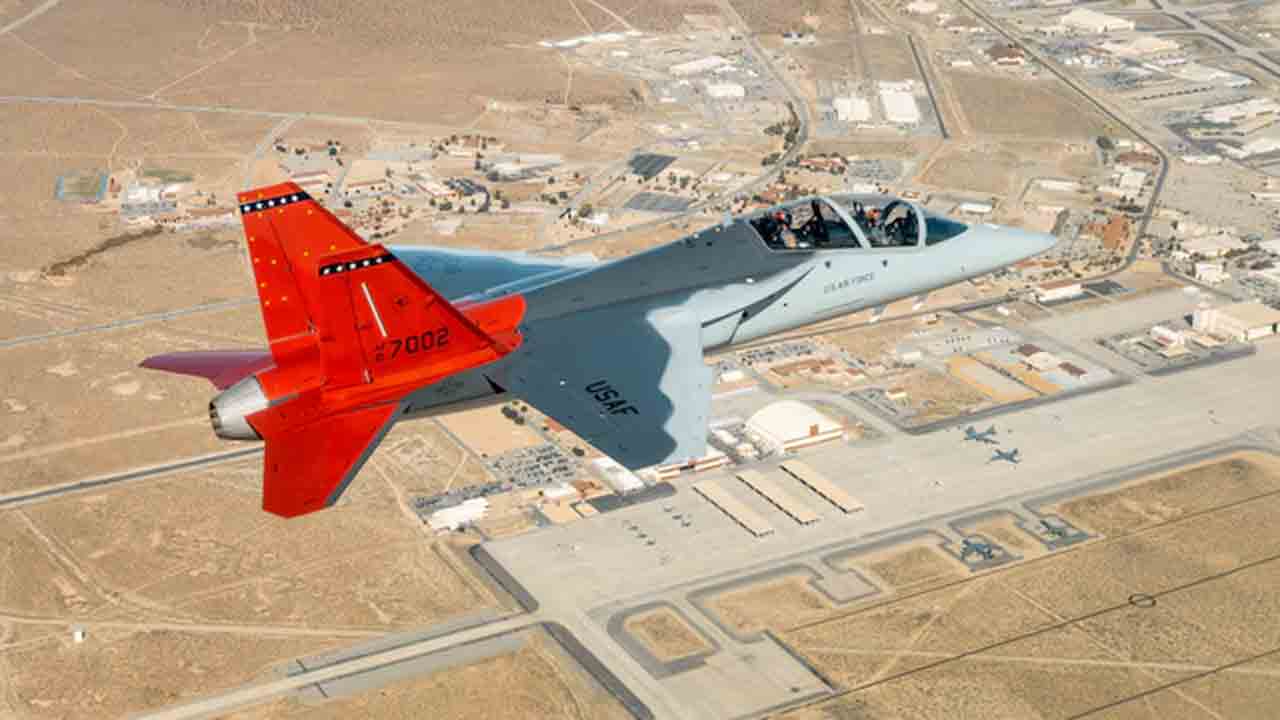
Despite approval for production, the advance will be carried out cautiously. The first three low-rate production lots will be evaluated individually, allowing results from ongoing tests to be incorporated before new industrial commitments are made.
This strategy seeks to reduce technical and operational risks, especially after a history of delays in the program. Among the obstacles faced were issues related to ejection seats, software and supply chains.
An emotional step toward the next generation
For the Air Force, the Red Hawk also carries symbolic weight. The aircraft was named in honor of the Tuskegee Airmen, the group of African-American aviators who marked U.S. military history during World War II.
Now, the T-7A represents a bridge between that legacy and the future of combat aviation. For new students, the aircraft will be the gateway to increasingly digital, demanding and connected cockpits.
Although further testing and development stages still need to be completed, approval for production places the program in a new phase. For instructors, students and maintenance teams, the Red Hawk is no longer just a technological promise and is beginning to become a reality at training bases across the United States.
Source and images: U.S. Air Force / Boeing / Saab. This content was created with the help of AI and reviewed by the editorial team.
