
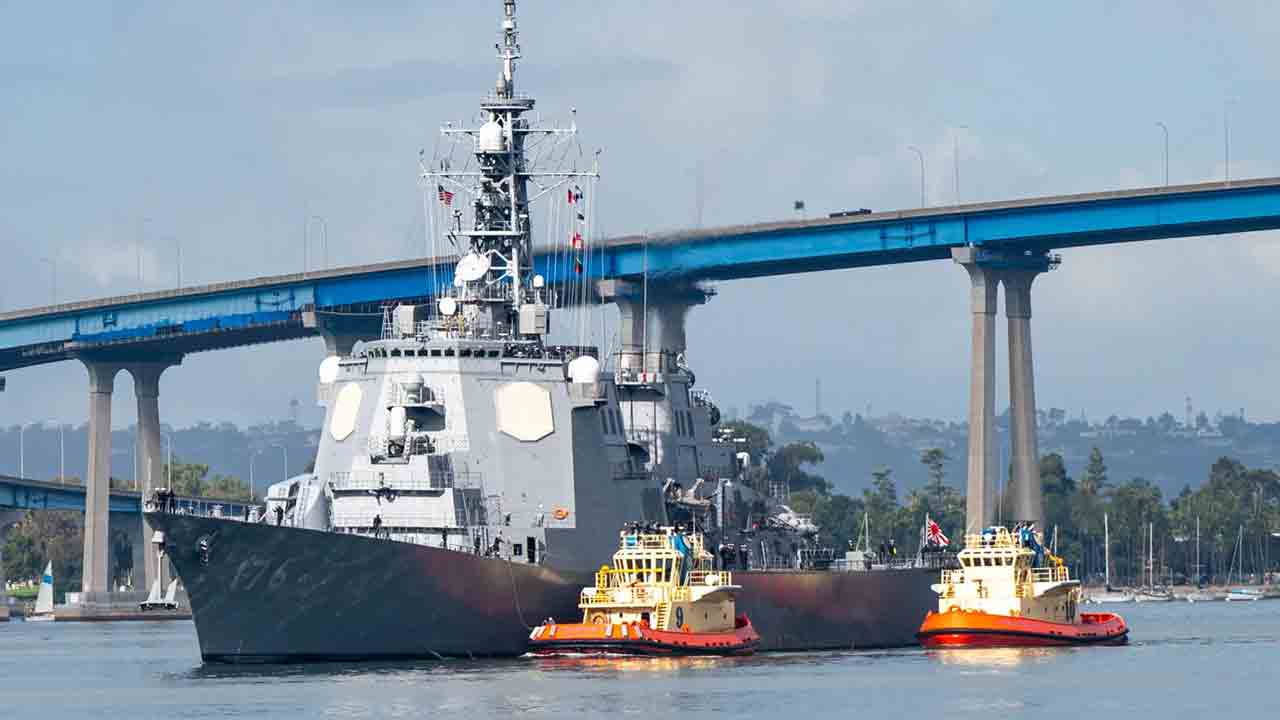
The Chokai, a Kongo-class destroyer, has become the first ship in this group within the Japan Maritime Self-Defense Force to gain the capability to launch Tomahawk cruise missiles, marking another concrete step by Tokyo to expand its deterrence power in the Indo-Pacific.
According to Japan’s Ministry of Defense, the ship completed its modernization at a shipyard in the United States and is expected to return to Japanese territory in mid-September after conducting live-fire exercises. The Chokai had been sent to the U.S. in October 2025 specifically to undergo the upgrade.

The integration of the Tomahawk into the Japanese destroyer is part of the country’s new defense strategy, which aims to equip its naval forces with the means to neutralize threats at long range. The Maritime Self-Defense Force’s plan calls for equipping all eight Aegis destroyers currently in service with the American missile: four from the Kongo class, two from the Atago class, and two from the Maya class.
In addition to the ships already in service, Japan also plans to integrate the Tomahawk into the two future vessels of the Aegis System Equipped Vessel program (ASEV), which are currently under construction. The move reinforces the intention to create a naval architecture with greater offensive reach and improved response capability in an increasingly tense strategic environment around the archipelago.

To enable this expansion, Tokyo agreed to purchase 400 Tomahawk cruise missiles from the United States in a package estimated at $2.35 billion. The sale was approved by the U.S. State Department in November 2023, while the formal agreement was finalized in 2024.
In the same year, Japan also signed an additional contract to acquire 200 missiles in the Block IV version directly from U.S. Armed Forces stockpiles. The decision was made amid increased activity by the Chinese fleet in the region, a factor that heightened risk perception and accelerated the need to strengthen long-range precision strike capabilities.
However, the Tomahawk is treated as an interim solution. Japan’s goal is to use the system until it can receive, at an adequate scale, its domestically developed 12SSM-ER missiles. The contract to begin mass production of this domestic weapon was signed in September 2025.
With the modernization of the Chokai, Japan takes an important step in transforming its strategic posture, expanding the power projection capability of its fleet and consolidating a more robust defense doctrine amid growing military competition in the Indo-Pacific.
+ FAA approves Saab 2000 freighter conversion and paves the way for TAM expansion in the U.S.
Source and images: Japan Ministry of Defense | US Navy. This content was created with the help of AI and reviewed by the editorial team.
