
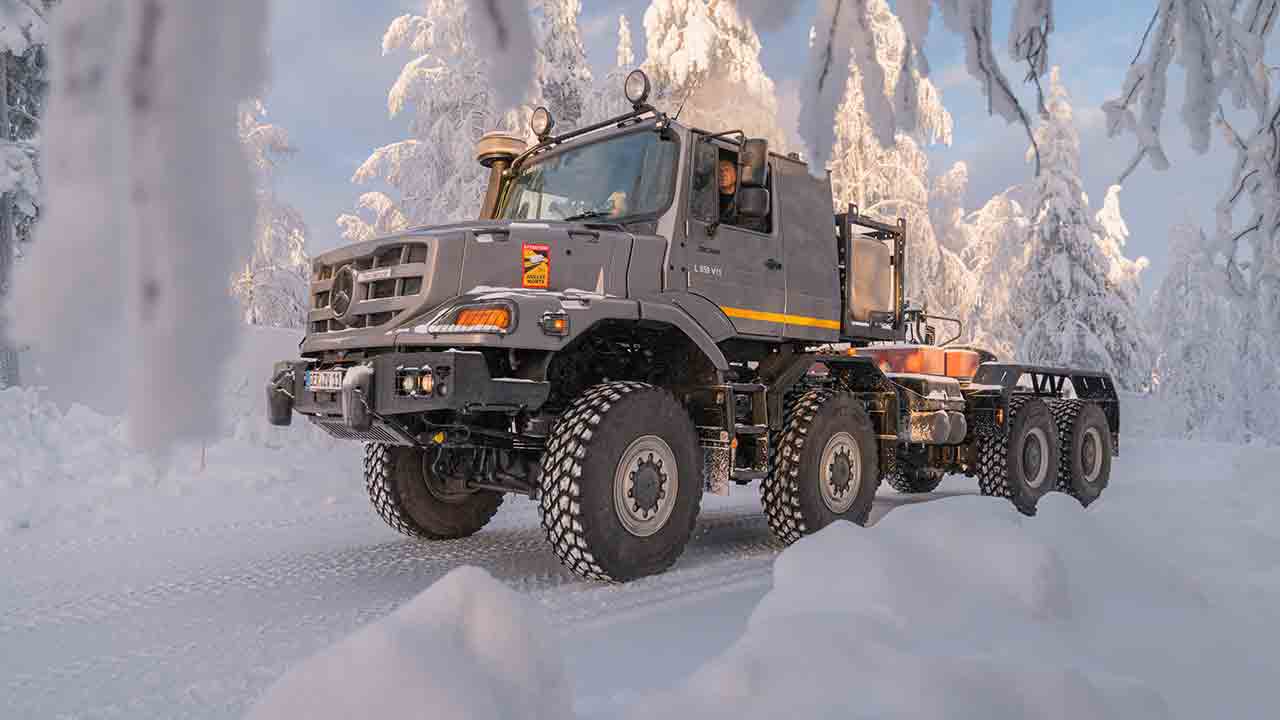
Daimler Truck AG announced last Tuesday (3) that the Mercedes-Benz Zetros defense vehicles have completed winter tests in Finland, validating their operational capability at temperatures of up to minus 40 degrees Celsius.
According to a report from the website Defence Blog, the Arctic testing campaign was conducted to verify whether the Zetros series of defense vehicles can maintain performance under harsh winter conditions, a crucial requirement for military customers operating in northern climates.

According to the company, the winter tests were carried out at the beginning of the year by the team of specialists from Mercedes-Benz Special Trucks. The tests lasted several weeks and focused on traction, driving stability on icy roads, low-temperature capability, and overall operational reliability in winter.
“Our customers, such as Lithuania, Canada, and Ukraine, depend on vehicles that operate anytime, anywhere — even in the freezing winters of northern latitudes,” said Dennis Kinzelmann, CEO of Mercedes-Benz Special Trucks.

“To meet this demand, we put our vehicles through very demanding tasks in extremely cold and winter conditions, which they have once again completed successfully.”
Daimler Truck stated that the Zetros defense vehicles demonstrated stable handling and full compliance with all technical parameters during the Arctic tests.
As part of the testing program, the vehicles were subjected to a cold-start procedure at minus 40 degrees Celsius inside a cold chamber. The company also conducted tests of the electronic stability program (ESP), designed to prevent skidding and improve stability on ice and snow surfaces.
Engineers carried out extensive brake tests to evaluate the vehicle’s behavior on different surfaces and under varying traction conditions, in both loaded and unloaded configurations, and in situations where only one axle was on an icy surface while the other was on gravel, in order to assess how the vehicle handles asymmetric traction and other extreme conditions.
Additional evaluations included kerosene operation and testing of the tire pressure control system. By adjusting air pressure, the system increases the tire contact area on snow, improving traction and mobility in winter environments.

The company also reported that the winter tests covered mechatronics, software and safety systems, as well as emissions and exhaust after-treatment systems.
Engineers evaluated engine and transmission performance in cold temperatures, along with the air-conditioning system in the driver’s cabin and the use of auxiliary heating in extremely low external temperatures.
Daimler Truck noted that, in addition to the Zetros, other Mercedes-Benz vehicles were tested in the same Arctic environment. These included the Unimog, the Econic, and the eArocs 400, which were also subjected to cold-weather evaluations.
The Zetros, in particular, is a conventional cab-behind-engine truck platform with four-wheel drive commonly used for military transport, logistics and support missions. Its configuration is designed to provide crew protection, high mobility and adaptability to different mission modules.
+ Russia uses new Izdeliye 30 cruise missile in the war against Ukraine
Photo: Daimler Truck. This content was created with the help of AI and reviewed by the editorial team.
