
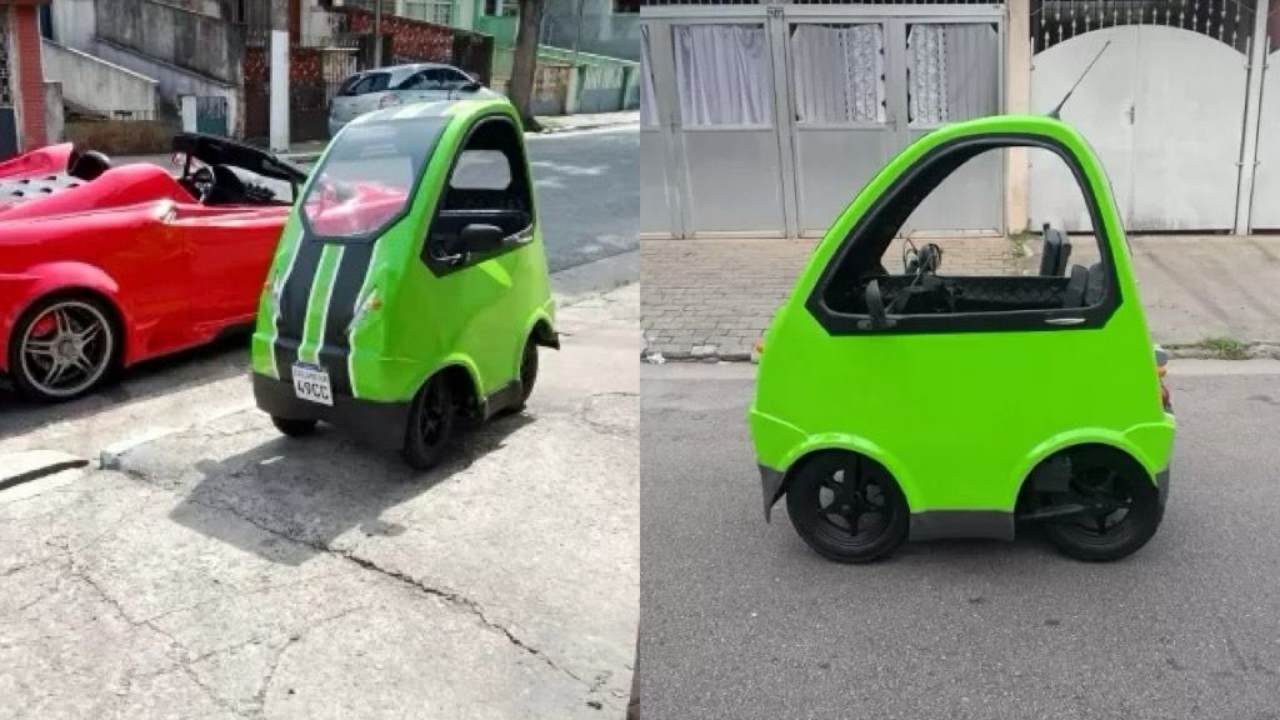
Caio Strumiello, known as the inventor from São Vicente, presents the Nanico P50, a tiny car that catches everyone’s attention wherever it goes
Have you ever imagined driving a vehicle that fits in an elevator, travels 40 kilometers with only one liter of fuel, and steals the spotlight on the busiest streets? This is the latest creation from Caio Strumiello, nicknamed “the inventor from São Vicente,” on the coast of São Paulo.
After gaining recognition with the amphibious car and the “Ka-rrão” — a Ford Ka transformed into a sports car — Caio decided to shift gears and bet on an even smaller project: the Nanico P50. The microcar, powered by gasoline, measures only 1.33 meters in length, 78 centimeters in width, and 1.03 meters in height.
“In fact, it is inspired by the Peel P50, an English car that was considered the smallest in the world. But mine is even smaller, it has four wheels and a reverse gear. Two thin people can fit inside, a bit squeezed,” jokes Caio.
The structure of the Nanico was born from a motorized wheelchair — another invention by Caio himself — widely used by disabled people in regions such as the Northeast. He has already manufactured more than 200 units of these wheelchairs, adapted to circulate on streets, beaches, and even inside supermarkets.
The bodywork of the vehicle was entirely handmade. “I draw on cardboard, cut it, assemble one side, duplicate the other, and assemble the bodywork. The headlights, taillights, everything is created on-site,” he explains. In just 20 days, the idea went from paper to the street, reinforcing Caio’s history of quirky and ingenious inventions.
This isn’t the first time the inventor has ventured into the world of compact cars.
In 2012, he created the first Nanico, which measured 2 meters in length, reached 80 km/h, and traveled 45 km with one liter of fuel. The project was even showcased on television and almost went into industrial production in Ceará, but it didn’t materialize.
“Back then, we almost took the project to industry, but it ended up stalling. Now, I’m relaunching the idea, in an even more compact version,” Caio recalls.
The new Nanico P50 can be equipped with 50 or 100 cc engines and reaches speeds of up to 60 km/h. One of its main features is its fuel efficiency: 40 km per liter.
“And it doesn’t even get wet in the rain!” emphasizes the inventor.
Caio even drove the P50 on Avenida Paulista, one of São Paulo’s iconic locations. Before doing so, he asked a friend to check with the police if a “wheelchair with a cover” could circulate in that area.
“They said yes, so I passed without any issues. I just couldn’t walk standing up!” he jokes.
Is it allowed to circulate?
According to expert Marco Fabricio Vieira, it is possible to legalize handcrafted vehicles like the Nanico P50 in Brazil, but the process involves several steps:
• A technical project signed by an engineer registered with CREA (Regional Council of Engineering and Agronomy);
• Obtaining the CSV (Vehicle Safety Certificate);
• Obtaining the CAT (Compliance Certificate with Traffic Legislation);
• Authorization from Detran;
• Technical inspections and submission of invoices for all parts used.
Another point is that legislation limits the production of handcrafted vehicles to only two units per person per year, which makes large-scale production impossible without creating a regulated micro-factory.
Possible Popularization?
Caio believes that with investments, the Nanico P50 could be sold at competitive prices.
“Today, since I make everything by hand, the cost is high, and I would sell it for around $3,850. With a production line, with an investment of about $769,000, which is low for the industry, we could sell it for $1,925, cheaper than a motorcycle,” he calculates. However, the driving force behind the inventor is passion.
“When you love what you do, you don’t get tired. I was hospitalized for 30 days, and my wife brought me a photo of the little car. I looked at it and thought, ‘It’s waiting for me outside.’ That gave me the strength to come back,” he shares.
The Nanico P50 represents much more than just a car curiosity. It is the living proof that creativity, passion, and perseverance can still overcome the lack of incentives and turn dreams into reality.
View this post on Instagram
