
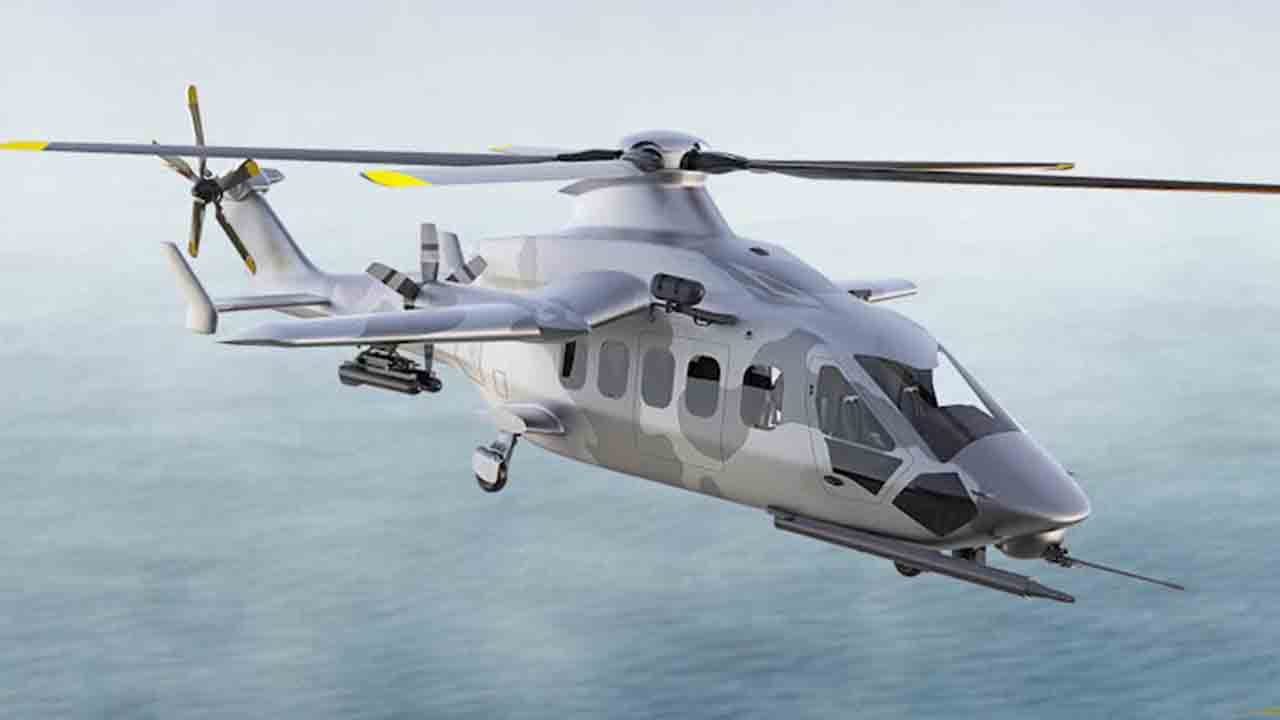
Airbus Helicopters has unveiled its concepts for NATO’s NGRC (Next Generation Rotorcraft Capability) program, an initiative aimed at developing a medium-sized multirole helicopter to replace current platforms between 2035 and 2040.
Rather than proposing a single aircraft model, the European manufacturer presented a dual-platform approach, combining operational versatility with high performance.
Two Platforms, One Integrated Strategy
The first proposal consists of a next-generation conventional helicopter designed to perform a wide spectrum of missions — from tactical transport and medical evacuation to special operations and armed support.

The second platform focuses on a high-speed compound helicopter, evolving concepts previously demonstrated in the experimental X³ and Racer programs. This configuration combines a traditional main rotor with lateral wings and additional propulsion, enabling:
- Significantly higher speeds than conventional helicopters
- Rapid acceleration and deceleration
- Advanced vertical maneuvering capabilities
- Extended operational range
According to the company, this architecture delivers a combination of speed, agility, and flexibility that could redefine the tactical use of rotary-wing aircraft on the modern battlefield.
Open Modular Architecture at the Core
The central technological pillar of the proposal is MOSA (Modular Open Systems Architecture), a concept that enables simplified integration of sensors, mission systems, and weaponry.
This approach reduces dependency on specific suppliers, facilitates future upgrades, and lowers lifecycle costs — a factor considered critical by the program’s participating nations.
Airbus is developing the studies in cooperation with Collins Aerospace, Raytheon, and MBDA, reinforcing the multinational nature of the initiative.
Division CEO Bruno Even stated that the concepts presented serve as a foundation for strategic dialogue with the armed forces involved in the NGRC program.
Continuity of the Current Lineup
While shaping the future, Airbus continues to focus on evolving its existing portfolio. The NH90 is awaiting structural upgrades through Block 1 and Block 2 improvements, while the H145M, H160M, and H225M models continue to be promoted as benchmarks in their respective categories.
Decisive Phase Through 2027
The NGRC program is now entering a critical stage. By the end of 2027, participating countries — France, Germany, Italy, the Netherlands, the United Kingdom, and Canada — are expected to select their preferred solution.
The objective is to launch full-scale development in 2030, laying the foundation for NATO’s next generation of military helicopters in the decades ahead.
With a combination of modularity, high speed, and multinational interoperability, NGRC could represent one of the most significant transformations in European military rotary aviation since the introduction of the NH90.
+ Sweden advances plans to return to blue-water operations with new frigates
+ Technical Comparison: MRH-90 Taipan vs UH-60M Black Hawk — Which Is More Efficient in Combat?
Source and images: Airbus Helicopters. This content was created with the assistance of AI and reviewed by the editorial team.
