
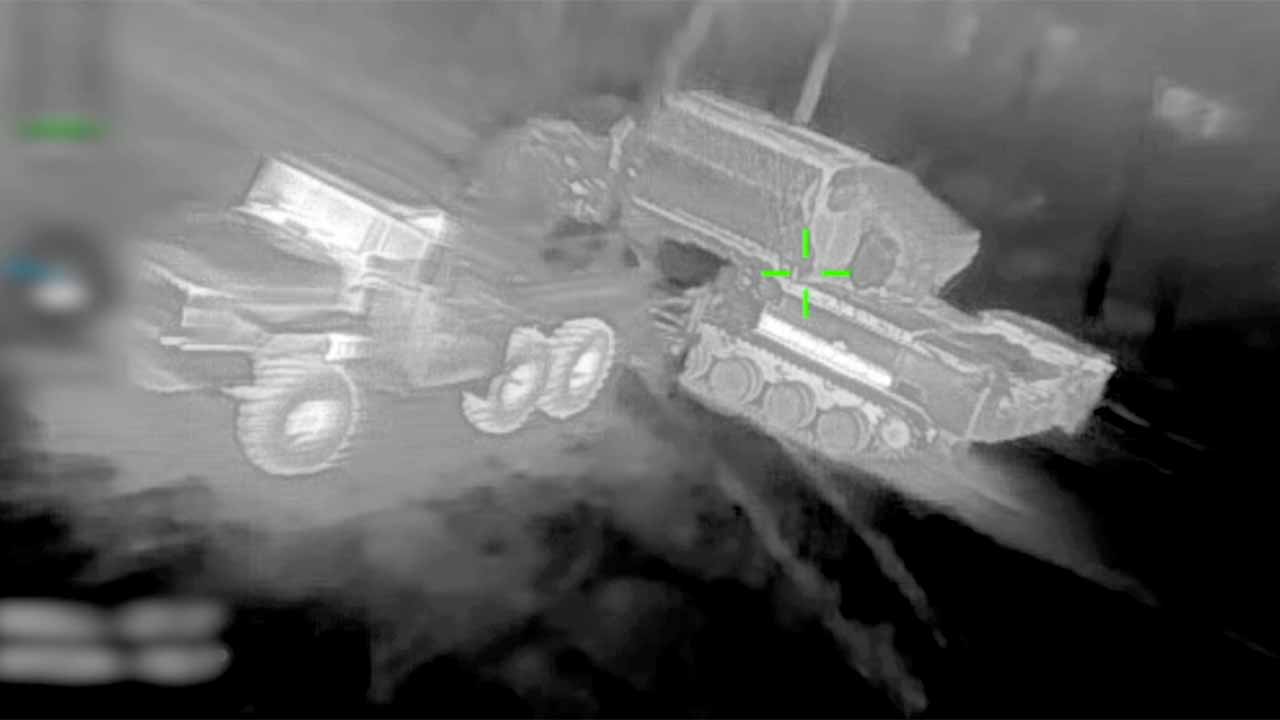
During January, the special unit “Ghosts,” linked to the Main Directorate of Intelligence of Ukraine’s Ministry of Defense, carried out a series of operations aimed at neutralizing enemy air defense and radar surveillance systems along the entire front line.
According to information released by the ministry on social media, the actions took place under low-temperature conditions and focused on reducing the adversary’s air detection and response capabilities, creating operational gaps in the integrated defense system.
Air defense systems hit
Among the confirmed targets was the Pantsir-S1 air defense system, designed for short-range defense of military and strategic facilities against aircraft, drones, and cruise missiles. The complex combines missiles and automatic cannons, providing close-in protection against aerial threats.
Subsequently, Ukrainian operators struck the Tor-M1 system, whose primary role is to protect sensitive targets against cruise missiles, unmanned aerial vehicles, and low-flying aircraft.
The operations also involved the more modern Tor-M2 version, which was put out of action along with a transport-loader vehicle (TZM). The destruction of this support vehicle compromises the launcher’s rapid reload capability, significantly reducing the system’s readiness in prolonged combat.
+ Click here to watch the video
Attacks on surveillance radars
In addition to air defense systems, scouts from the “Ghosts” unit disabled the RLM-ME vehicle, a component of the Nebo-M radar complex responsible for detecting low-altitude targets and enhancing situational awareness of the airspace.

Another piece of equipment hit was the Opponent-GE three-dimensional radar station, used to detect and track aerial objects, providing target data both to surface-to-air missile units and to fighter aviation.
Capabilities of the neutralized systems
The Pantsir-S1 features a radar capable of detecting targets at distances of up to 36 km. Its missiles can engage threats at up to 20 km in range and 15 km in altitude, while two twin 30 mm cannons provide close-in defense within a radius of up to 4 km.
The Tor-M1 uses its own radar with a detection range of up to 27 km. Its 9M331 missiles operate in a kill zone between 1.5 and 12 km, covering altitudes from 10 meters to 6 km.

The Tor-M2 incorporates an improved radar capable of detecting targets—including those with stealth characteristics—at distances of up to 32 km. With the use of 9M338 missiles, the engagement range has been extended to approximately 15–16 km, with a maximum altitude of up to 10 km, as well as the ability to engage up to four targets simultaneously.
In the field of long-range surveillance, the RLM-ME radar operates in the metric band and can detect aircraft and missiles at distances of up to 600 km when observing high-altitude targets. The Opponent-GE, in turn, operates in the decimeter band, reaching up to 400 km in range and 200 km in altitude, with the capability to track up to 150 aerial objects simultaneously.
The actions of the “Ghosts” unit indicate a concentrated effort to degrade the enemy’s integrated air defense and radar network, reducing its ability to detect, track, and engage targets in contested airspace.
+ Patria presents the TRACKX tracked armored vehicle for the first time in field trials
Source and images: Telegram @DIUkraine | Militarnyi. This content was created with the help of AI and reviewed by the editorial team.
