
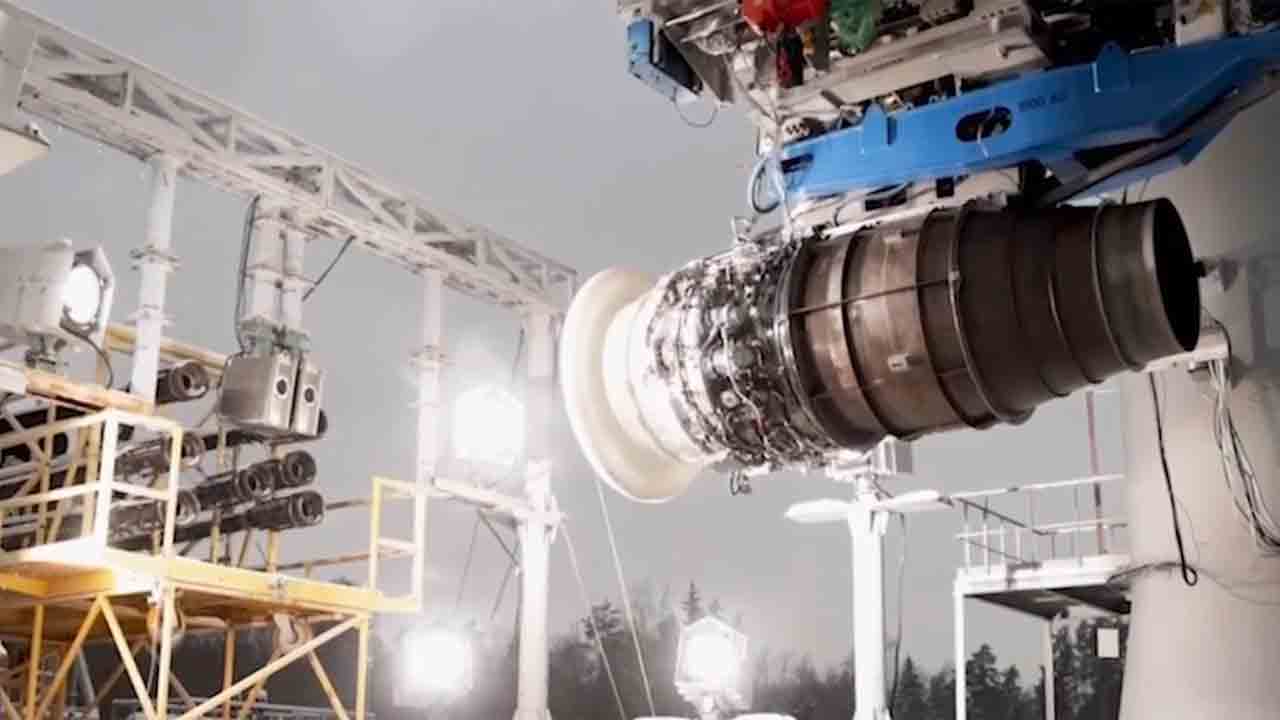
The Russian company ODK released a video of the certification tests of the PD-8 aircraft engine, developed for the Superjet aircraft. The trials assessed the reliability of the propulsion system and flight safety under an abnormal bird-strike scenario.
The tests were carried out at an open test stand of ODK-Saturn, located in Rybinsk, in the Yaroslavl region. During the procedure, the engine was operating at maximum takeoff power, with 8 tonnes of thrust, when it was subjected to the simultaneous impact of four birds—simulating a flock—launched by a special four-barrel device from a distance of five meters.
+ Click here to watch the video
To reproduce conditions close to real-world operation, the speed and accuracy of the impacts were calibrated based on the aircraft’s typical takeoff and landing speed of 103 meters per second. The birds struck the most critical areas of the fan blades as well as the aerodynamic splitter. To facilitate visual assessment, the fan blades were painted yellow and marked with specific reference points.

According to the company, the PD-8 withstood the trial without mechanical damage and maintained full controllability. “The engine underwent a rigorous test. The main success criterion is the absence of damage and the continuity of operation under flight conditions. During the simulation of the abnormal situation, the PD-8 suffered no damage and retained maneuverability,” said Sergei Mosin, deputy chief designer of the PD-8 for the engine nacelle and aircraft integration at ODK-Saturn.
Bird-strike tests are part of the certification process conducted by the United Engine Corporation, a holding company belonging to Rostec. According to UEC, the results confirm stable engine operation even in abnormal situations and reinforce flight safety under real-world conditions.
Currently, the PD-8 is undergoing a broad program of bench and flight tests aimed at validating the project’s engineering solutions and technical specifications. Previous trials have already included fan blade-off tests, water ingestion, acoustic evaluations, crosswind operation, and thrust reverser system tests, all completed successfully.

Source and images: Telegram @uecrus_official. This content was created with the help of AI and reviewed by the editorial team.
