
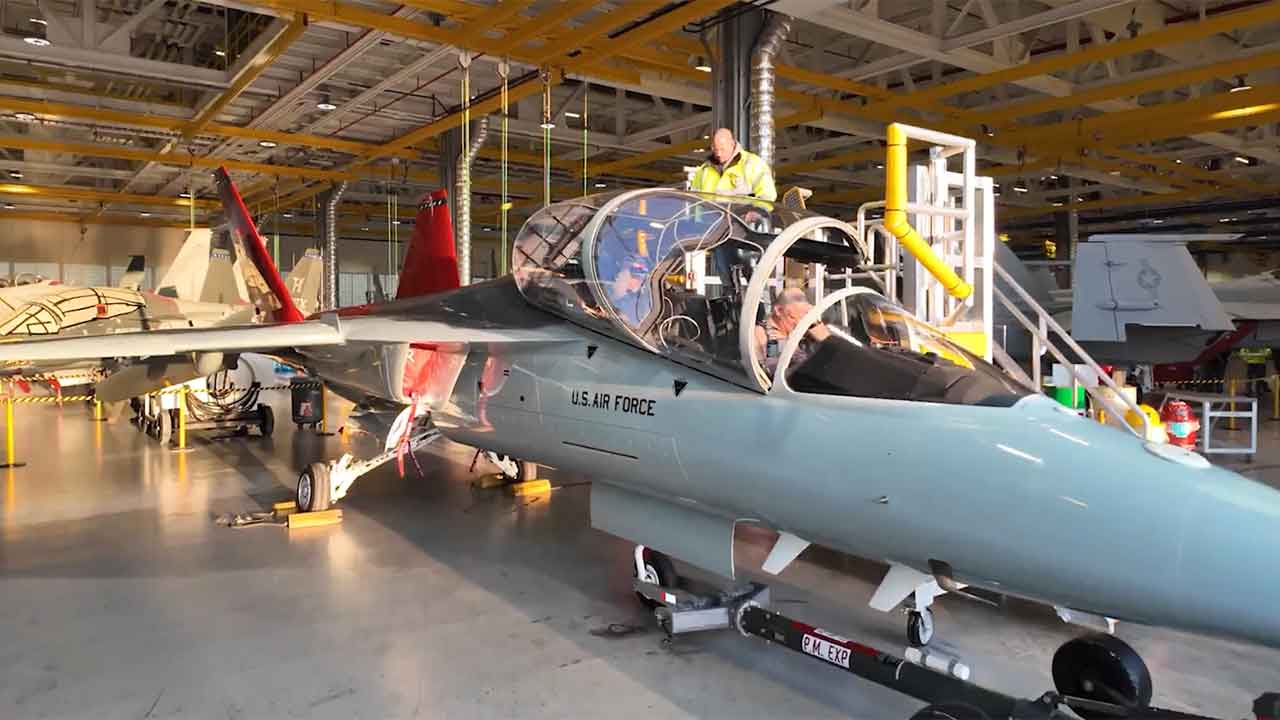
Boeing has officially delivered to the United States Air Force (USAF) the first serial T-7A Red Hawk training aircraft intended for an operational unit, marking a decisive step in modernizing the country’s fighter and bomber pilot training system.
The information was released by the company’s press service on X.
The jet, identified by tail number 7005, arrived at Joint Base San Antonio (JBSA), Texas, where it will serve as the main training platform for pilots assigned to fifth-generation aircraft such as the F-35A Lightning II and the F-22 Raptor, as well as the newest strategic bombers, including the B-21 Raider.
+ Click here to watch the video

The delivery represents a historic milestone, as the Red Hawk will replace the veteran T-38 Talon, which has served in training roles for more than six decades. Initially, the T-7A will be incorporated into the 99th Squadron of the 12th Air Wing. According to the Air Education and Training Command (AETC), the aircraft will provide cadets with modern resources for practicing advanced maneuvers, air combat simulations and emergency situation training.
Developed by Boeing in partnership with Sweden’s Saab, the T-7A program was conceived to meet increasingly complex requirements for training pilots who will operate highly advanced aircraft. The Red Hawk was designed to withstand high loads, execute high-agility maneuvers and operate across multiple flight profiles.
The USAF plans to acquire more than 350 units in the coming years, gradually replacing the entire T-38 fleet. The first cadets are expected to begin training as soon as supporting infrastructure and simulator complexes at JBSA are completed.

However, the aircraft’s entry into active service faced several delays over the past few years. Among the major challenges encountered by the program was the failure of the ACES 5 ejection system, which raised critical concerns related to incorrect activation at high speeds, failure of the canopy destruction system, and errors in the firing sequence between the instructor’s and cadet’s seats.
During testing phases, stability issues at high angles of attack were also revealed, complicating or preventing the safe execution of training maneuvers. Additionally, software failures required extensive revisions and new testing cycles.
Beyond technical obstacles, Boeing faced supply chain difficulties and quality control issues, resulting in successive delays in the production schedule. Initial deliveries, originally planned for 2024, were postponed to 2025, then to 2026, and the current estimate is that initial operational capability (IOC) will only be reached between 2027 and 2028.

Source and images: BoeingDefense | militarnyi. This content was created with the help of AI and reviewed by the editorial team.
