
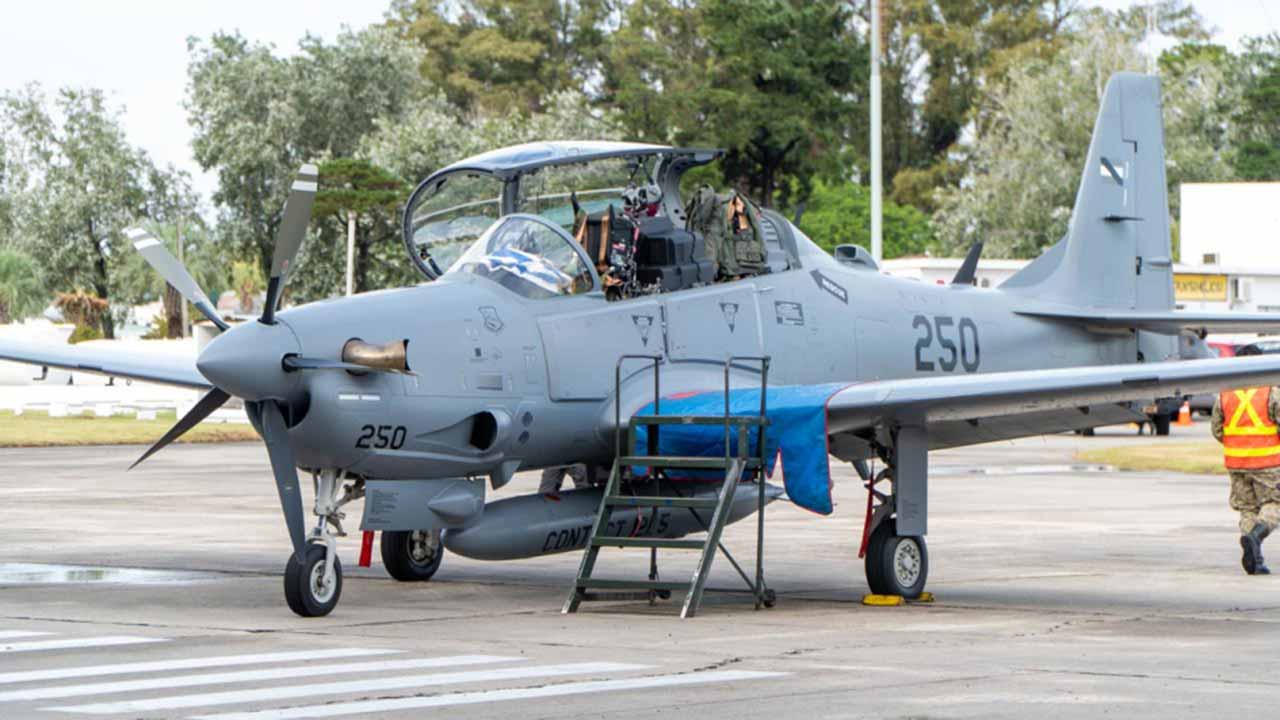
During a ceremony held on February 24, 2026, the Uruguayan Air Force (FAU) officially presented the first two A-29 Super Tucano aircraft acquired under a fleet renewal program aimed at strengthening airspace control and protecting national borders.
The event was led by the President of the Republic, Yamandú Orsi, and the Minister of National Defense, Sandra Lazo. The contract, signed at the end of 2024, provides for the acquisition of six A-29 aircraft, along with mission equipment, integrated logistics services, and a state-of-the-art flight simulator. The total investment exceeds US$100 million.
According to Minister Sandra Lazo, the incorporation of the new aircraft represents a strategic step forward. “The Air Force is strengthening sovereignty in the skies, which is essential for fulfilling its primary mission: controlling and defending national airspace,” she said.
Technological leap and radar integration
The aircraft will be based at Air Brigade 2 in Durazno, joining Air Squadron No. 2 “Caza,” which currently operates the A-37 Dragonfly. According to Lazo, the arrival of the A-29 represents “a technological leap of decades” compared to the FAU’s current combat capabilities.

The Super Tucano aircraft will operate in an integrated manner with the country’s radar network and the Air Force’s command and control structure, expanding the capacity to identify and intercept irregular aircraft. The minister highlighted that the goal is to strengthen the national air surveillance system and improve effectiveness in mitigating illicit air traffic.
FAU Commander-in-Chief, Air Force General Fernando Colina, described the incorporation as “a before and after” moment for the institution. According to him, the A-29 offers excellent operational cost-effectiveness and a high level of integration with sensors and radar systems.
Training and regional projection
Some Uruguayan pilots and technicians have already completed theoretical training with manufacturer Embraer. The practical phase will begin with company instructors and will initially involve six pilots. The expectation is that within about six months they will be fully qualified on the new aircraft.
The minister also emphasized that the acquisition of a state-of-the-art simulator could position Uruguay as a regional reference in pilot training, considering that several Latin American countries operate the same model.
Currently, the A-29 Super Tucano is in service with 22 air forces worldwide and has accumulated more than 600,000 flight hours, consolidating its position as a global leader in its category.
Operational characteristics of the A-29

The Super Tucano is a multirole aircraft equipped with advanced avionics and a modern human-machine interface (HMI), enabling precise target identification. Its capabilities include:
- Border patrol and surveillance
- Air interception
- Counter-drone operations
- Air escort
- Interdiction and support for military operations
- Advanced pilot training
The aircraft can reach speeds close to 450 knots, offers excellent endurance, and can operate from unprepared runways, including in environments with limited infrastructure. Its design prioritizes simplified maintenance, high structural reliability, and low life-cycle costs.
The ceremony was also attended by former President Luis Lacalle Pou and former ministers Javier García and Armando Castaingdebat, as well as authorities from the Ministry of National Defense.
With the incorporation of the new A-29 aircraft, Uruguay strengthens its air surveillance and defense capabilities, consolidating a state policy focused on sovereignty and national security.
+ Drones tested in Ukraine will strengthen New Zealand’s military capabilities
Source and images: Fuerza Aérea Uruguaya | Ministry of National Defense | This content was created with the assistance of AI and reviewed by the editorial team.
