
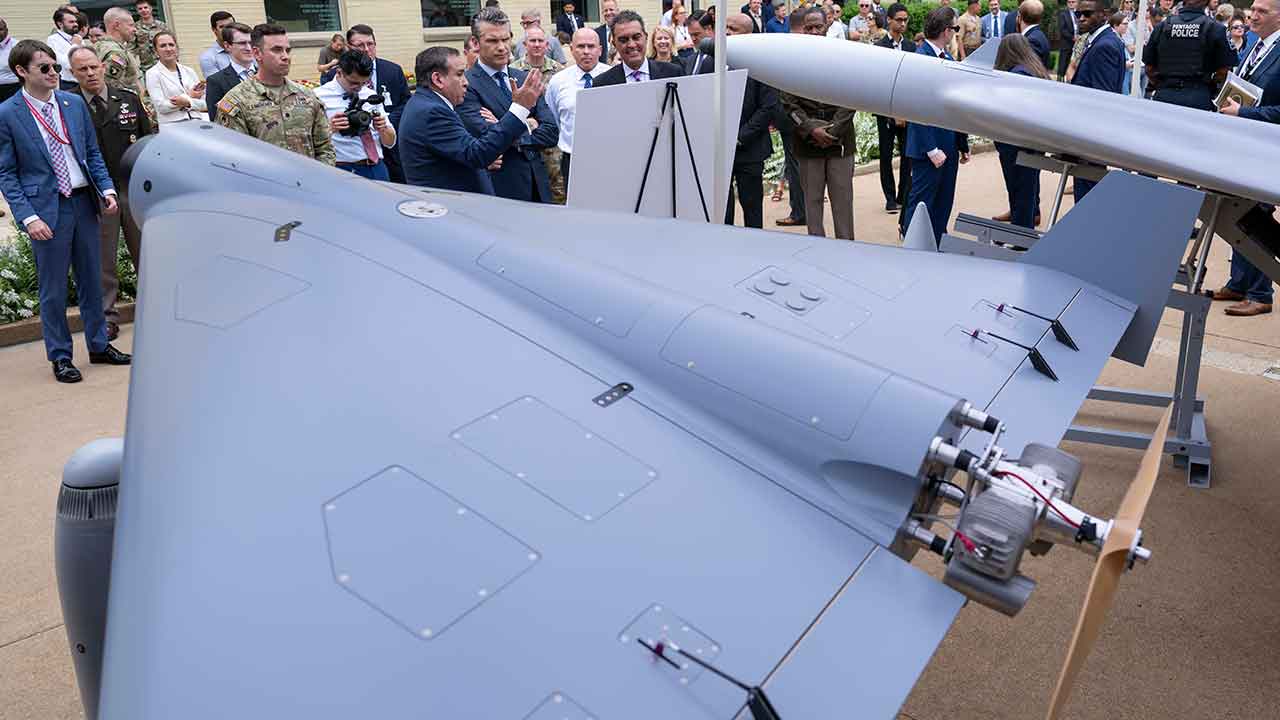
The United States has taken a significant step in the development of cost-effective aerial capabilities by unveiling its own version of a kamikaze drone, designed to directly compete with the Iranian loitering munition Shahed-136.
Named LUCAS (Low-Cost Unmanned Combat and Autonomous System), the new system was presented on Wednesday (16) during a demonstration of autonomous technologies in the Pentagon courtyard.
+ Video: Pakistan’s JF-17 Fighter Jets Arrive at RIAT 2025 with Special Liveries
Secretary of Defense Pete Hegseth attended the presentation of LUCAS, which was developed by Arizona-based defense company SpektreWorks. The goal is to deliver a cost-effective, modular, and highly adaptable aerial combat platform ideal for distributed operations, particularly in the Indo-Pacific theater.
According to SpektreWorks, LUCAS is classified as a Group 3 Unmanned Aerial System (UAS), designed to operate in hostile environments with minimal logistical demands. Its open architecture allows integration of various payloads, including reconnaissance sensors, attack systems, and communication relays.

The drone can be used both as a training target and as a combat vehicle. It supports multiple launch configurations, such as rocket-assisted takeoff (RATO) and truck deployment, facilitating use by non-specialized troops and enabling rapid field mobilization.
Additionally, LUCAS is compatible with cooperative autonomous operations and network-centric attacks, representing a fraction of the cost of traditional aerial systems. The platform uses a FLM 131 attritable chassis and incorporates advanced navigation systems with optimized size, weight, and power (SWaP) requirements.
Another standout feature of LUCAS is its ability to function as a signal relay in the MUSIC (Multidomain Unmanned Systems Communications) mesh network, ensuring secure communication between U.S. and allied forces even in infrastructure-compromised or jammed environments.
The launch of the drone comes amid growing demand for affordable, expendable aerial solutions. The success of Iranian Shahed-136 drones in conflicts like Ukraine has accelerated the U.S. search for more sophisticated, interoperable domestic alternatives.
According to SpektreWorks, the drone has already passed successful tests and is ready for production, potentially joining the U.S. and allied armed forces soon.
Source and images: defense.gov. This content was created with the help of AI and reviewed by the editorial team.
