
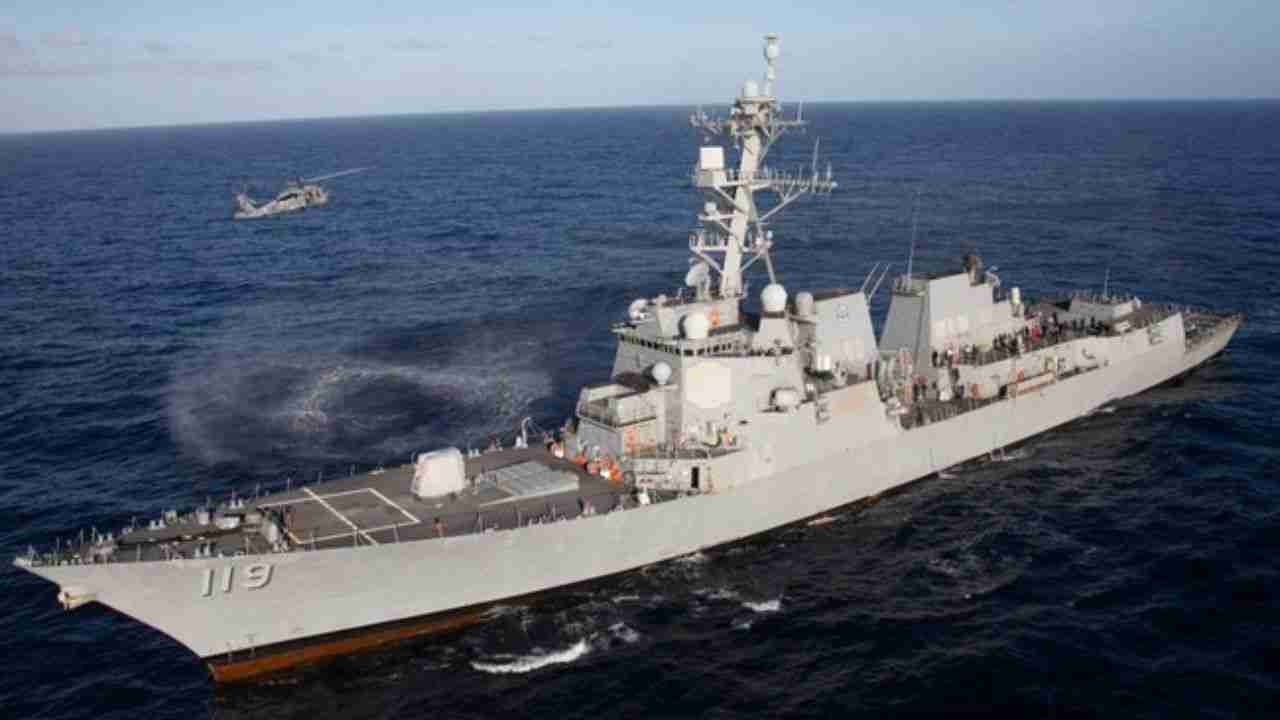
The United States has significantly expanded its military presence in the Middle East amid escalating tensions with Iran.
A new Arleigh Burke-class destroyer has joined the naval force already stationed in the CENTCOM area of responsibility, bringing the number of U.S. warships in the region to ten. At the same time, President Donald Trump has once again spoken about a “massive armada” led by the USS Abraham Lincoln aircraft carrier, suggesting that the force would be ready to act swiftly if the situation deteriorates.
In addition to the naval reinforcement, highly specialized air assets have begun arriving in the vicinity of the operational theater. A RC-135V Rivet Joint, an aircraft dedicated to signal intelligence gathering, landed at Al Udeid Air Base in Qatar after departing from the U.S. and stopping in the United Kingdom. This type of aircraft is critical for mapping radars, communications, and air defense systems of a potential adversary, creating a detailed electronic picture of the battlefield before any potential military operation.
Flight tracks also indicate the movement of other rare capabilities, such as the E-11A BACN, which serves as an airborne communications node, and EA-18G Growler electronic warfare jets, which are believed to have left the Caribbean heading toward the Atlantic. There are also indications of combat search-and-rescue HC-130J aircraft moving and additional deployment of Patriot and THAAD missile defense systems. While there has not yet been a large influx of tactical fighter jets from the Air Force into the region, analysts point out that the combination of these assets suggests preparations for a limited air operation, particularly targeting strategic sites within Iranian territory.
During a Senate hearing, Secretary of State Marco Rubio stated that the expanded military presence aims to ensure the protection of around 30,000 to 40,000 U.S. troops spread across bases in the Middle East, all within range of Iranian short-range ballistic missiles and drones. Rubio emphasized that the president maintains the option of a preventive strike if there is evidence that Tehran is about to attack U.S. or allied troops or facilities, including Israel.
Alongside military movements, the diplomatic confrontation is intensifying. Trump has once again pressured Iran to accept a new deal involving the definitive cessation of uranium enrichment, limits on ballistic missiles, and the cessation of support for allied groups in the region. Iranian officials deny direct negotiations, though they acknowledge indirect communications through intermediaries. Meanwhile, Israel is closely watching the indirect talks, Iranian leaders threaten to retaliate against any attack on Tel Aviv, and countries like Saudi Arabia, the UAE, and Turkey signal discomfort with the prospect of a conflict.
Although no shots have yet been fired, the situation suggests that the region is nearing a critical point, with clear signs that a military escalation could occur at any time.
Source: The War Zone | Photo: X @disclosetv | This content was created with the help of AI and reviewed by the editorial team
— Rapid Response 47 (@RapidResponse47) January 28, 2026
