
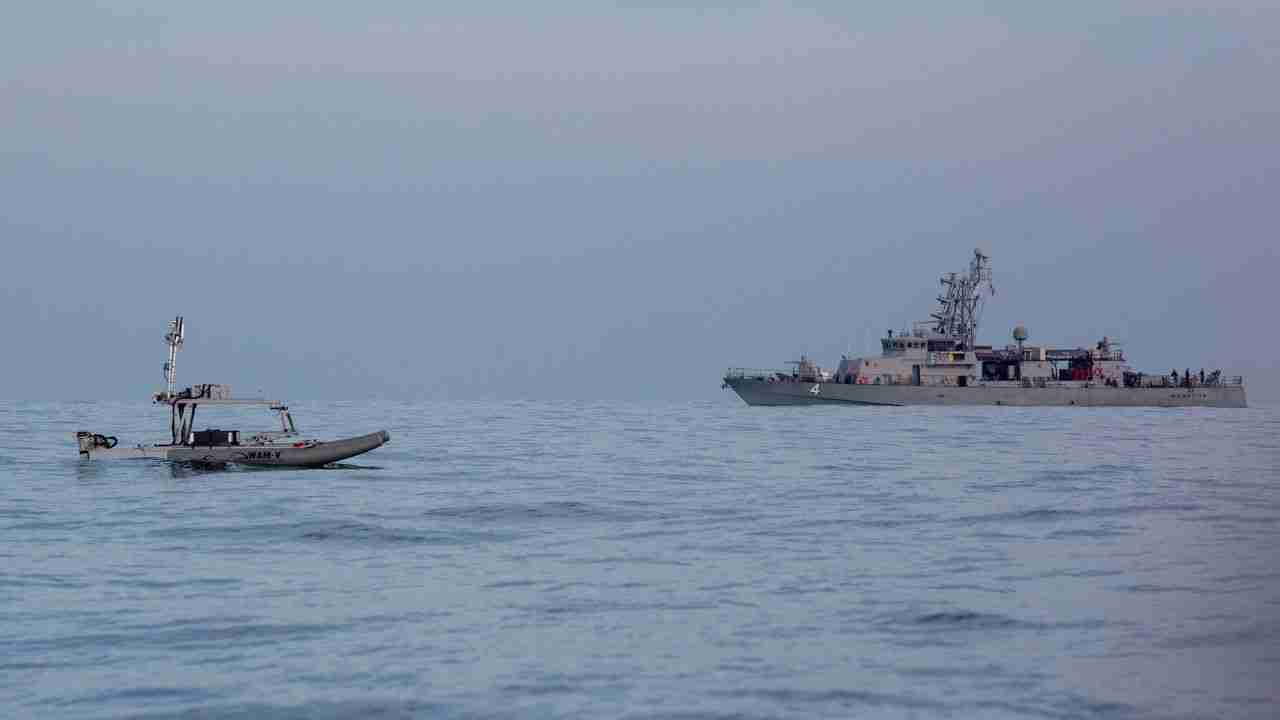
 US Navy accelerates modular drone fleet to counter Chinese advance (X @USNavy)
The United States Navy is advancing an ambitious program for modular Unmanned Surface Vehicles (USVs), named MASC (Modular Surface Attack Craft), designed for surveillance, electronic warfare, and even long-range attacks.
Unlike previous models, which focused on specific sizes (large or medium), the MASC prioritizes containerized payloads, such as missile launchers and sensors, adaptable to different missions. The goal is to create a versatile fleet capable of operating either independently or in conjunction with manned ships, enhancing naval firepower and deterrence in a growing tension with China.
The program calls for three types of drones: a basic model (with two 40-foot containers and a range of 2,500 nautical miles), a high-capacity model (four containers), and a single payload model (a smaller container, ideal for specialized missions).
The Navy also requires the USVs to be autonomous, able to avoid collisions without human intervention, and continue operating even without communication with the base. In addition, the program aims for rapid production (in less than 18 months) and designs based on commercial standards, facilitating repairs and reducing costs.
The MASC is seen as a response to the slow traditional naval construction and the need to deter China in the Pacific. With the advantage of modularity, these drones can confuse adversaries, as the same ship could carry missiles, aerial drones, or electronic warfare systems, making it harder to identify its capabilities. Partnerships with allies such as the United Kingdom and Australia (under AUKUS) could accelerate the project, while the Navy works to make its vision of a hybrid manned/unmanned fleet a reality before the rivalry with Beijing intensifies further.
Source: The War Zone | Photo: X @USNavy | This content was created with the help of AI and reviewed by the editorial team.
See the game-changing, cross-domain, cross-service concepts the Strategic Capabilities Office and @USNavy are rapidly developing: an SM-6 launched from a modular launcher off of USV Ranger. Such innovation drives the future of joint capabilities. #DoDInnovates pic.twitter.com/yCG57lFcNW
— Department of Defense 🇺🇸 (@DeptofDefense) September 3, 2021
