
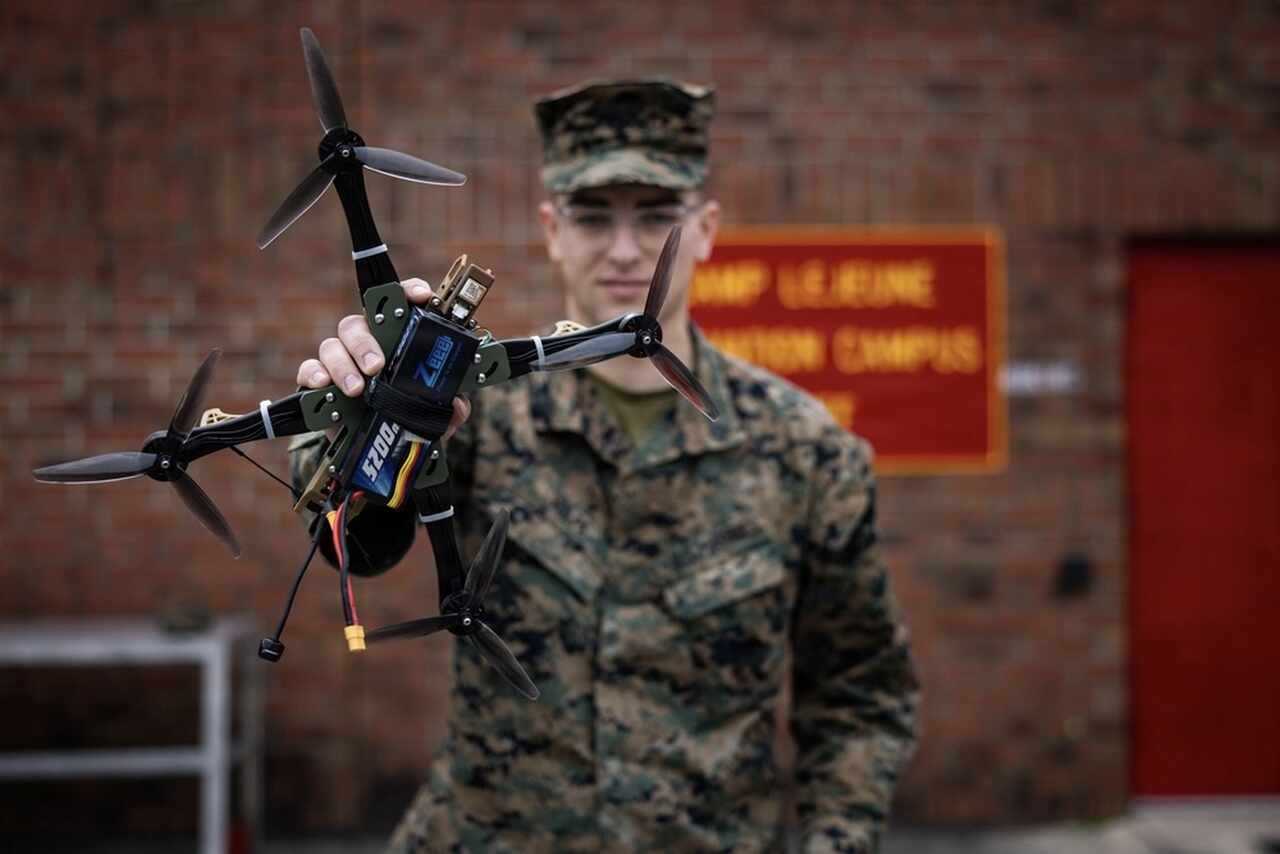
The US Marine Corps has approved the operational use of the HANX, its first 3D printed drone, after flight authorization from NAVAIR.
According to the Defence Blog website, the drone was built in compliance with the National Defense Authorization Act (NDAA). The HANX was developed by the 2nd Marine Logistics Group and received provisional flight authorization from the Naval Air Systems Command (NAVAIR), allowing it to be operated and employed by Marine Corps units.
Its approval indicates that the drone meets the rigorous requirements of the NDAA and marks a new step in the deployment of low-cost, adaptable unmanned systems, entirely built by Marines for operational use.
The HANX was designed as a modular platform that can be quickly adapted for different missions, including reconnaissance, logistics, and one-way attacks. The aircraft’s structure and many components are 3D printed, allowing units to locally manufacture parts, repair damage quickly, and modify the design without relying on suppliers.
According to the Marine Corps, the platform was created in response to the Department of Defense’s stated goal of expanding US drone capabilities and acquiring a large number of one-way and multi-mission unmanned attack systems by 2028.
Unlike previous experimental projects, the HANX was designed from the start to meet the safety and acquisition standards required for fleet-wide use. The drone was developed by Sergeant Henry David Volpe, an automotive maintenance technician from the 2nd Maintenance Battalion, who works at the Innovation Campus of the II Marine Expeditionary Force at Camp Lejeune.
Volpe led the design, prototyping, and testing process, producing five main versions of the aircraft before final approval. “This was only possible thanks to collaboration with the team around me. I designed it, but I didn’t work on it alone,” emphasized Volpe.
Marine Corps officials stated that the drone’s compliance with the NDAA ensures that all critical components come from approved manufacturers and are free from malicious software that could compromise data or allow adversary interference.
Volpe stated that finding compatible components was one of the hardest parts of the project. “Anyone can build a cheap drone using cheap unapproved parts; however, finding parts that are not at risk of containing malicious software is difficult,” he said.
Even so, the drone can be produced at a low cost and built entirely within Marine Corps units, offering a flexibility that is not possible with off-the-shelf commercial systems that cannot be modified by operators.
With the approval, the Marine Special Operations Command at Camp Lejeune has begun preparing to use the platform, and other units are expected to adopt the system as training expands. Volpe mentioned that explosive ordnance disposal units are among those planning to acquire several drones for operational tasks.
Photo: Sgt. Alfonso Livrieri. This content was created with the help of AI and reviewed by the editorial team.
