
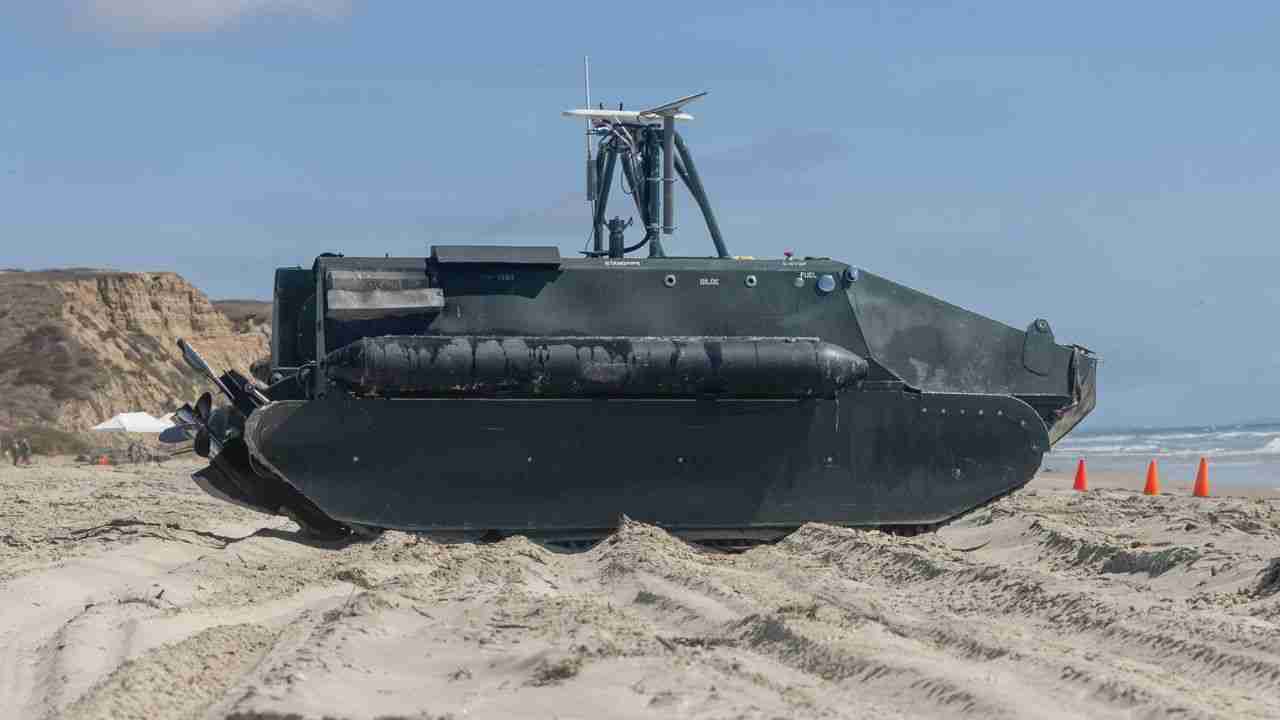
The United States Marine Corps conducted tests with an unmanned amphibious vehicle during Technical Concept Experiment 25.2 at Camp Pendleton, California.
The experimental platform was observed operating in the coastal surf zone, demonstrating the ability to move from sea to land without a crew.
The system uses tracks and includes additional flotation elements designed to ensure stability and buoyancy even in harsher maritime conditions. During the demonstration, the vehicle was unarmed but equipped with sensors, communication systems, and a flat area for cargo transport, indicating a focus on mobility and operational support.
According to observations during the test, the unmanned amphibious vehicle can be remotely controlled via satellite communications, allowing operations beyond line-of-sight from ships or command posts away from the coast. The initiative aligns with Marine Corps doctrine to employ more dispersed forces in littoral environments, with reduced logistical dependence and greater operational flexibility.
Source: Defence Blog | Photo: X @Defence_IDA | This content was created with the help of AI and reviewed by the editorial team
U.S Marine Corps just tested a cutting-edge Unmanned Swarming Amphibious Craft at Camp Pendleton’s Red Beach.
This tracked remote-controlled vehicle handles sea-to-shore ops in the surf zone, with flotation & sensor payloads. Future of dispersed amphibious warfare? pic.twitter.com/5AzX7S9Ewb
— International Defence Analysis (@Defence_IDA) December 15, 2025
