
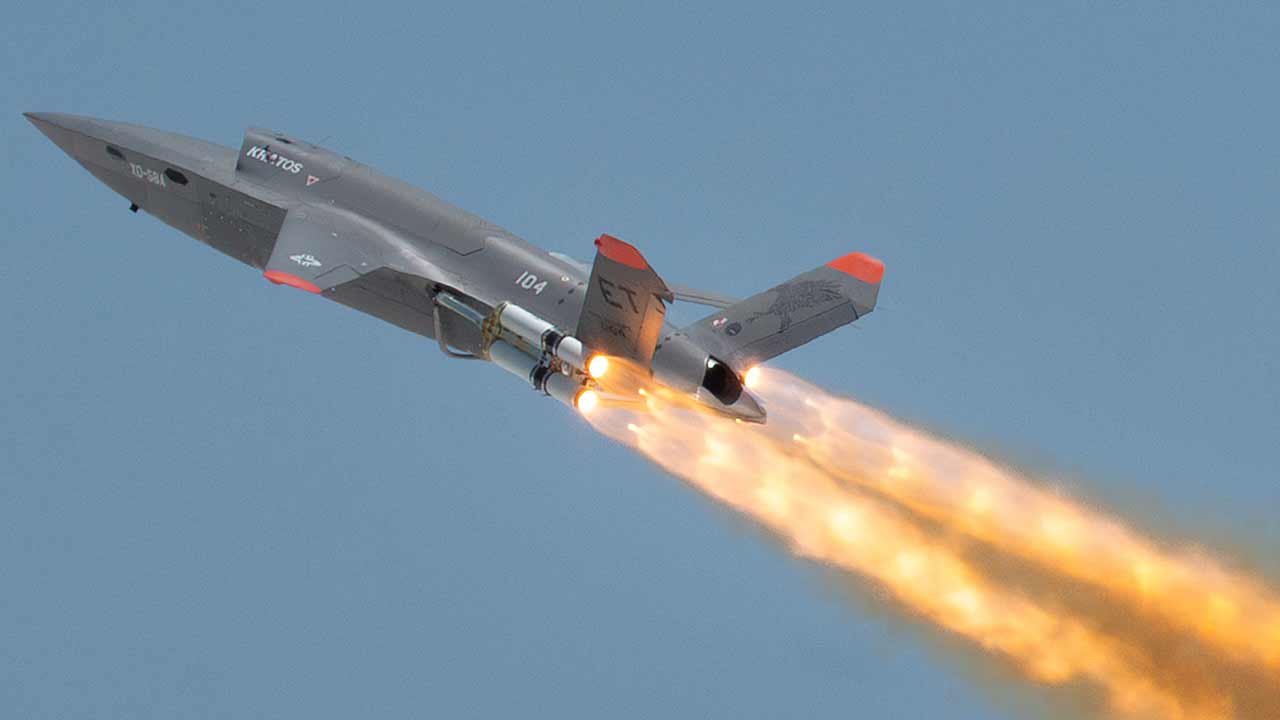
The United States Air Force conducted a significant flight test in Florida, demonstrating the concept of human-machine cooperation by operating Autonomous Collaborative Platforms (ACPs) alongside manned fighter jets during a training mission at Eglin Air Force Base.
In the recent demonstration, pilots of an F-16C Fighting Falcon and an F-15E Strike Eagle each controlled two XQ-58A Valkyrie drones in a real aerial combat scenario. The drones responded in real time to commands and maneuvered in coordination with the manned aircraft, showcasing progress in integrating semi-autonomous systems into military operations.
+ Video shows transport of giant section of new Type 26 frigate of the British Royal Navy
+ AFRL releases video footage of the first flight of the XQ-67A, the evolution of the XQ-58A Valkyrie
According to the Air Force, ACPs are designed to operate in high-risk environments in a flexible, cost-effective manner and independent of traditional runways. Acting as force multipliers, these unmanned aircraft help reduce pilot workload, enhance situational awareness, and increase the chances of mission success in contested airspace.
The flight was carried out through a joint initiative of the Rapid Defense Experimentation Reserve, a Department of Defense program under the Office of the Under Secretary for Research and Engineering. Also participating in the exercise were the Air Force Research Laboratory (AFRL), the Air Force Test Center, the Air Combat Command, and the U.S. Navy.
The data collected during the test will support the future development and operational use of autonomous and semi-autonomous aerial platforms. As the U.S. modernizes its airpower strategy, ACPs are expected to play a crucial role by providing scale, operational agility, and tactical advantage on the modern battlefield.
Source and images: U.S. Air Force Research Laboratory. This content was created with the help of AI and reviewed by the editorial team.
