
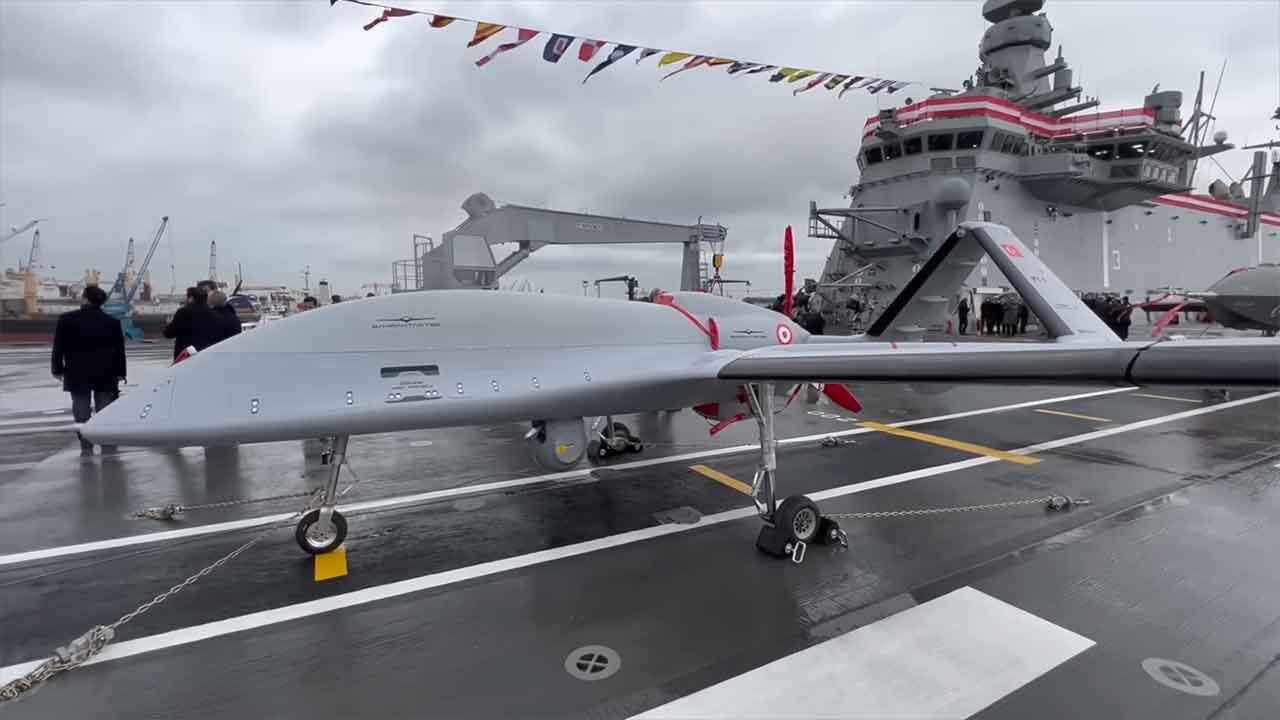
The platform developed by Baykar can remain airborne for more than 24 hours, carry different sensors and operate through satellite communications
Turkey’s Ministry of National Defense has announced the addition of new Bayraktar TB3 unmanned aerial vehicles to the inventory of the country’s Land Forces Command.
The information was presented by ministry spokesperson Rear Admiral Zeki Aktürk during the weekly press briefing. According to the representative, inspection and acceptance activities for different quantities of the model have been completed, allowing the aircraft to enter operational service.
The Bayraktar TB3 was first added to the Turkish Land Forces inventory in September 2025. The new announcement indicates the continuation of deliveries and the gradual expansion of the fleet available for reconnaissance, surveillance, intelligence and guided-munition missions.
Developed by Turkish company Baykar, the TB3 was designed to operate both from land-based facilities and from ships equipped with short flight decks. To achieve this, the aircraft features folding wings, reducing the space required for storage in naval environments.
Operations from the TCG Anadolu
One of the Bayraktar TB3’s main advantages is its ability to perform automatic takeoffs and landings on ships that do not have catapults or arresting cables, systems normally used by conventional aircraft carriers.

During the testing campaign conducted aboard the TCG Anadolu, the Turkish Navy’s main amphibious assault ship, the TB3 carried out fully autonomous operations on a short runway.
According to Baykar, these tests made the model the first armed unmanned aerial vehicle to perform fully autonomous takeoffs and landings from a ship with this configuration.
This capability expands the operational possibilities of the TCG Anadolu, allowing the vessel to serve as a platform for unmanned aircraft during maritime surveillance, naval force protection, target identification and support missions in coastal areas.
Testing with different munitions
Throughout its development program, the Bayraktar TB3 accumulated hundreds of flights and underwent evaluations with different systems produced by the Turkish defense industry.
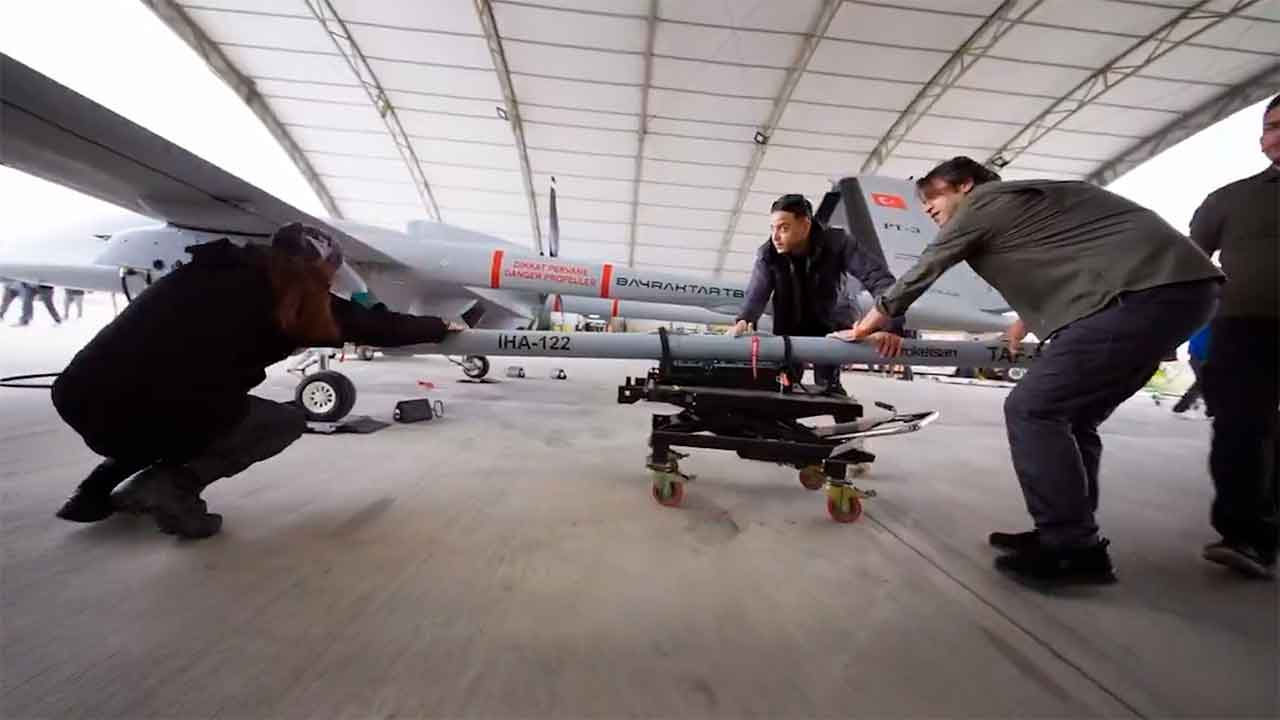
The weapons tested include MAM-L and MAM-T guided munitions, the UAV-122 system, the CİRİT laser-guided missile and other domestically manufactured equipment.
The integration of different munitions allows the platform to be configured according to the profile of each mission. The drone can also operate exclusively as an observation and intelligence-gathering system without carrying weapons.
Participation in the Steadfast Dart 2026 exercise
In 2026, the Bayraktar TB3 carried out its first international operational mission during the Steadfast Dart 2026 exercise, organized by the North Atlantic Treaty Organization.
During the exercise, the drone took off autonomously from the TCG Anadolu and conducted precision strikes against surface targets.
During the phase held in the Baltic Sea, the aircraft operated in heavy snowfall, strong winds and below-zero temperatures. According to the information released, the TB3 continued operating despite the adverse weather conditions that limited the participation of other aircraft.
Turkey used the performance demonstrated during the exercise to showcase the system’s ability to operate in environments different from those encountered during testing in the Mediterranean.
Endurance of more than 24 hours
The Bayraktar TB3 has a maximum takeoff weight of approximately 1,600 kilograms and can carry up to 280 kilograms of payload.
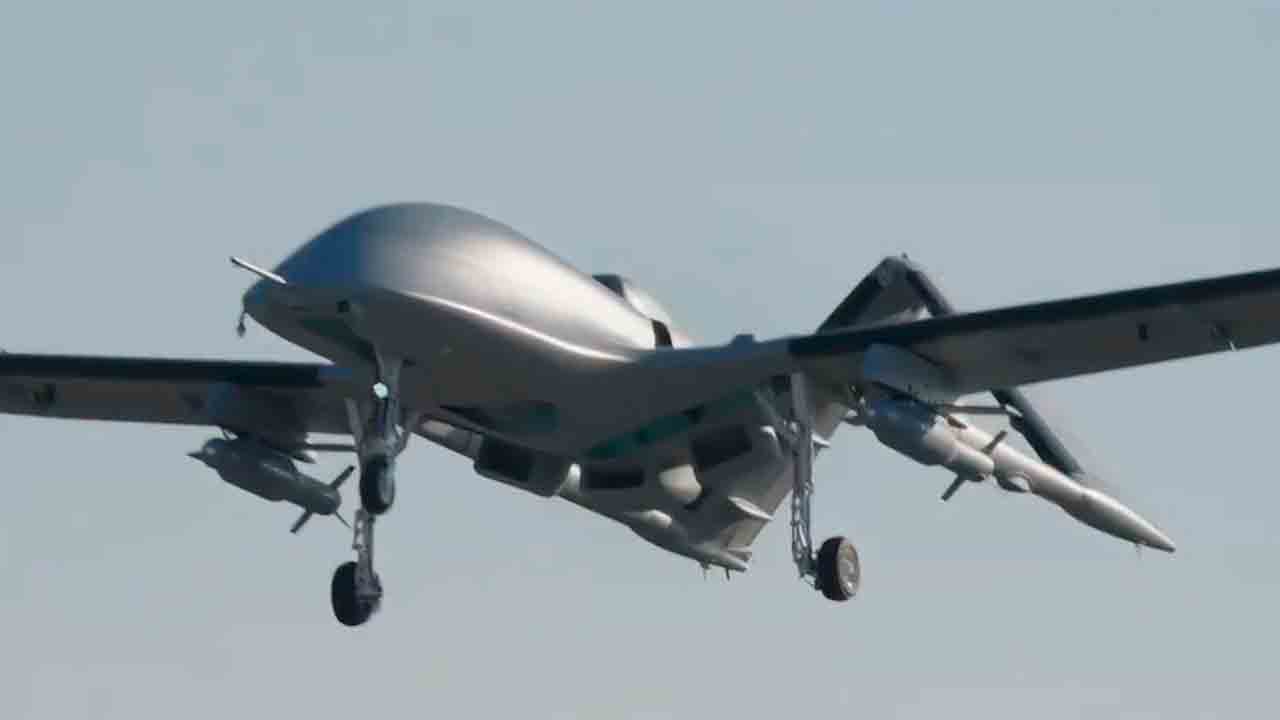
Equipped with a 170-horsepower turbodiesel engine, the drone can remain airborne for more than 24 hours. Its reported maximum ceiling is 25,000 feet, approximately 7,620 meters, while its operational altitude can reach 20,000 feet, around 6,100 meters.
The platform can carry electro-optical and infrared systems, electronic intelligence sensors known by the acronym ELINT, and surveillance radars. This modular architecture allows the equipment to be adapted for land or maritime missions.
Satellite communication
Another important feature is its beyond-line-of-sight communication infrastructure, known as BLOS. The system combines direct data links and satellite communications, allowing the aircraft to be controlled over long distances.
The TB3 also features automatic takeoff, landing, taxiing and cruise-navigation functions. Its flight-control system uses a redundant architecture, data fusion from different sensors and navigation capabilities independent of GNSS signals.
These solutions were developed to maintain the aircraft’s stability even in environments affected by electronic interference or with limited access to satellite positioning systems.
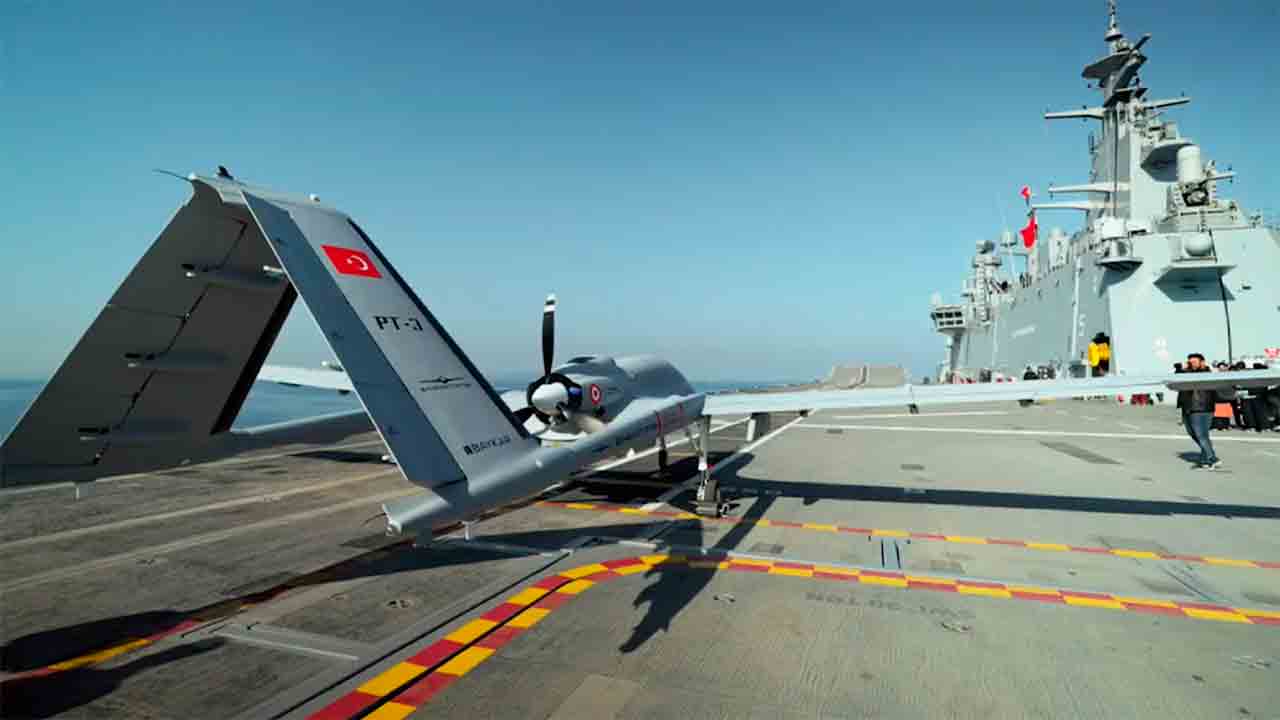
The addition of new units represents another step in Turkey’s strategy to expand the use of unmanned aircraft across different branches of its Armed Forces. In addition to land operations, the Bayraktar TB3 is expected to play an important role in the expansion of Turkey’s carrier-based aviation and in strengthening the operational capabilities of the TCG Anadolu.
+ Il-96-400M and Il-96-300 head to Khabarovsk for a new phase of testing
Source: SavunmaSanayiST. This content was created with the help of AI and reviewed by the editorial team.
