
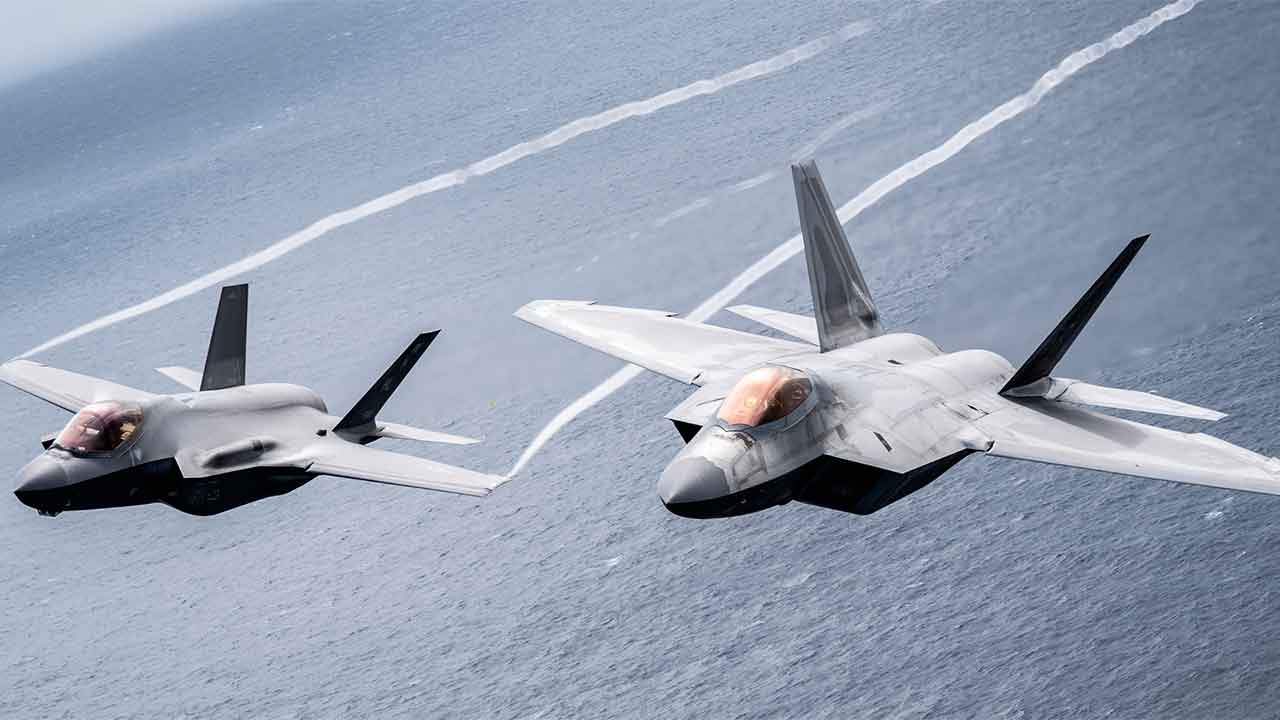
During a visit to Qatar, the President of the United States Donald Trump surprised many by publicly announcing the development of a new twin-engine fighter jet called the F-55, which he described as a “major upgrade to the F-35.” In addition, Trump confirmed plans for a modernized version of the F-22, named “F-22 Super”.
“We’re going to make the F-55, which will be a twin-engine super-upgrade to the F-35, and then we’ll make the F-22. I think the most beautiful fighter in the world is the F-22, but the F-22 Super will be a very modern version,” Trump stated during a meeting with executives from Boeing and GE Aerospace.
The statement came just one day after the announcement of a major deal for the delivery of 160 aircraft to Qatar Airways, and may signal new ambitions from Trump for the U.S. defense industry, especially in the event of another presidential term.
Lockheed Martin responds
Shortly after the announcement, Lockheed Martin, the manufacturer behind the F-35 and F-22 programs, responded on social media with a message supporting Trump’s statement:
“We thank @POTUS for his support of the F-35 and F-22 and will continue working closely with the government to realize his vision of air dominance.”
F-55: new platform or confusion?
The alleged F-55 project had never been officially mentioned before. If it is indeed a new twin-engine modification of the F-35, it would represent a major structural change to the original design, which was conceived as a single-engine aircraft. Trump criticized that feature, stating he prefers planes with “two or four engines.”
However, experts suggest there may have been a slip of the tongue. In 2018, Trump had previously referenced a non-existent F-52 during a speech.
Real updates underway

Despite the uncertainty surrounding the F-55, upgrade programs for the F-35 (Block 4) and F-22 are real and already in progress. The goal is to extend the service life of these fighters until the future F-47—a sixth-generation aircraft that Trump publicly mentioned in March this year—enters operation.
The upgrades involve advancements in avionics, sensors, stealth capabilities, and weapon systems, aimed at maintaining U.S. air superiority amid growing global competition.
Sources and images: X @POTUS | Lockheed Martin @LockheedMartin. This content was created with AI assistance and reviewed by the editorial team.
