
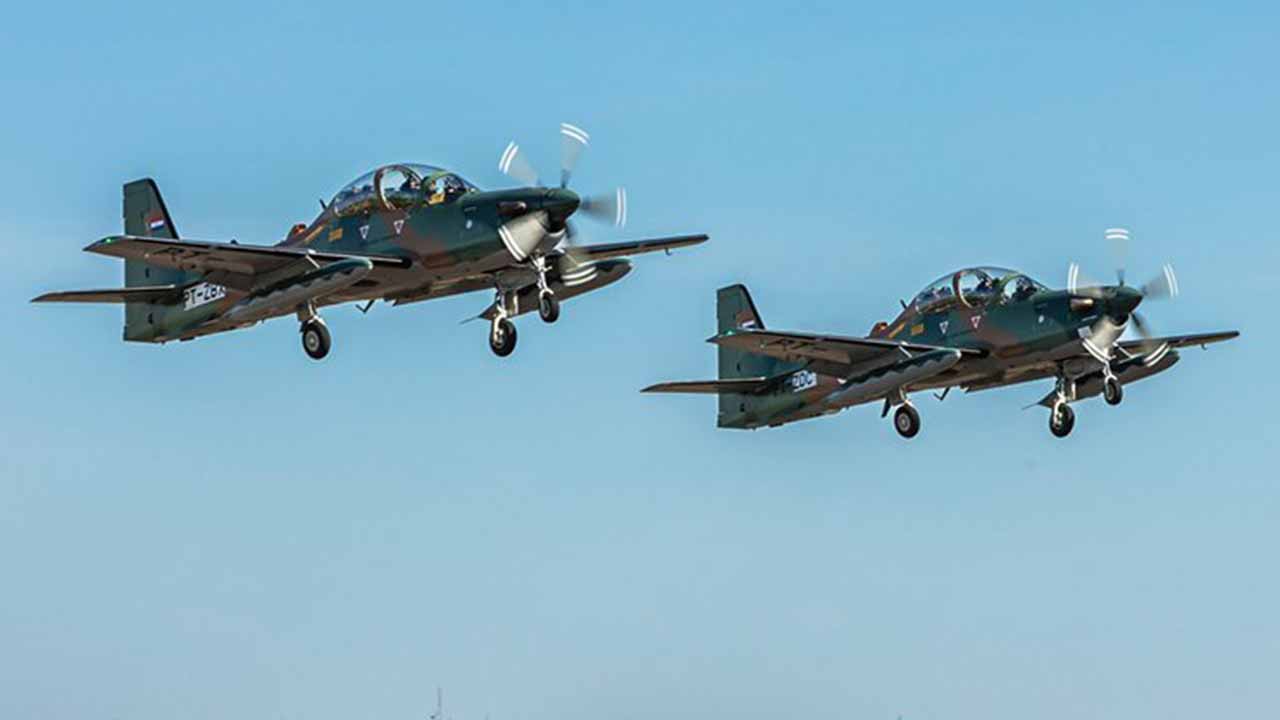
The Paraguayan Air Force intercepted a light Bolivian Cessna 206 aircraft suspected of transporting cocaine, in an operation involving a Tucano and an A-29 Super Tucano.
Images of the aerial pursuit were released by the channel ABC TV Paraguay.
According to preliminary information, the incident began around 11 a.m. local time, when Paraguayan military personnel detected an aircraft classified as “irregular” in the north of the country. Subsequent identification indicated it was a Cessna 206 with Bolivian registration CP-2088, recorded in the department of Concepción. Initial detection occurred near Paso Bravo National Park.
+ Germany advances counter-drone defense with integration of Interceptor-S on Boxer armored vehicle

In a statement to the press, the commander of the Paraguayan Air Force, General Julio Fuyabondo, explained that the initial phase involved discreet escorting, with a surprise ground operation supported by a helicopter at a potential landing site. However, when the aircraft approached to within about 40 km of the Brazilian border, active interception was authorized to force a landing.
After identification, the Cessna’s pilots were ordered to establish communication and land, requirements that were ignored. As a result, the Tucano and Super Tucano crews fired warning shots, as предусмотрed under Paraguayan law.
According to the command, the aircraft landed near the border city of Capitan Bado, where two vehicles approached. After further warning shots, the trucks left the area, and the Cessna remained on the ground for about a minute and a half before taking off again, reportedly without time to unload its cargo.

However, videos posted by local residents suggest that the cargo may have been unloaded before takeoff, indicating that traffickers managed to remove the illicit material.
After taking off, the aircraft was again escorted by a pair of Tucanos and Super Tucanos until it left Paraguayan airspace toward Bolivia. The total duration of the operation, according to the command, was between 3.5 and 4 hours. Paraguay notified the Bolivian Air Force and provided the target’s coordinates at the moment it entered Bolivian airspace. Further investigations regarding registration CP-2088 fell under Bolivian jurisdiction.
Although the distance between the landing site and the Bolivian border appears to exceed the standard range of the Cessna 206, the commander explained that traffickers frequently install improvised internal fuel tanks, significantly extending these aircraft’s range.
The Paraguayan Armed Forces highlighted that the increase in the detection of flights linked to drug trafficking is due to the use of air-surveillance radars. With the arrival of new systems supplied by the United States, expectations are to further enhance interception effectiveness. Under national legislation, the use of lethal force is restricted to self-defense or the neutralization of an immediate threat to third parties, with warning shots generally permitted.
In November 2024, the Paraguayan government secured financing from BNDES for the acquisition of six A-29 Super Tucano aircraft manufactured by Embraer. The light attack aircraft are primarily employed in combating drug cartels, intercepting smuggling aircraft, and supporting ground forces. Paraguay received the first batch of the A-29 in late June 2025.
Super Tucano chases suspected drug-trafficking aircraft for nearly 4 hours in Paraguay
The Paraguayan Air Force intercepted a light Bolivian Cessna 206 aircraft suspected of transporting cocaine, in an operation involving a Tucano and an A-29 Tucano
Source: ABC TV Paraguay pic.twitter.com/MDhLgWVHBB— saibadetudo.com.br (@saibadetudo25) February 8, 2026
Source and images: Embraer | ABC TV Paraguay. This content was created with the help of AI and reviewed by the editorial team.
