
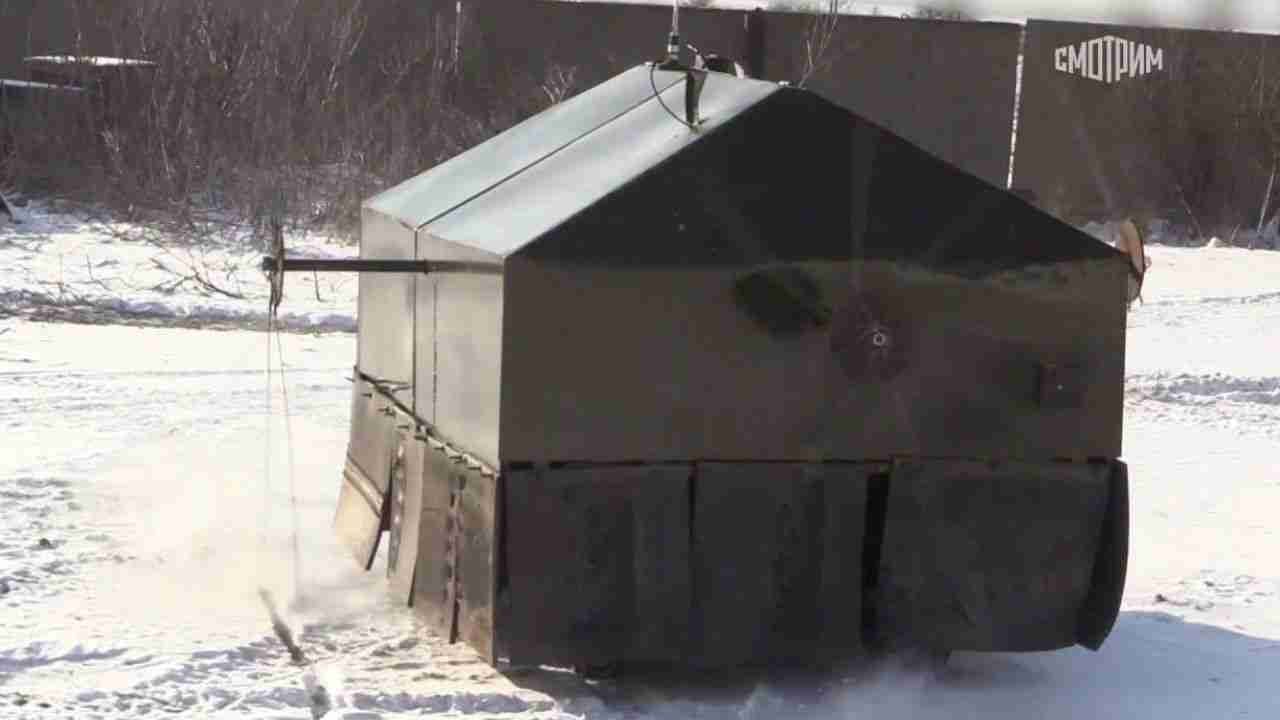
Russia has unveiled an unusual experiment aimed at protecting military equipment from drones: the installation of structures with “fans” and spinning cables on a ground robotic system.
The goal is to create a mechanical barrier capable of striking or destabilizing drones approaching the vehicle, especially FPV models widely used on the battlefield.
The prototype consists of a type of cover mounted on the robot, with rotating mechanisms positioned on the sides, front, and rear. Cables attached to these axles spin as the vehicle moves, powered by independent motors.
However, the released footage shows that the system itself ends up hitting the ground, hindering mobility and raising questions about its effectiveness in real-world movement.
Experts also question the equipment’s performance in environments with dense vegetation, urban areas, and uneven terrain. In addition to the risk of cables getting tangled in obstacles, they could hit the vehicle’s own bodywork and kick up dust and debris that could interfere with operations.
The concept, however, is not entirely new. Russian patents already describe similar solutions installed on vehicles such as the UAZ-452 “Bukhanka,” using spinning blades instead of cables to intercept drones. In these designs, the space between the blades and the vehicle body is intended to destabilize shaped charges and reduce jet effects in case of detonation, including versions aimed at protection from attacks from above.
Source: Militarnyi | Photo: Telegram – Andrii Tarasenko | This content was created with the help of AI and reviewed by the editorial team.
🇷🇺🇺🇦 Russia has introduced an unmanned ground vehicle equipped with a trial anti-drone system
It utilizes spinning cables attached to fans, designed to take down incoming FPV drones pic.twitter.com/qo5PKmc8AR
— Lord Bebo (@MyLordBebo) February 9, 2026
