
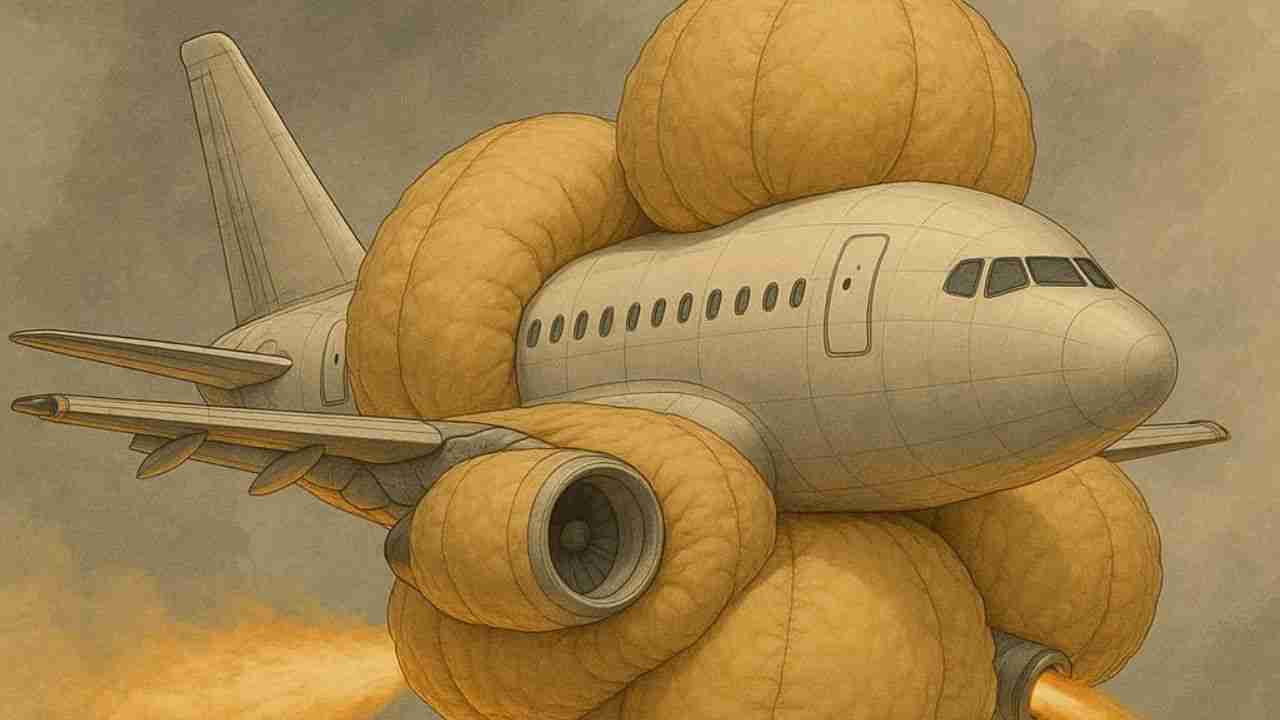
After the tragic Air India Flight 171 accident in June 2025, engineers from the Birla Institute of Technology and Science in Dubai developed a ‘crash-proof’ airplane prototype.
Named Project REBIRTH, the system uses artificial intelligence to trigger external airbags, impact-absorbing fluids, and reverse thrust in the air, turning potential fatal crashes into safer landings.
The invention is a finalist for the James Dyson Award, which recognizes ideas capable of making a global impact.
The functioning of REBIRTH involves sensors that monitor altitude, speed, engines, direction, fire, and pilot reaction, automatically activating the airbags if an accident is imminent below 900 meters. The airbags rapidly expand around the fuselage, resembling a large popcorn kernel, while special fluids absorb impacts to reduce injuries. Additionally, the system can use thrusters or reverse thrust to slow down and stabilize the aircraft, increasing the chances of survival.
The engineers claim that the airbags can be installed on both new and existing aircraft, and they plan to conduct tests in aerospace laboratories.
Despite the prospect of awards and funding if they win the James Dyson Award, Wasim and Srinivasan emphasize that their main goal is to save lives, offering a second chance even in extreme failure situations. The hope is that, in the future, the system will be tested and used on real flights.
Source: New York Post | Photo: The James Dyson Award – PROJECT REBIRTH | This content was created with the help of AI and reviewed by the editorial team
Engineers presented “Project REBIRTH,” an AI-powered airplane bag system using airbags, fluids, and thrusters to reduce crash impacts. Inspired by the June 2025 Air India disaster, it is shortlisted for the James Dyson Award. pic.twitter.com/0gh1UxCrRB
— 🌍 Breaking News of the Day (@BNOfTheDay) September 12, 2025
