
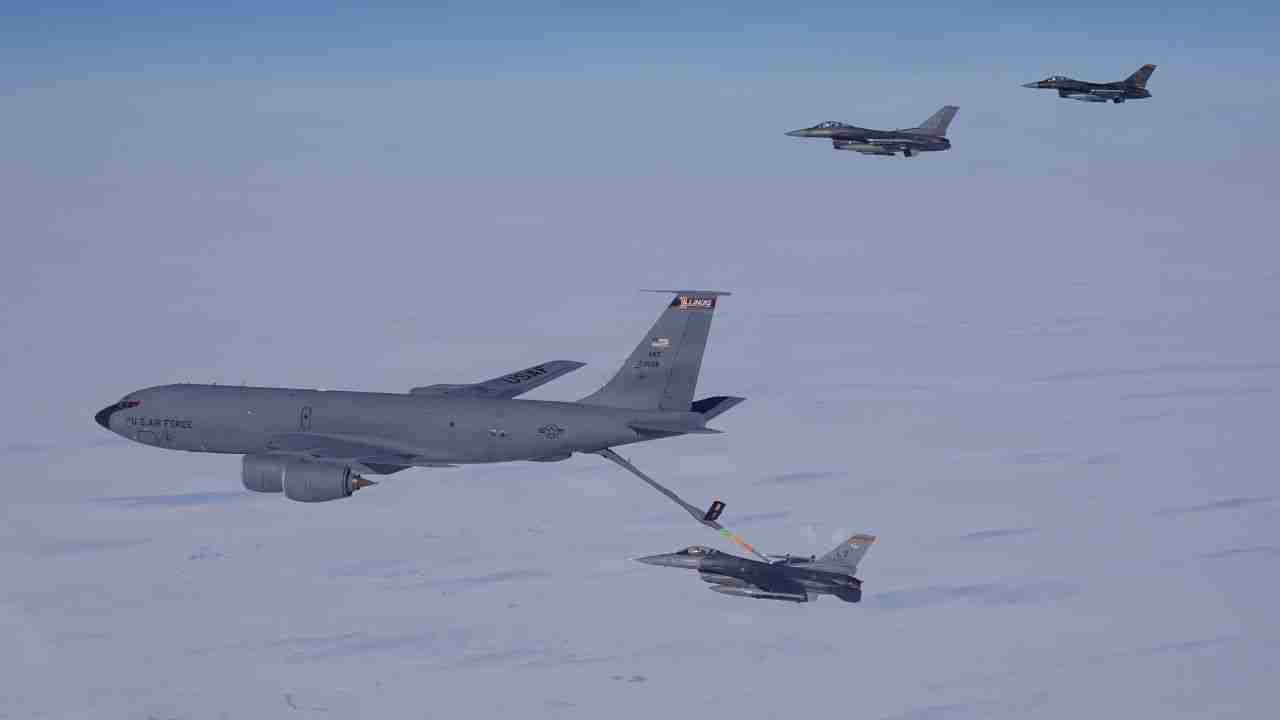
The North American Aerospace Defense Command (NORAD) conducted a military exercise in Alaska to demonstrate its rapid response capability to aerial threats in the region.
The operation involved deploying F-16 fighter jets from the 18th Fighter Interceptor Squadron to the remote King Salmon airport, where alert and interception simulations were carried out. The action reinforces constant surveillance over a strategic area near the Arctic and the Bering Sea.
During the training, the fighters executed interception missions against a KC-135 refueling aircraft, with support from other air units. After the simulation, the KC-135 itself conducted in-flight refueling of the F-16s, ensuring a safe return to their home base. The operation highlighted the logistical and operational capabilities of air forces operating in remote regions.
The released images show different versions of the F-16, including modernized models and aircraft with special paint schemes previously used in aggressor training missions. Some of these aircraft have already participated in real interceptions of Russian planes near Alaskan airspace, indicating ongoing tensions and continuous monitoring in the region.
Another highlight was the use of the “Angry Kitten” electronic warfare system, which enhances defense capabilities and interference in the electromagnetic environment. Although there is no confirmation of its direct link to the increasing presence of Russian intelligence aircraft in the area, the equipment underscores the adaptation of air forces to new combat scenarios. At the same time, U.S. military authorities advocate the use of older, modernized fighters for homeland defense, reserving more advanced aircraft for operations in higher-risk strategic regions.
Source: The Aviationist | Photo: X @NORADCommand | This content was created with the help of AI and reviewed by the editorial team
F-16 Fighting Falcons from the Alaskan NORAD Region recently operated from remote locations in Alaska, maintaining NORAD’s readiness to respond to potential threats to North America. https://t.co/Yu3Sgv7cGh
— North American Aerospace Defense Command (@NORADCommand) April 6, 2026
