
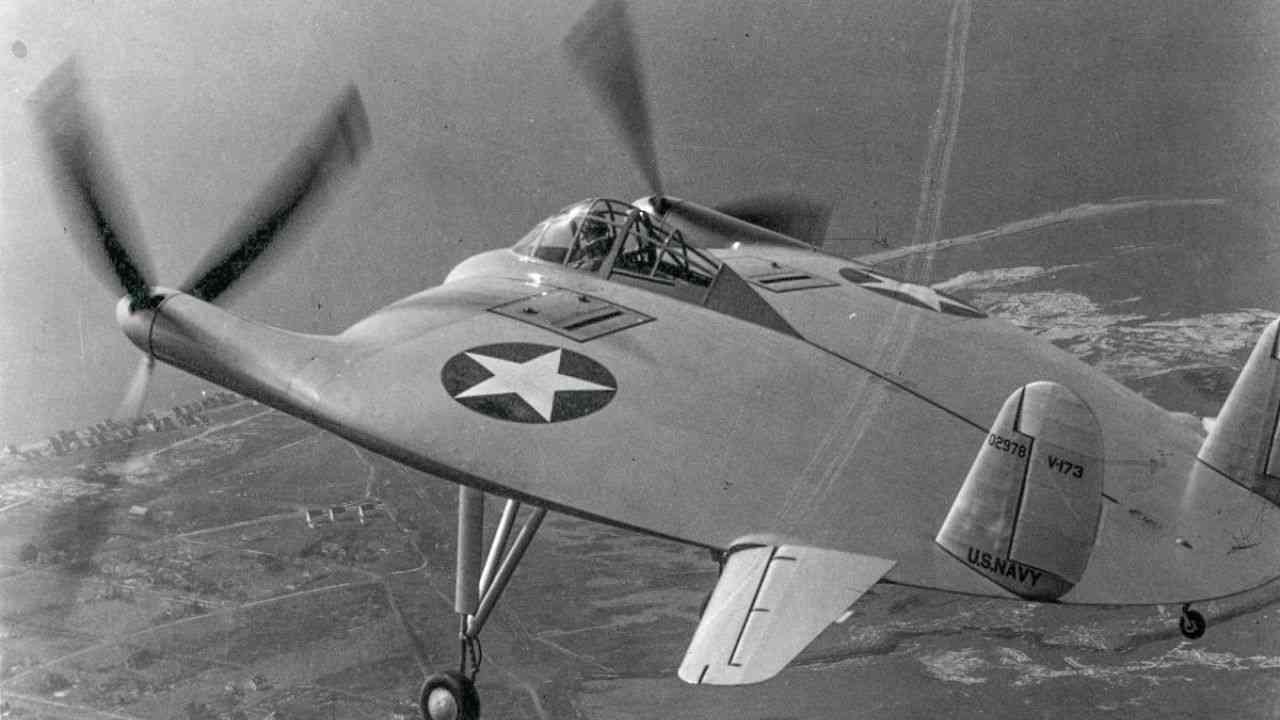
Meet the disc-shaped plane that almost changed US aviation (X @NavalInstitute)
During World War II, while aviation advancements focused on faster and deadlier aircraft, the U.S. Navy bet on an unusual idea: the Vought V-173, nicknamed the “Flying Flapjack.”
With a circular shape and flying saucer appearance, the prototype created by engineer Charles Zimmerman surprised by actually flying, defying expectations that it would never leave the ground. Its innovative design allowed takeoffs on very short runways and exceptional maneuvers, thanks to large propellers at the wingtips.
The project development was kept secret and faced many technical challenges, especially in synchronizing the engines. Still, the V-173 made its first flight in 1942 and completed nearly 200 tests by 1943. Its lightweight wood and fabric structure showed impressive performance: it took off in about 60 meters and maintained stability even at low speeds, being able to even take off vertically with favorable wind.
The United States Navy considered using the Flying Flapjack on smaller aircraft carriers, but jet advancements eventually rendered the concept obsolete.
Although the final combat model, the XF5U-1, was never used in war, the Flying Flapjack left a lasting legacy. It anticipated concepts now common in drones and vertical takeoff and landing (VTOL) aircraft, showing that the pursuit of agility in confined spaces was already a concern in the 1940s. Its impact is remembered as a milestone of boldness and innovation in aviation history.
Source: Olhar Digital | Photo: X @NavalInstitute | This content was created with the help of AI and reviewed by the editorial team
Today is #PancakeDay! During WWII, the experimental Vought V-173 “Flying Pancake” was developed into the Vought XF5U “Flying Flapjack” as a potential U.S. Navy short take-off and landing (STOL) fighter. The program was canceled because of advancements in jet technology. pic.twitter.com/sosv9uuthB
— U.S. Naval Institute (@NavalInstitute) February 21, 2023
