
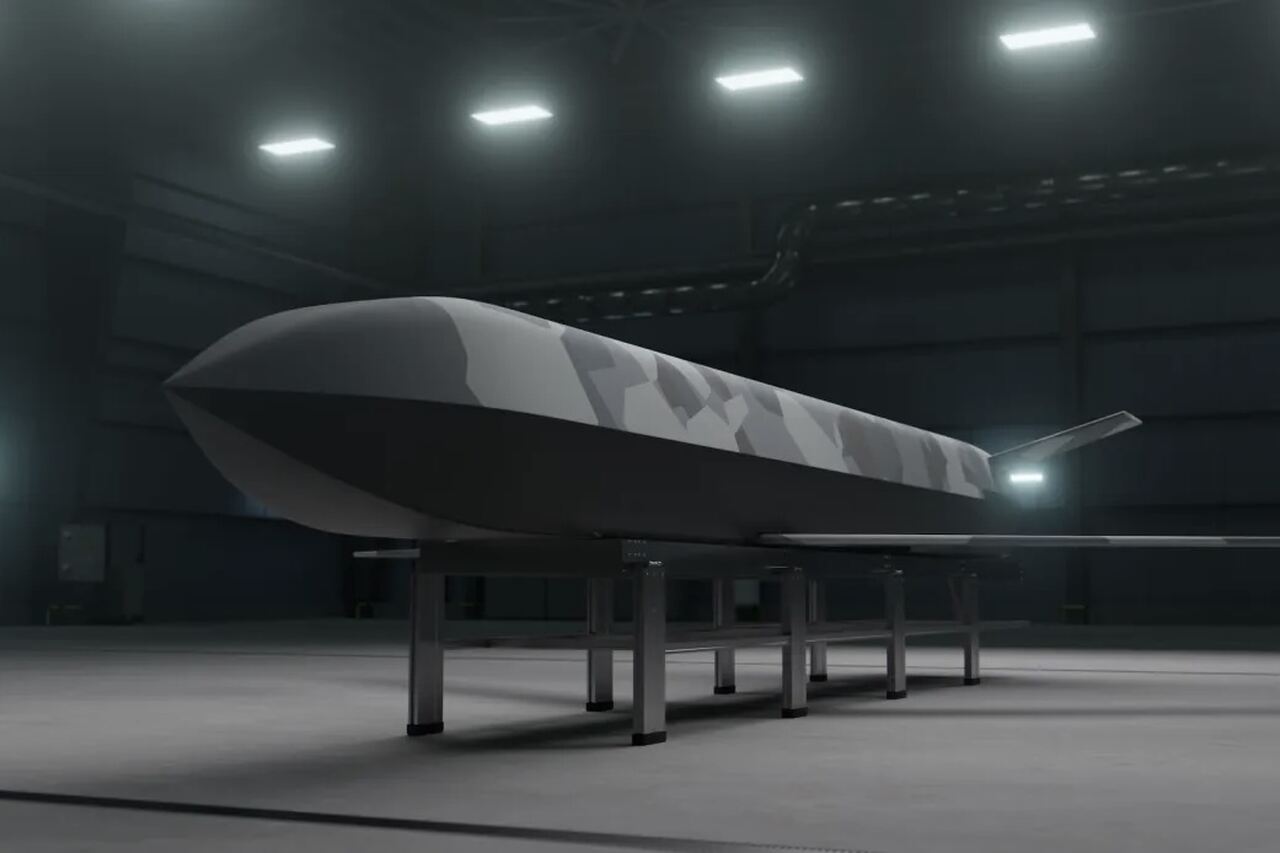
Lockheed Martin and BAE Systems have partnered to develop a range of unmanned aerial systems (UAS), all based on a common design.
The partnership marks a union between two of the world’s largest defense contractors, joining forces to enter the growing field of cheaper, disposable drones and munitions.
The collaboration was announced last Tuesday (September 9) at the Defense and Security Equipment International (DSEI) exhibition in London, England.
This union specifically involves the advanced research and development divisions of the two companies: Lockheed Martin Skunk Works and BAE Systems’ FalconWorks.
Concept images of the UAS, currently unnamed, show a missile-like vehicle with a fuselage clearly optimized for low observability and prominent humps.
The UAS features notably long and narrow main wings with an apparently limited wingspan, V-shaped rear fins, and smaller, angled ventral fins.
Big news from #DSEI as UK BAE Systems Falconworks and Lockheed Martin’s Skunk Works announce collaboration to develop versatile, modular CCA/drone family – can be air launched, maritime, or air dropped from back of a transport aircraft ramp. First role – EW #avgeek pic.twitter.com/ZUiqWoJN1z
— Tim Robinson (@RAeSTimR) September 9, 2025
According to the TWZ website, the UAS is expected to operate using some type of swarm capability and, generally, seems to follow a format similar to Lockheed Martin’s Common Multi-Mission Truck (CMMT).
For now, it is still difficult to determine the overall size of the vehicle based solely on images. The companies described the UAS as “autonomous,” though it is unclear whether it will have a “human operator” and what role that operator would play.
However, given advances in artificial intelligence and machine learning, discussions are increasing around the use of increasingly autonomous weapon systems.
Two global innovators.
One powerful partnership.
We’re excited to be working with @LockheedMartin to combine capabilities and develop a range of uncrewed autonomous air systems.
🔗 https://t.co/ImdBFYHfKt pic.twitter.com/PttbJ74tRu
— BAE Systems (@BAESystemsplc) September 9, 2025
Photo and video: BAE Systems / X @RAeSTimR / X @BAESystemsplc. This content was created with the help of AI and reviewed by the editorial team.
