
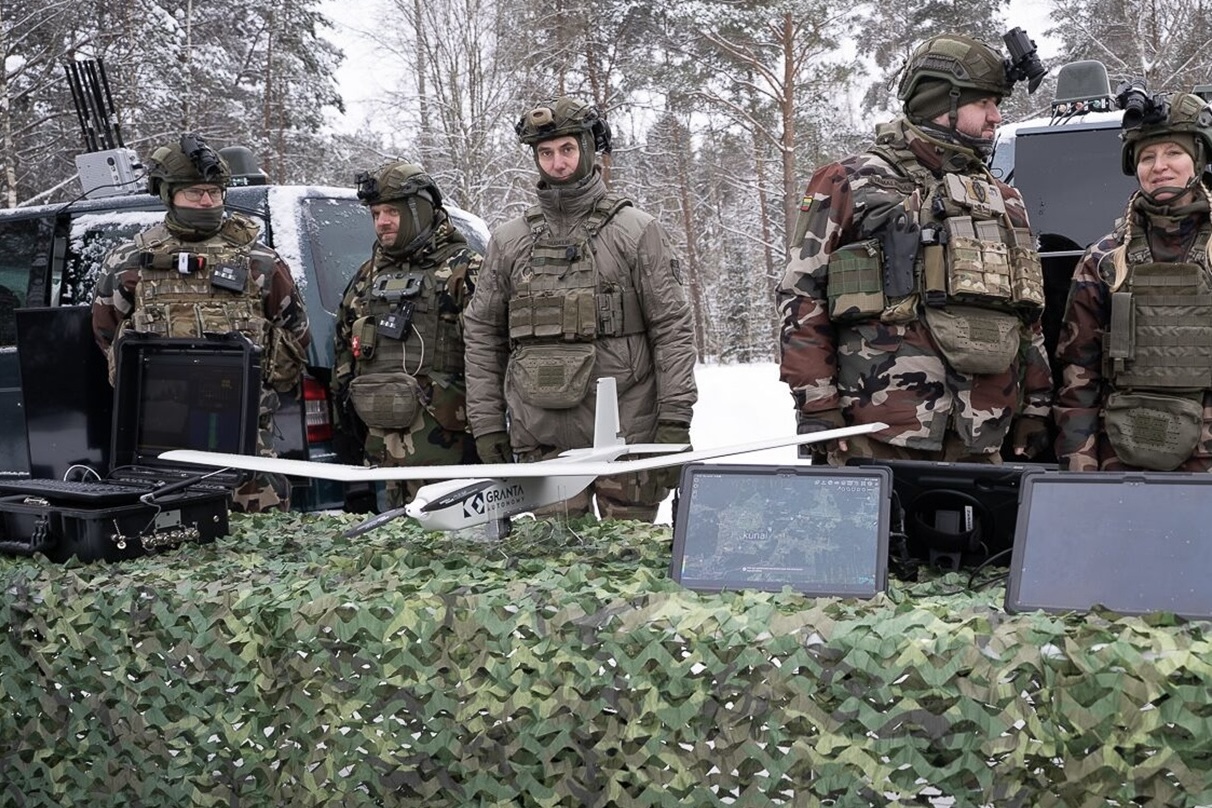
The Lithuanian Army demonstrated the operation of the Hornet XR reconnaissance drone from Granta Autonomy during a visit by Danish and Lithuanian leaders.
The demonstration was attended by King Frederik X and Queen Mary of Denmark, alongside Gitanas Nausėda, President of Lithuania, and the First Lady, Diana Nausėdienė, according to a statement released by Granta Autonomy.
The visit took place within formations of the National Defence Volunteers and the Lithuanian Riflemen’s Union, where the delegation was briefed on recent updates to Lithuania’s territorial defense forces and observed unmanned systems now entering regular service.
According to Granta Autonomy, the delegation reviewed the company’s fixed-wing unmanned reconnaissance system Hornet XR, which was selected by Lithuanian military organizations as part of their unmanned modernization efforts.
The platform is described as a lightweight reconnaissance asset intended for unit-level intelligence gathering, with a reported operational range of up to 50 kilometers and autonomous endurance of approximately three hours.
The system is designed to carry electro-optical payloads optimized for surveillance and target observation while maintaining a low acoustic and visual signature during flight operations.
According to Granta Autonomy, the platform’s size and flight profile help reduce detectability, allowing it to operate in contested environments where traditional reconnaissance assets face higher risks.
The system is launched and recovered without the need for complex infrastructure, making it suitable for use by territorial defense units operating with limited logistical support.
The Hornet XR has already seen operational use, including deployments related to combat in Ukraine, where it was provided to airborne units and others for battlefield reconnaissance tasks.
Similar systems are being developed worldwide as part of studies on lessons learned from the conflicts between Russia and Ukraine.
In real-world large-scale battlefield scenarios, small- and medium-sized unmanned aerial platforms have been prioritized as cost-effective tools to enhance situational awareness and decision-making at the tactical level.
Photo: Granta Autonomy. This content was created with the assistance of AI and reviewed by the editorial team.
