
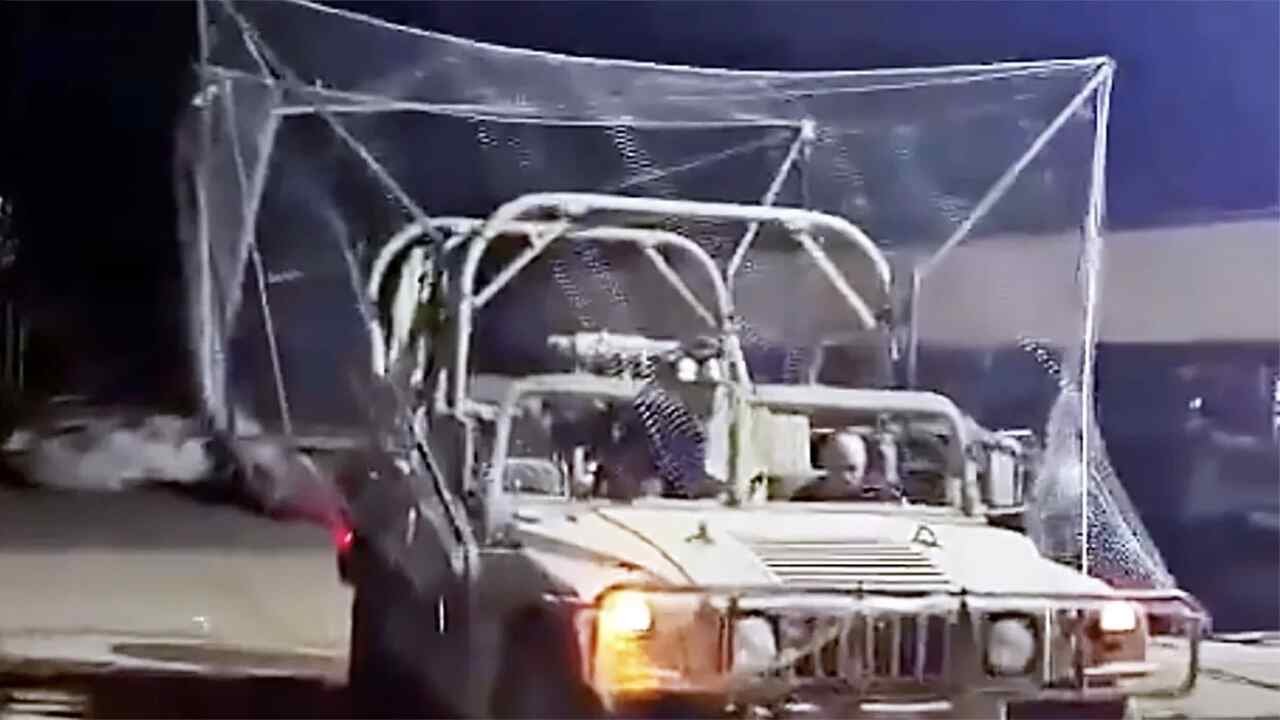
Israel has begun using nets to protect its military vehicles against FPV drone attacks from Hezbollah, which have become increasingly frequent during the war in Lebanon.
In a video shared on social media on Wednesday (29), an Israeli ground vehicle can be seen driving with an anti-drone net mounted around its body, resembling a soccer goal.
The goal is for drones to get caught in nylon or metal mesh nets and be neutralized, or at least kept at a sufficient distance from the occupants before exploding, although the latter option is more limited and depends on the type of vehicle and the drone’s warhead.
Based on the video that surfaced yesterday on social media, it appears that the level of protection the net can provide to passengers in the open Israeli vehicle is likely very limited in the event of a drone warhead detonation.
The measure was adopted by Israeli forces after what has been described as an inability to deal with the threat of Hezbollah FPV drones, according to the website The War Zone.
This frustration grew over the past weekend, when an Israeli soldier was killed by a Hezbollah FPV drone attack, while six others were seriously injured. As soldiers were loading the wounded into a helicopter, another drone approached for a second strike, which was thwarted by the intervention of an Israeli servicemember.
“The attack exposed a growing vulnerability: the lack of preparedness of the Israel Defense Forces for first-person-view (FPV) drones in Lebanon, which have become an increasingly prominent weapon in Hezbollah’s arsenal during the current fighting,” reported The Times of Israel on Monday (27).
Despite its limitations, this type of net has become quite common in Ukraine, with both sides using nets over vehicles, buildings, and along roads to create safer travel corridors. With this in mind, it is likely they will also become increasingly common in southern Lebanon.
Israeli Defense Forces testing a folded anti-drone net installed on a Humvee.
The video emerged amid a surge of Hezbollah strikes with FPV drones against the IDF in Lebanon. pic.twitter.com/PwIyuJQVs4
— Status-6 (War & Military News) (@Archer83Able) April 29, 2026
Photo and video: X @Archer83Able. This content was created with the help of AI and reviewed by the editorial team.
