
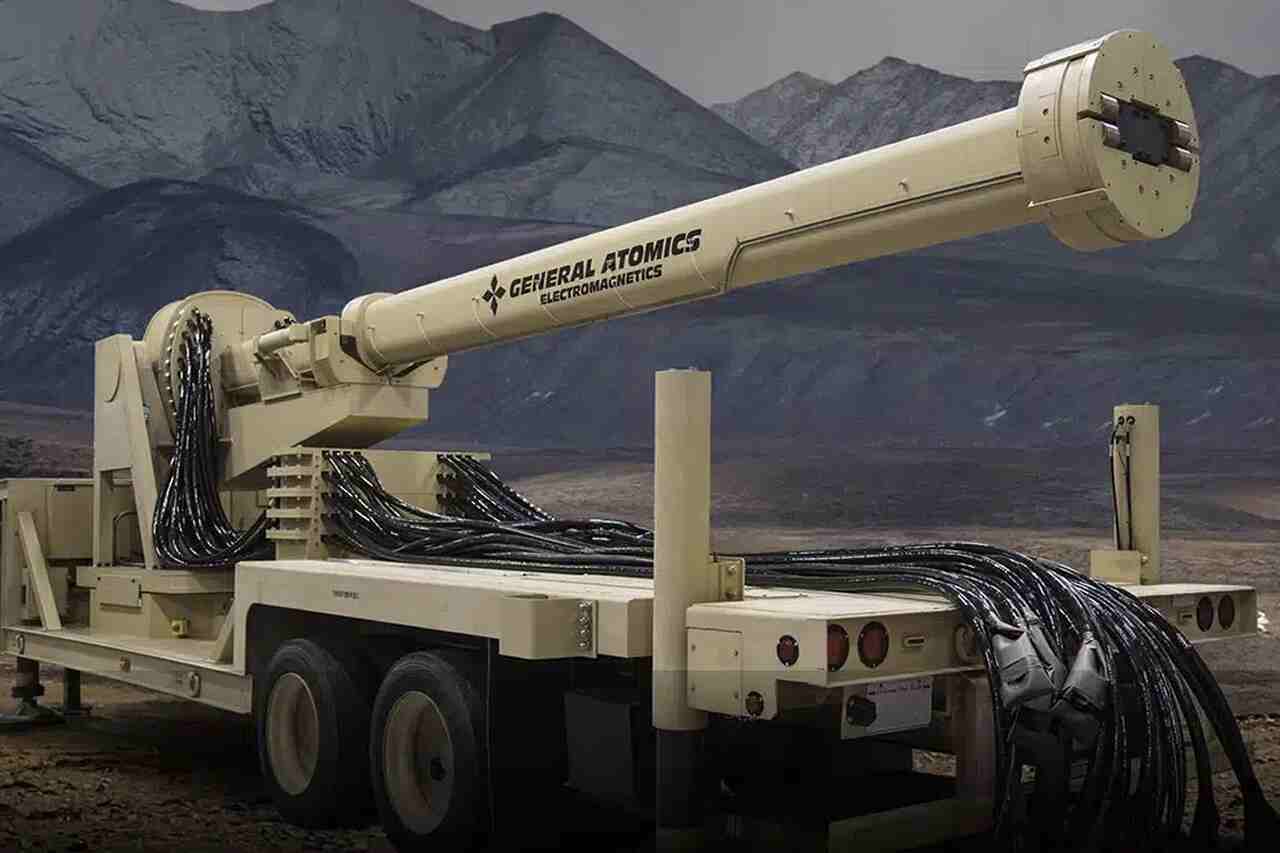
General Atomics is promoting an electromagnetic cannon technology that was previously developed as part of the U.S. initiative to create the Golden Dome, a national air and missile defense network.
According to Naval News, graphics of the electromagnetic cannon were displayed by General Atomics at its booth during the annual meeting of the United States Army Association held last week in Washington, D.C.
Despite the cancellation of the U.S. Navy and Army electromagnetic cannon programs in 2021, the California-based defense company has maintained its research and development of the experimental technology and is now rolling out its air defense applications.
The company’s electromagnetic cannons are now being promoted for the Golden Dome. “The system works. It stopped because it wasn’t, you know, operational. But in terms of technical challenges, […] they were solved. We are bringing it all together and making it operable for soldiers and sailors,” said Mike Rucker, head of weapons at GA-EMS, to Naval News.
Rucker, who previously served as program manager for General Atomics’ electromagnetic cannon project for the U.S. Navy, told Naval News that the company’s efforts have attracted international attention.
Although none of these foreign parties were identified, Rucker noted that Washington was “cooperating” with these nations regarding their interest in General Atomics’ electromagnetic cannon products.
Beyond the Golden Dome, Rucker also noted that the terminal defense potential of the electromagnetic cannon could be useful for U.S. forces defending Guam, a U.S. territory in Micronesia that lacks defenses against mass attacks from Chinese long-range weapons.
An infographic from General Atomics stated that the company’s multi-mission electromagnetic cannon system can fire projectiles at speeds up to Mach 6.
Three variants of the electromagnetic cannon were listed, with energy capacities ranging from 3 to 32 megajoules. The company also stated that these systems are capable of intercepting ballistic and cruise missiles.
Photo: General Atomics. This content was created with the help of AI and reviewed by the editorial team.
