
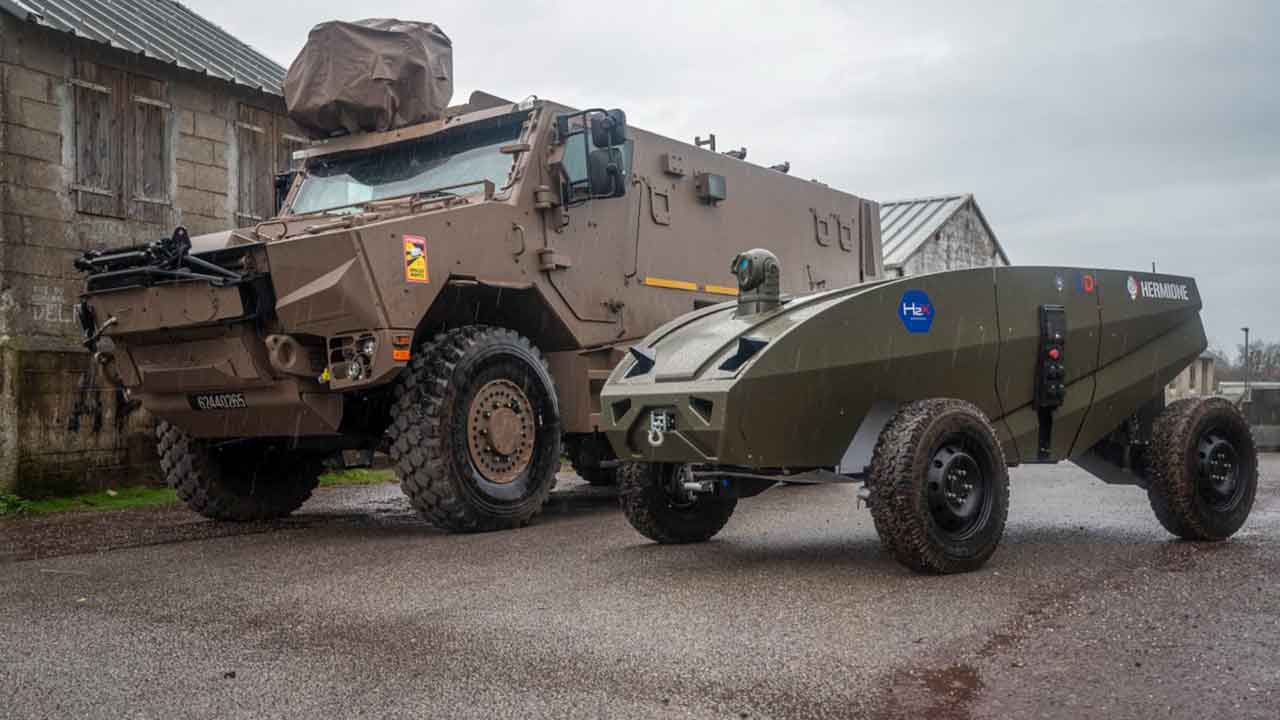
The French Army has launched a new phase of experimentation in ground robotics and artificial intelligence (AI), testing the next-generation unmanned ground vehicle Hermione at the facilities of Saint-Cyr Coëtquidan, France’s main military academy.
The initiative was officially confirmed by the French Army this week.
+ France sends troops to Greenland in exercise led by Denmark
The trials are part of the Pendragon program, which focuses on integrating AI-enabled combat systems into future military operations. According to the Army, the objective of the first AI-guided combat unit is “to anticipate tomorrow’s battles while accelerating decision-making and tactical effectiveness.”
In a statement, the land force highlighted that the project is being conducted jointly with the Ministry of the Armed Forces’ agency responsible for defense AI and reflects the ambition to prepare the country for future conflicts. The stated goal is to deliver the first operational robotic unit to active-duty forces by 2027.
Hermione

Hermione was developed through a partnership between the Polish company P.H.U. Lechmar and the French firm H2X-Defense. It is a modular, wheeled unmanned ground platform designed to carry out a wide range of missions. The vehicle has a standard payload capacity of 300 kilograms, with alternative variants capable of carrying up to two tonnes.
Designed to operate on uneven or rugged terrain, Hermione features all-wheel drive and reaches a maximum speed of approximately 24 miles per hour (about 39 km/h). Its dimensions are 3.3 meters in length, 1.85 meters in width, and 1.4 meters in height, excluding installed mission equipment. The version presented at the MSPO trade show weighed around 700 kilograms and offered a ground clearance of 300 millimeters.
The propulsion system is based on hydrogen fuel cells integrated with TPED-certified cylinders, which power 8 kW in-wheel electric motors. The vehicle is also equipped with a 25 kWh battery and, according to the manufacturers, can operate for up to 20 hours. Hydrogen refueling takes about three minutes, and the cylinders can be replaced in the field, reducing downtime.
The selection of Hermione for evaluation aligns with the broader effort by the French Army to introduce AI-enabled robotics into maneuver units. The tests at Saint-Cyr Coëtquidan aim to assess levels of autonomy, mobility, energy performance, and integration with command-and-control networks.
Tactical exercise integrating the electrically powered “Hermione” H2X robot and an ACT drone for thermal detection. April 2024
The Pendragon program also explores the use of AI-based decision-support tools, cooperation between manned and unmanned assets, and the incorporation of robotic platforms into dismounted and mechanized formations. According to the Army, the data collected during this experimental phase will be decisive in defining the requirements for the first operational robotic unit, scheduled to enter service in 2027.
Source and images: Armée de Terre X @armeedeTerre | Académie militaire de Saint-Cyr Coëtquidan, X @SaintCyrCoet. This content was created with the help of AI and reviewed by the editorial team.
