
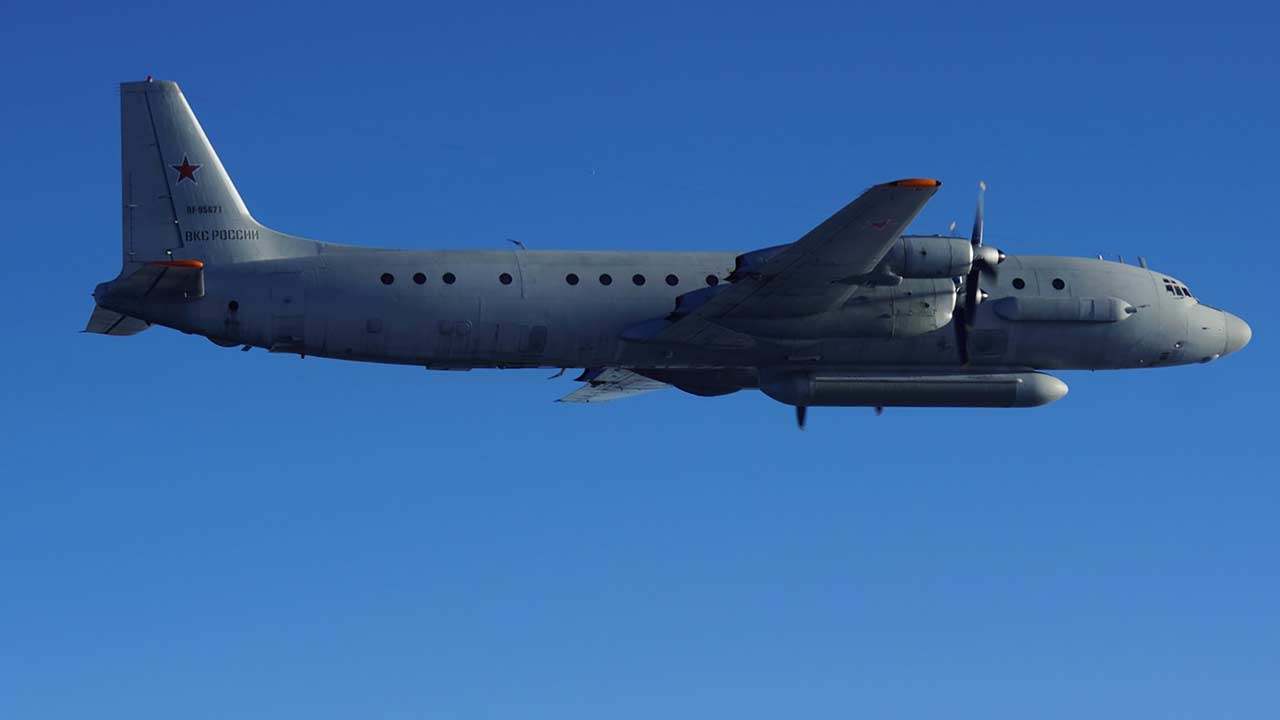
Two stealth F-35 fighters from NATO were scrambled from Evenes Air Base in Norway on a Quick Reaction Alert (QRA) mission after the detection of a Russian reconnaissance aircraft, the IL-20 COOT-A, flying in international airspace north of Finnmark.
According to @NATO_AIRCOM, this was the first live mission coordinated by the new Combined Air Operations Centre (CAOC) in Bodø, responsible for monitoring and controlling NATO’s air activities in the high north of Europe.
+ United States expected to receive prototype of new M1E3 Abrams tank by the end of 2025
The F-35 interceptor, operated by the Royal Norwegian Air Force, identified the IL-20, an electronic intelligence (ELINT) aircraft used by Russia for signal gathering and communications surveillance. This type of aircraft is frequently spotted near NATO airspace.
The Quick Reaction Alert mission is an essential part of NATO’s integrated air defense, ensuring an immediate response to any unidentified aircraft approaching Allied airspace.
What is the IL-20 COOT-A
The IL-20 “Coot-A” is a reconnaissance and electronic intelligence aircraft developed by the Ilyushin Design Bureau in the 1960s and widely used by the Russian Air Force. Based on the IL-18 military transport aircraft, it was modified for surveillance and data collection missions with specialized sensors, side antennas, optical systems, and long-range radar.
Its main role is to intercept radar emissions, communications, and electronic activity from foreign powers, providing strategic intelligence about the tactical environment and NATO forces’ presence.
Despite its dated design and turboprop engines, the IL-20 remains operational thanks to its range of over 6,000 km and ability to operate in Arctic and Barents Sea regions — sensitive monitoring zones between Russia and NATO allies.
Source and images: NATO Air Command / @NATO_AIRCOM. This content was created with the help of AI and reviewed by the editorial team.
