
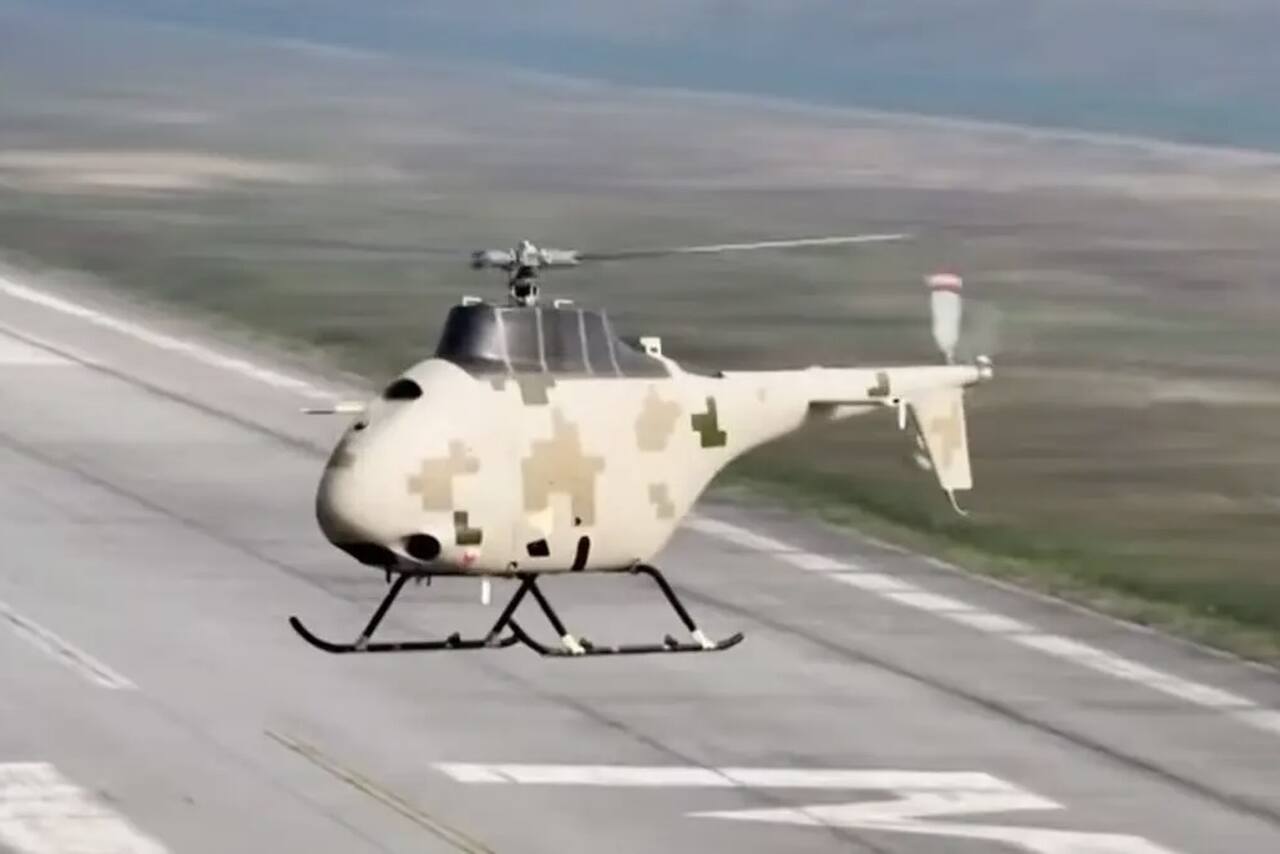
The Moyujian, China’s new unmanned attack helicopter, is ready for critical combat testing, according to the South China Morning Post.
The new multi-role helicopter was showcased on November 27 at Aero Asia, the annual air show held in Zhuhai, southern China, where the next stage of testing was announced by the manufacturer, Sichuan Tengden Technology.
At the event, the aircraft appeared camouflaged on a static display, supported by images of its successful first high-altitude live-fire test.
According to Tengden, the unmanned aircraft was designed for reconnaissance missions, precision strikes, communications relay, emergency rescue, and wildfire prevention.
The Moyujian has a maximum range of 1,000 km and a flight time of 9 hours, with the ability to reach altitudes of up to 7,200 meters. The helicopter was designed to take off and land at high altitudes in adverse conditions, according to the company.
These capabilities are crucial for China’s operations on the Tibetan Plateau, where the terrain ranges from 4,000 to 5,000 meters in altitude. This region includes the Himalayas along the border with India, where low oxygen levels and strong winds challenge the performance of normal aircraft.
Tengden also highlighted that the design supports both plateau deployment and maritime missions, making it suitable for both military and civilian applications requiring long flight times and stable performance.
In July, the Moyujian conducted live-fire target tests at an altitude of over 4,000 meters while carrying two missiles, according to an operator from Tengden speaking to the state-owned channel CCTV.
The helicopter was reportedly tested against both moving and stationary targets, completing the mission as planned. According to the developers, this achievement has strengthened confidence in the helicopter’s performance in high-altitude areas where flight reliability is more difficult to maintain.
The operator also confirmed that the next testing phase will involve satellite communication and beyond-line-of-sight control. The mission will take place at altitudes above 6,000 meters, which requires high stability, strong engine performance, and reliable data links.
The company said that the helicopter has already completed six years of evaluations covering rugged terrain, mission systems, maritime environments, and wildfire prevention work. With these phases completed, the helicopter is now ready to enter combat-oriented testing.
Photo: YouTube @CCTV. This content was created with the help of AI and reviewed by the editorial team.
