

The United States Air Force has announced that the VC-25B Bridge aircraft has officially completed the modification and flight testing phases and has now entered the painting stage. The provisional “Air Force One” is expected to be unveiled during the Northern Hemisphere summer with a new red, white and blue livery.
The program was created as an interim solution to strengthen the United States’ presidential airlift capability while the definitive new VC-25B aircraft, developed by Boeing to replace the current VC-25A, remain delayed.
According to the Air Force, the need for an interim aircraft became more urgent after deliveries of the new VC-25B aircraft slipped beyond the initial 2024 target, while the current VC-25A fleet began facing extended heavy maintenance cycles. The new timeline cited by the service indicates that the long-term VC-25B aircraft are expected to be delivered in 2028.
What is the VC-25B Bridge program?
The VC-25B Bridge program is a United States Air Force transition program designed to place a provisional presidential aircraft into service before the arrival of the two main new VC-25B aircraft. In practice, it serves as an operational “bridge” to reduce pressure on the current VC-25A fleet, the adapted Boeing 747-200B aircraft currently used to transport the U.S. president.
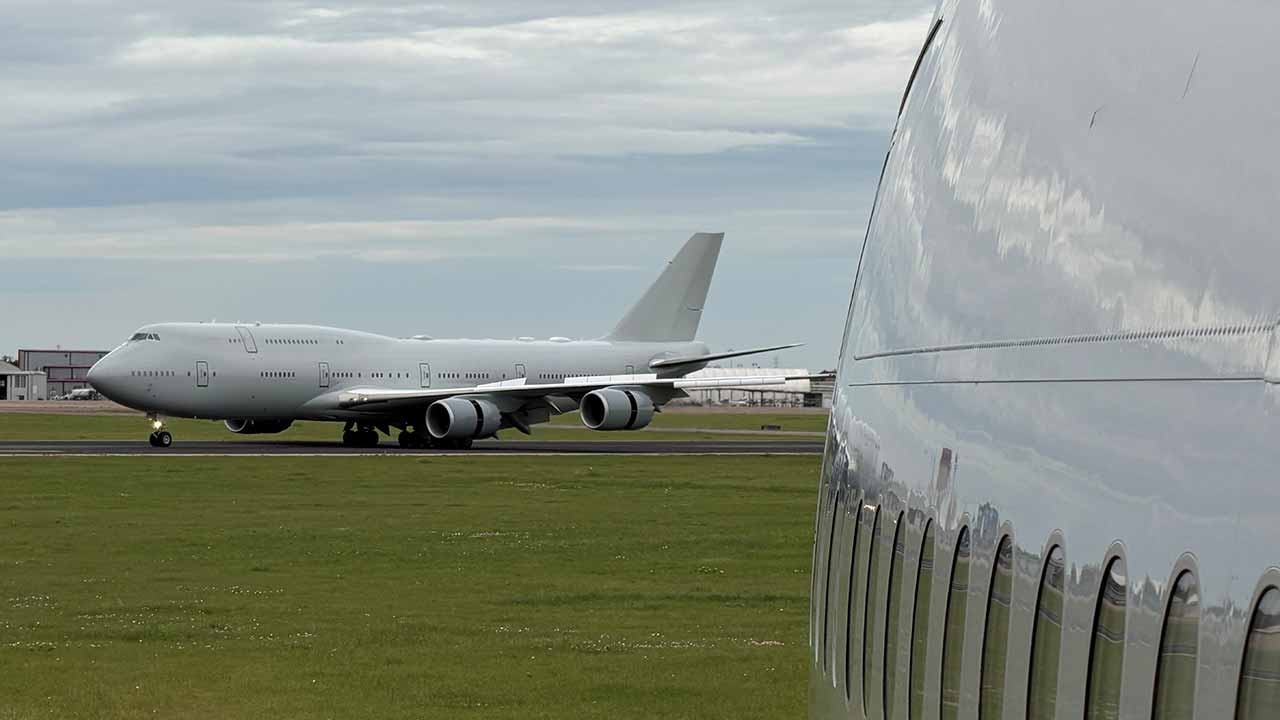
The Bridge aircraft is a Boeing 747-8i originally configured for a head of state, accepted from Qatar by the United States and modified to serve temporarily until the new VC-25B aircraft are ready. L3Harris was selected to carry out the adaptations, including communications systems, protection and customization required for a presidential aircraft.
When the president of the United States is aboard an Air Force aircraft, it uses the call sign “Air Force One.” For this reason, although the term is popularly associated with the presidential aircraft itself, it is technically a call sign.
According to the Air Force, the Bridge program also represents a shift in how the service intends to deliver critical capabilities. The project concentrated authority and responsibility in a structure similar to that of a direct-reporting portfolio manager, allowing decisions to be accelerated and different agencies involved to be aligned around a single operational goal.
“This program exemplifies what is possible when clear accountability is placed on one person, and the entire enterprise of stakeholders aligns behind a single mission outcome: deliver a bridge capability as soon as possible to relieve pressure on the aging VC-25A fleet,” said Gen. Dale White, direct-reporting portfolio manager for Critical Weapon Systems.
Task force was created in 2025
The Air Force said that, in February 2025, a dedicated task force was created to accelerate the VC-25B Bridge program while also trying to reduce delays in the production of Boeing’s definitive VC-25B aircraft.
One focus of the effort was to stabilize the programs’ technical requirements. According to the service, requirements instability is one of the main causes of delays in complex military projects. For this reason, an intergovernmental team defined a baseline of requirements focused on the essential capabilities needed to transport the president of the United States with security, resilient communications and adequate protection.
Air Force Chief of Staff Gen. Ken Wilsbach said the program demonstrates the institution’s ability to innovate and adapt quickly to ensure continuity of government under different conditions.
In addition to the Bridge aircraft, the effort involves other Boeing 747-8 aircraft used for support roles, pilot training, maintainer preparation and the development of a supply chain for the future presidential fleet. According to the Air Force, the goal is not only to cover a temporary gap, but also to prepare the structure that will support the new VC-25B aircraft for decades to come.
Source: U.S. Air Force / Secretary of the Air Force Public Affairs. This content was created with the help of AI and reviewed by the editorial team.
