
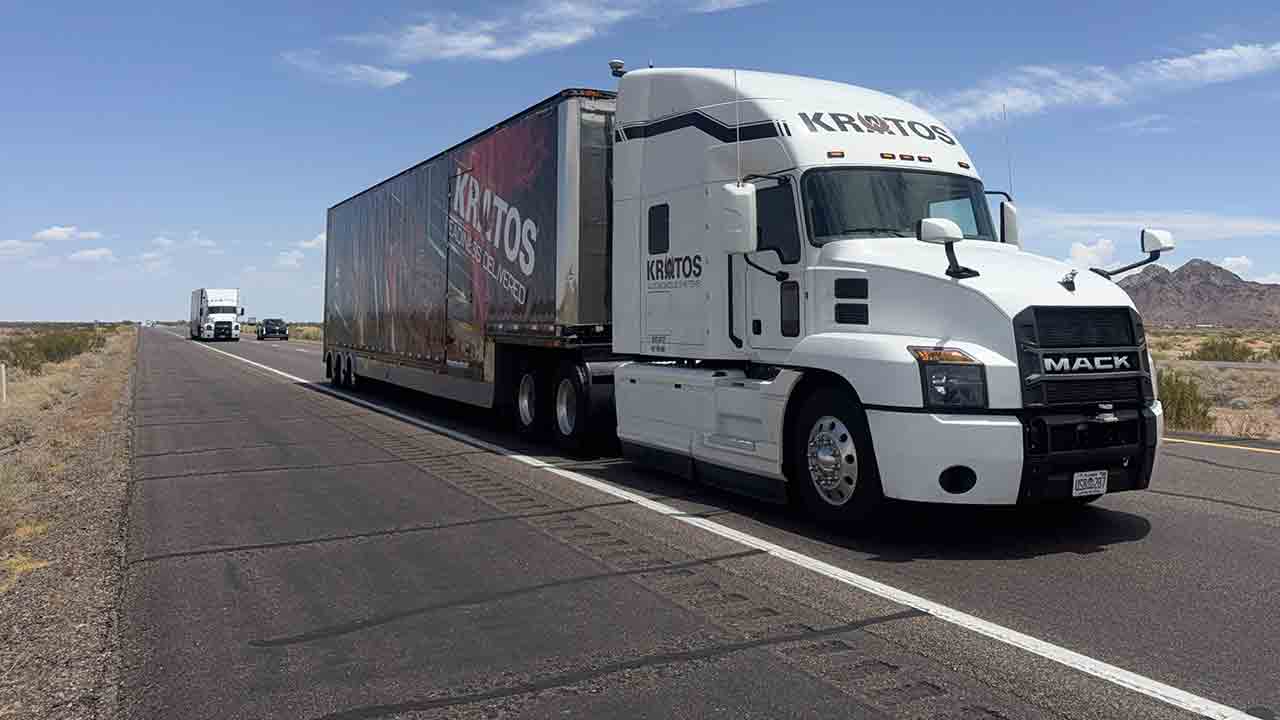
Kratos Defense & Security Solutions has completed a long-distance operation using an autonomous truck convoy, transporting racing equipment from Charlotte, North Carolina, to Naval Base Coronado in California in support of the NASCAR Anduril 250 race.
The journey marked a significant step forward for platooning technology, a system in which a lead truck is driven by a human operator while a second vehicle follows autonomously, synchronizing steering, braking, and speed. In Kratos’ case, the following truck also carried a safety operator onboard to supervise the operation.
The technology originated in defense applications but is now beginning to gain traction in commercial use. Kratos had already tested the concept in 2025 during an operation connected to the Brickyard 400 at the Indianapolis Motor Speedway. This time, however, the system was deployed on a long-haul interstate route as part of a real-world motorsports logistics operation.
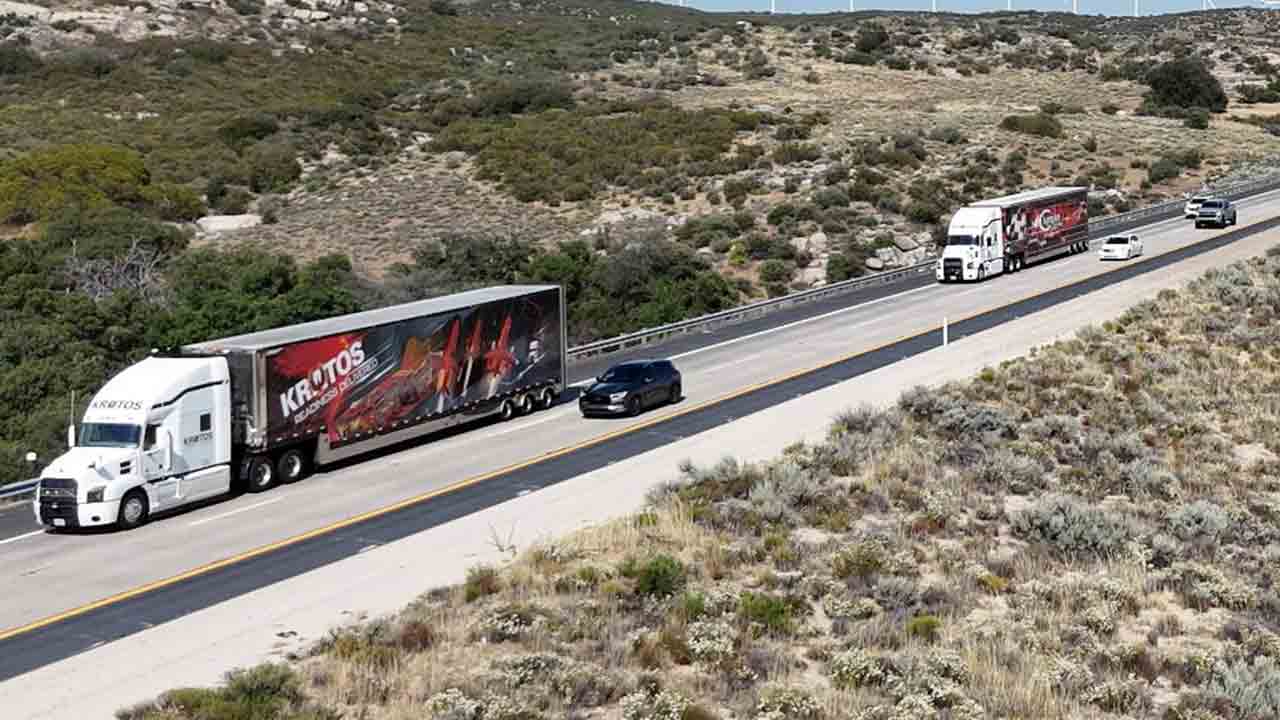
This is not a case of a truck driving down the highway entirely on its own without any human presence. The model adopted by Kratos is closer to an automated convoy, where a single driver could eventually coordinate multiple vehicles at the same time. The goal is to increase freight capacity, reduce operating costs, and help address the driver shortage in the transportation industry.
According to Maynard Factor, Kratos’ Vice President of Business Development, the operation demonstrated that the system has moved beyond the demonstration phase into a more scalable execution model. “Last year, we proved the concept. This year, we demonstrated execution at scale,” the executive said.
The partnership involved Champion Tire & Wheel, a company specializing in motorsports logistics and a support provider for NASCAR operations. For the automotive industry, the demonstration is significant because it shows how autonomous driving may first become widespread in specific commercial applications such as freight transportation, controlled convoys, and planned logistics routes before becoming common in passenger vehicles.
Beyond its commercial potential, the operation also reinforces Kratos’ dual-use strategy: developing technologies for defense and adapting them for civilian markets. In the trucking sector, this could impact both traditional road freight transportation and military operations, where logistics convoys are essential and often exposed to significant risks.
Regulatory, technical, and safety challenges still remain before this type of system can be widely adopted on public roads. Even so, the journey between the U.S. East Coast and West Coast indicates that autonomous truck convoys are moving beyond controlled testing environments and getting closer to real-world commercial operations.
+ Porsche celebrates 75 years in the United Kingdom with limited-edition 911 GT3
Source and images: Kratos Defense & Security Solutions. This content was created with the assistance of AI and reviewed by the editorial team.
