
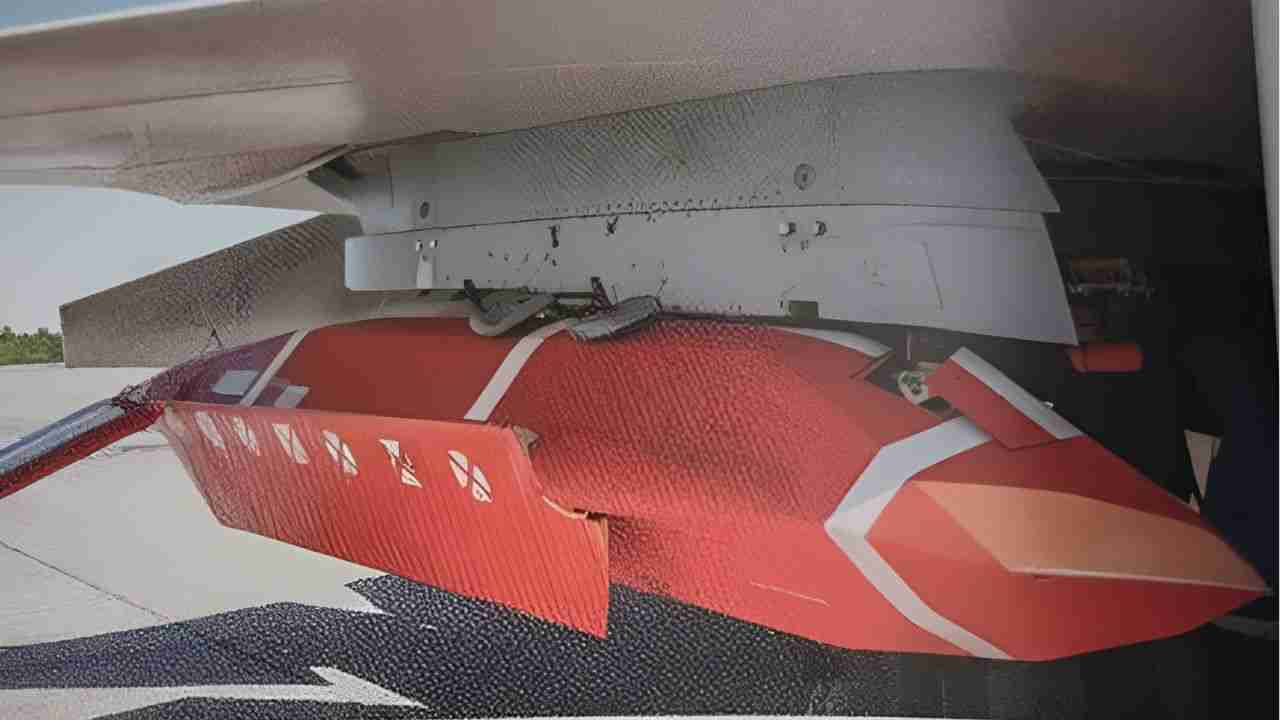
Ukraine has released new details about the S-71K “Kovyor”, an air-launched cruise missile developed by Russia and already used in combat since late 2024.
Designed specifically for the Su-57 stealth fighter, the weapon emerges as a cheaper alternative to traditional missiles, allowing for larger-scale production amid wartime demands. With an estimated range of up to 300 km, the model expands Russia’s ability to strike targets at a distance, beyond the immediate reach of Ukrainian air defenses.
Information released by Ukraine’s military intelligence (GUR) includes an interactive 3D model and a detailed technical analysis of the missile. The S-71K uses a warhead based on the OFAB-250-270 bomb, weighing around 250 kg, integrated into its structure—highlighting a pragmatic approach that combines existing technologies with a new delivery system. Its fuselage is designed to reduce radar detection with a low-profile shape and lightweight materials, though without extensive use of special coatings, helping to keep costs lower.
Another notable point is its heavy reliance on foreign components. According to GUR, most of the missile’s electronic systems originate from countries such as the United States, China, Germany, Japan, and Taiwan, indicating weaknesses in the sanctions regime imposed on Russia. This ability to access and integrate global technologies has allowed the country to continue developing new weapons despite international restrictions.
In addition to the S-71K, there are indications of more advanced versions, such as the S-71M, which may feature real-time human control and more sophisticated sensors, as well as potential integration with combat drones like the S-70 Okhotnik. This points to an evolution in Russia’s strategy, combining stealth aircraft, unmanned systems, and lower-cost missiles to increase pressure on Ukrainian air defenses, which already face limitations in resources and Western-supplied equipment.
Source: The War Zone / Defence Blog | Photo: X @OSINTWarfare | This content was created with the help of AI and reviewed by the editorial team
Ukraine’s Main Directorate of Intelligence (HUR) has released images of debris and additional details concerning Russia’s newest munition, the S-71K “Kovyor.”
The system is described as a cruise missile capable of striking targets at ranges of up to 300 km, carrying a 250 kg… pic.twitter.com/lUQ00Mn0bM
— OSINTWarfare (@OSINTWarfare) April 28, 2026
❗War&Sanctions: DIU has published an interactive 3D model, along with information on the components and electronic parts of the enemy’s new S-71K “kovyor” air-launched cruise missile.
🔗 https://t.co/LE3mnNcUu0 pic.twitter.com/NbEktBy9eX
— Defence Intelligence of Ukraine (@DI_Ukraine) April 27, 2026
