
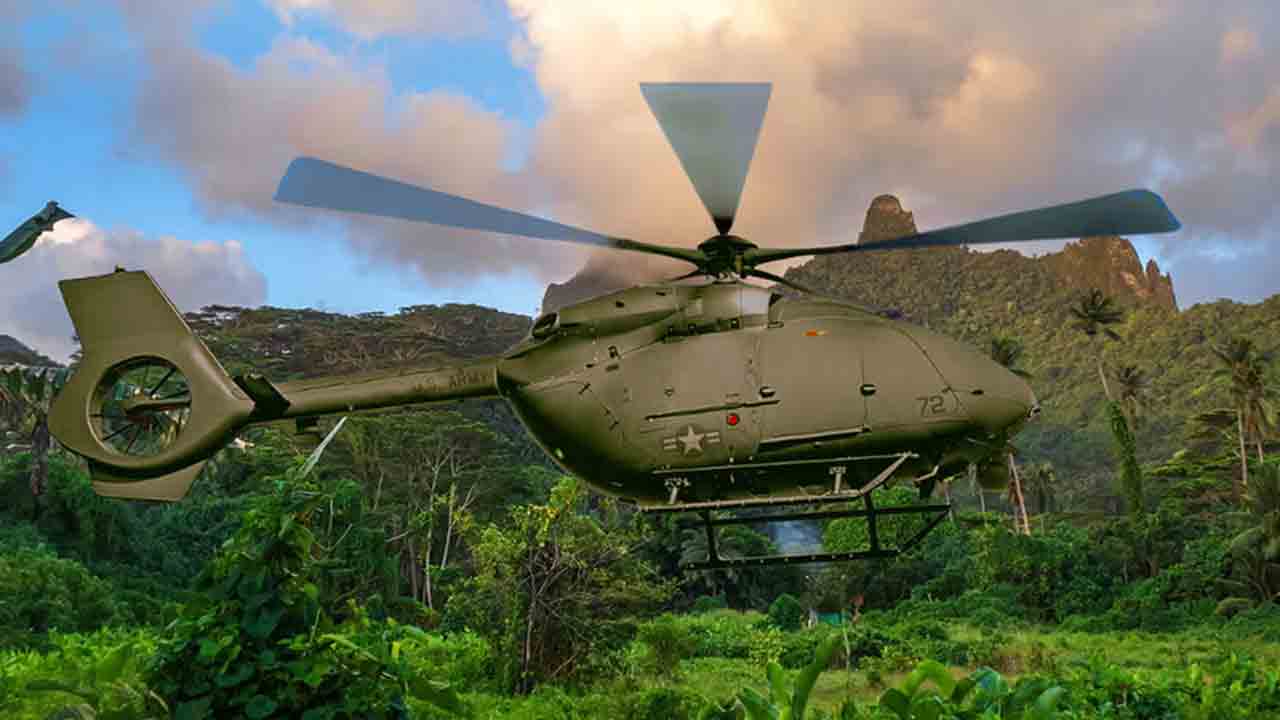
MQ-72C Lakota Connector advanced in testing with autonomous flight, obstacle avoidance, and safe landing, reinforcing the U.S. Marine Corps’ focus on pilotless logistics for high-risk zones.
The United States Marine Corps is tackling a challenge that could determine the success of future military operations: how to deliver supplies to troops spread across dangerous areas without putting pilots at risk.
The answer may lie in the MQ-72C Lakota Connector, an autonomous version based on the UH-72 Lakota helicopter. The aircraft is part of the Aerial Logistics Connector program, created to develop a new unmanned logistics transport capability in contested environments.
The project took another important step after Airbus U.S. Space & Defense, L3Harris Technologies, Shield AI, and Parry Labs completed the fourth autonomous flight test of the aircraft. For the first time, the technologies from all four companies operated together aboard an H-145, performing autonomous flight, avoiding obstacles, and landing safely under conditions similar to real operations.
Why does this matter?
In modern warfare, supplying troops can be as challenging as confronting the enemy directly. Smaller units, more dispersed and operating far from major bases, need to receive ammunition, fuel, equipment, spare parts, and medical supplies even when the airspace is under threat.
That is where the MQ-72C comes in. The concept is to allow essential cargo to reach high-risk areas without relying on human crews onboard.
Unlike many experimental projects, the Lakota Connector does not start from scratch. It uses a proven platform and combines it with autonomy systems, open architecture, and digital integration. This could make the path to operational use faster, more cost-effective, and less risky.
An aircraft that can evolve with the mission
The MQ-72C was developed using a modular approach known as MOSA, which allows new technologies to be integrated more easily. In practice, this means the aircraft can receive new sensors, software, mission systems, and future payloads without needing to be completely redesigned.
This feature is important because modern conflicts evolve rapidly. An autonomous logistics system must adapt to new threats, new routes, and new missions.
In addition to transporting supplies, the platform may also incorporate additional capabilities in the future, such as signals intelligence sensors and systems launched from the aircraft.
Source and images: l3harris | Airbus U.S. Space & Defense. This content was created with the help of AI and reviewed by the editorial team.
