
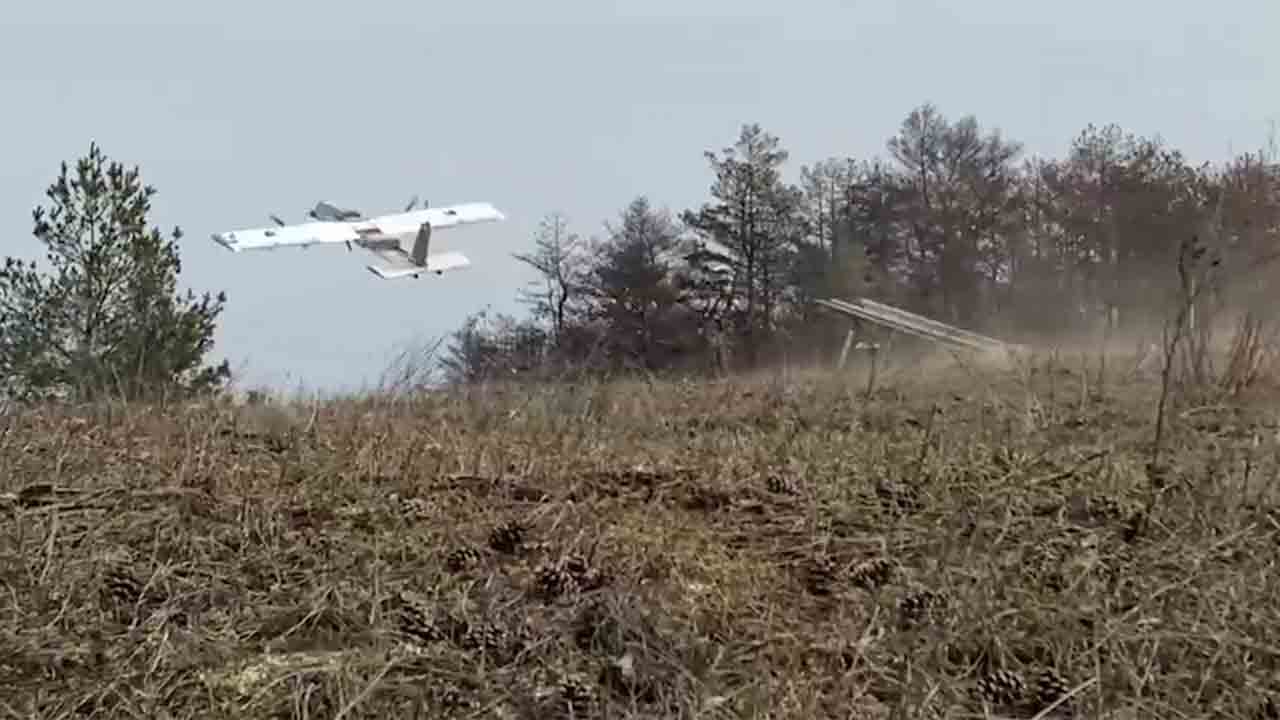
Russia’s defense industry has developed a new mass-produced universal munition designed specifically for attack drones.
Named KOT BC, the payload combines shaped-charge, fragmentation, and thermobaric effects in a single system, increasing the weapon’s versatility on the battlefield.
According to information released by Russian channel TV Zvezda, the new munition is already being integrated into the fixed-wing Molniya drone, one of the models most widely used by Russian forces in attacks against Ukrainian targets.
According to sapper Artem Kernasov, the warhead was designed to engage different types of targets with a single configuration. The shaped-charge effect would be capable of penetrating structures and shelters, while the fragmentation component expands the lethal radius against exposed troops. The thermobaric component, meanwhile, reinforces the blast impact, especially against fortified and entrenched positions.
To increase attack efficiency, the Molniya drone can carry two munitions at the same time, taking advantage of its payload capacity. In addition to increasing destructive potential, the configuration also works as operational redundancy: if one fails, the other can still complete the mission.
The Molniya continues to be presented by Russian military personnel as one of the simplest and most reliable drones in operation. Operators and technicians highlight its ease of use and maintenance as factors that helped consolidate the model in the Russian arsenal. Now, a modernized version of the aircraft is beginning to be introduced into service units.
According to observation technician Ilya Tutov, the new version of the drone has received features based on artificial intelligence, including automatic target acquisition. The technology is intended to improve the aircraft’s performance even in environments affected by electronic warfare, reducing dependence on the operator in situations involving poor image quality or strong interference.
+ Ukraine destroys rare Russian Typhoon-VDV armed with 30 mm cannon near defensive line
The development of the Molniya also draws attention because of its origins. According to Russian accounts, the project reportedly began in a rudimentary way, created by enthusiasts in garages before being incorporated by the government and taken to industrial-scale production.
With the adoption of the new combined munition and the integration of automated systems, the Molniya drone now represents another step in Russia’s attempt to expand the effectiveness of its unmanned platforms in offensive operations.
Source and images: TV Zvezda | Telegram @mod_russia. This content was created with the help of AI and reviewed by the editorial team.
