

The Japanese company Japan Maritime United held on March 13, 2026, the launch ceremony for two new Sakura-type patrol ships destined for the Japan Maritime Self-Defense Force (JMSDF).
The event took place at the company’s shipyard in Isogo, in the city of Yokohama, marking another step in the country’s naval modernization program.
During the ceremony, the third and fourth hulls of the new class of ships were launched simultaneously, named JS Hinoki (OPV-903) and JS Sugi (OPV-904). Following Japanese tradition, patrol ships receive names inspired by nature — in this case, two emblematic trees of the country: the Japanese cypress (Hinoki) and the Japanese cedar (Sugi).
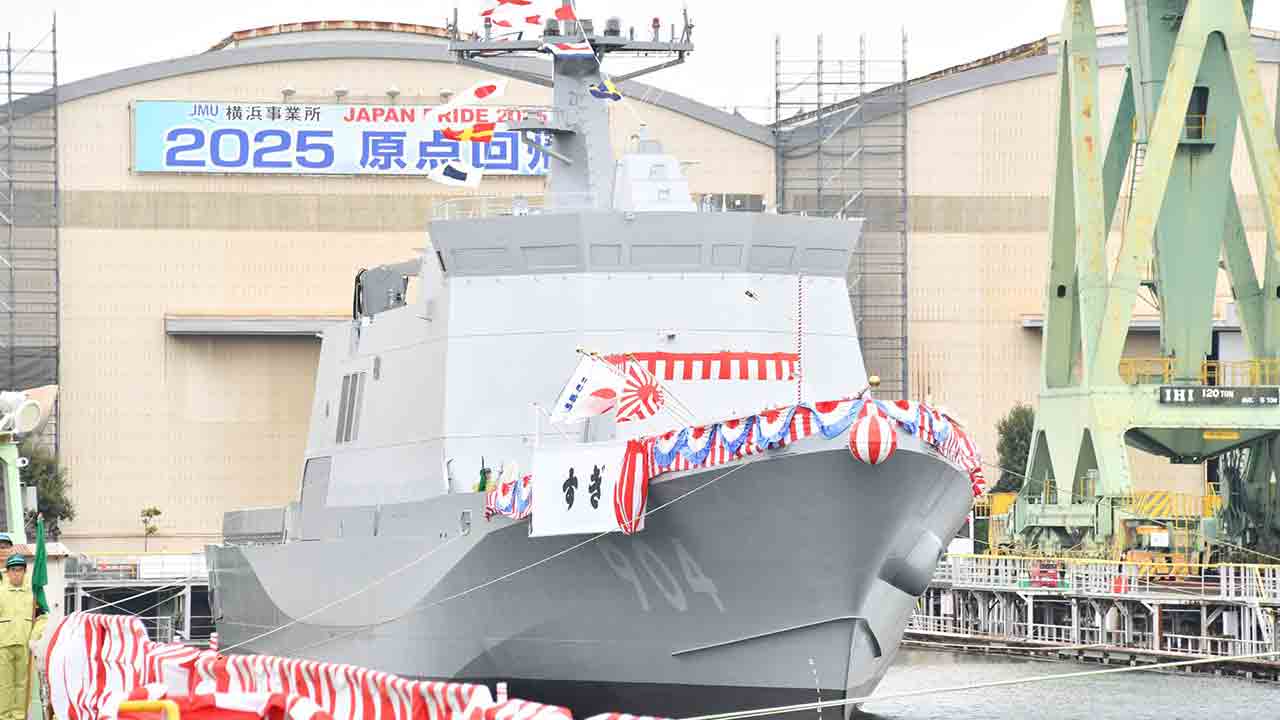
New patrol ship program
Construction of the first four units of the Sakura class began on February 14, 2025. In just over a year, the shipyard managed to launch all four hulls that make up the first production batch.
According to the Japanese Ministry of Defense, these vessels are expected to enter service in March 2027.
In total, Japan plans to build 12 next-generation offshore patrol vessels, which will replace the six Hayabusa-class missile boats scheduled to be decommissioned by 2029.
Technical characteristics
The new Sakura-type ships were designed for patrol missions, maritime surveillance, and protection of Japanese sea lanes.
Main specifications:
- Displacement: about 1,900 tons
- Length: approximately 95 meters
- Beam: 12 meters
- Maximum speed: over 20 knots
- Crew: about 30 personnel
In terms of armament, each ship will initially be equipped with a 30 mm automatic cannon. However, the design also includes modular structures that will allow the installation of up to eight anti-ship missiles.
The exact model has not yet been confirmed, but experts point to the Type 17 anti-ship missile, currently in production and expected to become the main anti-ship missile of Japan’s maritime forces. The system has an estimated range of up to 400 kilometers.
Platform for drones and modern operations
Another highlight of the project is the presence of a helicopter platform at the stern, which can be used by crewed aircraft or unmanned aerial systems.
In addition, the ships will receive equipment to operate unmanned underwater vehicles intended for missions such as:
- naval mine countermeasures
- underwater reconnaissance
- mine laying
This capability expands the role of the new ships within the modern concept of maritime operations with autonomous systems, increasingly adopted by navies around the world.
According to official information released by the JMSDF, the first two ships of the Sakura class are expected to be launched in November this year, while the third and fourth are scheduled for March next year.
+ US releases photos of the A-10 Thunderbolt II during a mission in Operation Epic Fury
Source and images: X / @JMSDF_PAO. This content was created with the help of AI and reviewed by the editorial team.
