
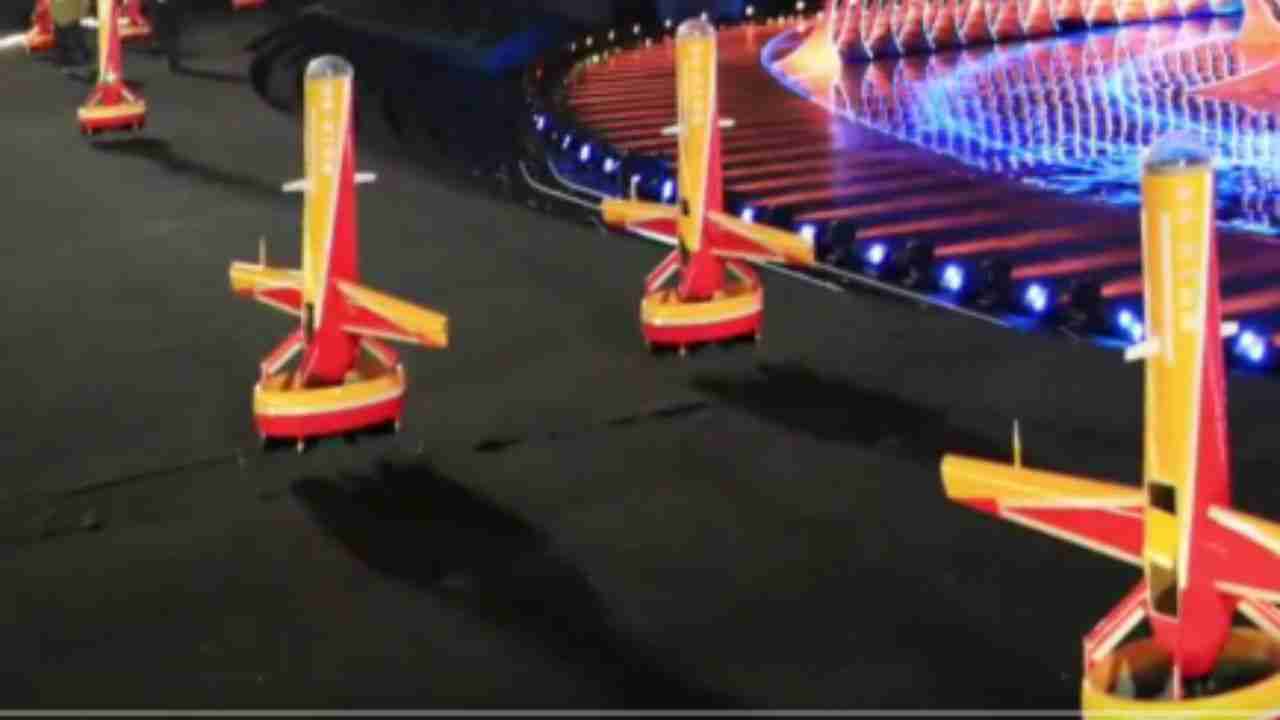
State-owned Chinese company AVIC Chengdu Aircraft Industry Group officially introduced a new vertical take-off and landing (VTOL) unmanned aerial vehicle, named Yunying-25V, during CCTV’s traditional televised festival held in 2026 in the city of Yibin.
The model, described as a “tail-sitter” drone (taking off supported on its tail), drew attention for its ducted propeller design, closely resembling the V-BAT developed by American company Shield AI.
In the public demonstration, ten aircraft performed a coordinated flight, marking one of the first large-scale displays of the system. According to the manufacturer, the Yunying is designed to operate in confined spaces, requiring only a 3 by 3 meter area for take-off and landing. The concept allows for rapid deployment from limited terrain or even mobile platforms, emphasizing agile and flexible use in diverse scenarios.
The drone comes in two versions: an electric version with a maximum take-off weight of 25 kg, and a gasoline-powered version reaching 31 kg. Both can operate up to 4,000 meters altitude. The reported maximum speed is 190 km/h for the electric configuration and 210 km/h for the fuel-powered version. Payload capacity ranges from 3 kg to 4 kg depending on the model. With a wingspan of 2.6 meters and total length of 1.96 meters, the system features a modular, detachable structure, facilitating transport in utility vehicles and allowing flight preparation in under five minutes.
Classified as a hybrid VTOL platform, the Yunying combines vertical take-off with the cruise efficiency typical of fixed-wing aircraft. The system enables transition from vertical to horizontal flight, achieving higher speeds compared to traditional multirotor drones. Equipped with electro-optical sensors for real-time image transmission, it can be used in urban monitoring, industrial inspections, and emergency response missions.
Although the company does not mention foreign competitors, the overall configuration clearly references the V-BAT, highlighting the growing global competition in the compact drone segment for expeditionary operations and distributed surveillance.
Source: Defence Blog | Photo: X @tphuang | This content was created with AI assistance and reviewed by the editorial team
AVIC CAC showcases how easy it is for a person to control a bunch of drones for an airshow.
I’d imagine that 1000s of drones show would involve more than this. pic.twitter.com/FABF4zLcN0
— tphuang (@tphuang) February 17, 2026
