
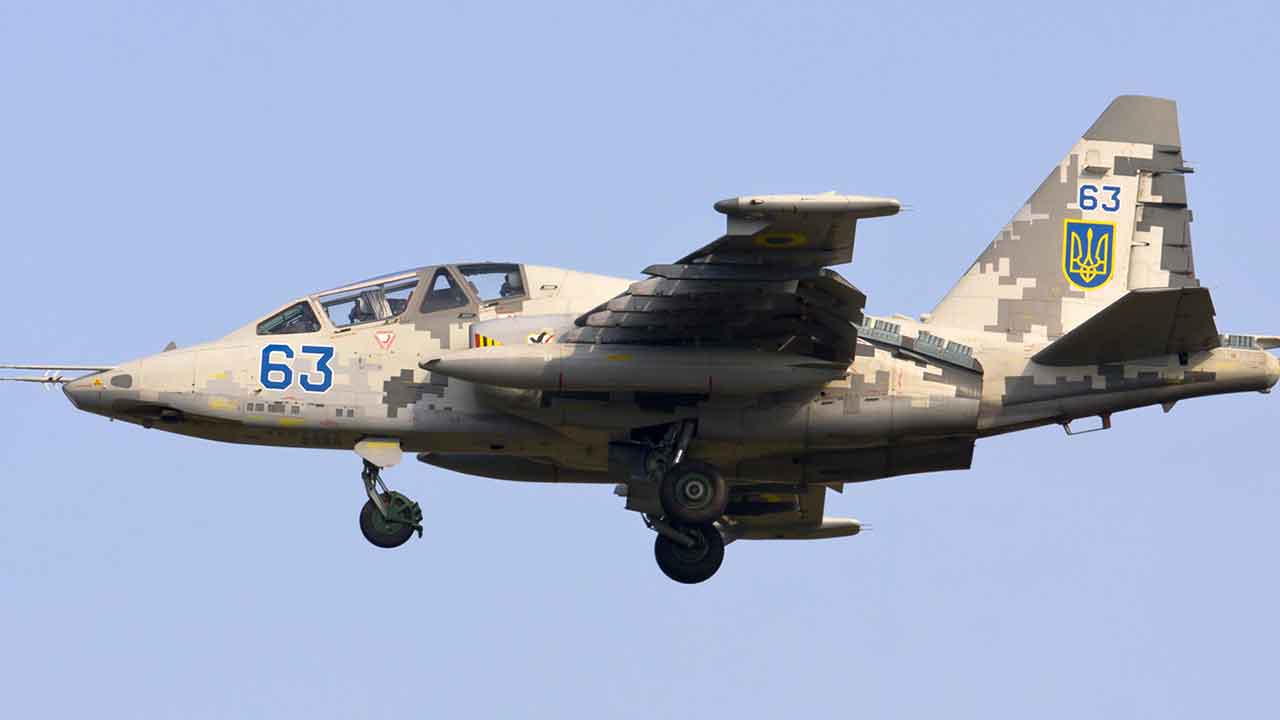
A video recorded by a camera mounted on the wingtip of a Ukrainian Su-25 captured the moment the aircraft was hit in mid-flight and disintegrated in the air.
The footage shows the jet flying level when a flash and sparks indicate the impact, followed by the rupture of the fuselage, the separation of parts of the plane, and finally, the wing falling amid a column of smoke.
In less than 20 seconds, the sequence highlights the violence of the attack and how quickly the situation became irreversible for the pilot.
The Su-25, identified by the tactical number “21 Blue,” was piloted by Stanislav Rykov of the 299th Tactical Aviation Brigade, who was killed in action on February 7, 2024. Considered one of the most experienced ground attack pilots in the force, he had accumulated 385 combat missions. His death was mourned by colleagues, who highlighted his skill and leadership. The exact location of the crash was not disclosed by Kiev, but Moscow claimed to have shot down a Su-25 near Novotroitske, in the Donetsk region, on the same date.
Unconfirmed reports suggest that the shootdown may have been caused by a Russian R-37M missile, a long-range weapon used by Su-35S fighters and MiG-31BM interceptors. With an approximate range of 200 kilometers and inertial navigation with active radar guidance in the terminal phase, the missile has been cited by Ukrainian pilots as one of the main threats in the conflict’s airspace, often launched from Russian territory, severely limiting Kiev’s air operations.
The vulnerability of the Su-25, combined with its low-altitude mission profile and high exposure, helps explain the significant losses of this model throughout the war. At least 22 Ukrainian aircraft of this type have been visually confirmed as destroyed, a number that could be higher. Still, the jet continues to be widely used by both sides, adapting tactics and weaponry to extend its range and survivability in one of the most hostile air environments ever recorded.
Source: The War Zone | Photo: X @GZsgallos2007 | This content was created with the help of AI and reviewed by the editorial team
The loss of a Ukrainian Su-25. The aircraft was hit by an R-37 missile; the responsibility likely lies with either a MiG-31BM or a Su-35S fighter, as these are the types that typically patrol with such long-range missiles. The pilot lost his life during the action. Blue skies to… pic.twitter.com/lNXZPuzHXS
— Zsiguli🇭🇺 (@GZsgallos2007) January 27, 2026
