
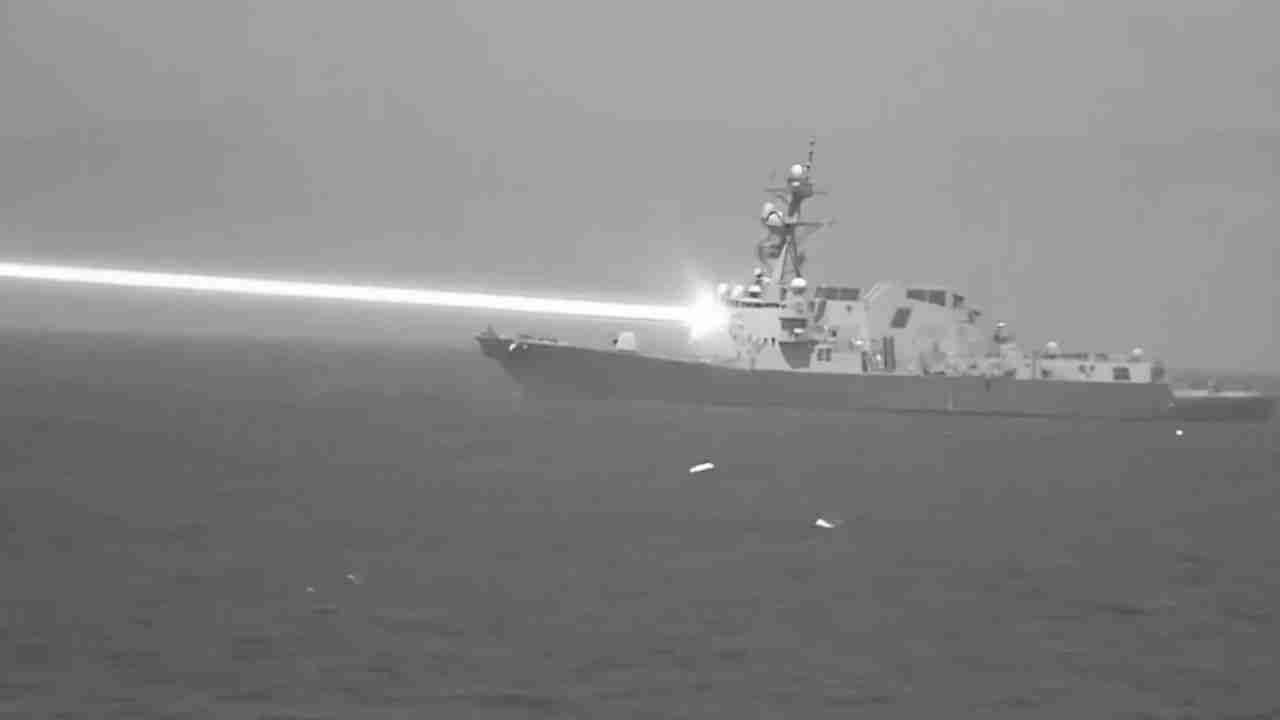
The United States Navy intends to make directed-energy weapons, especially lasers, the primary short-range defense of its warships.
The Chief of Naval Operations, Admiral Daryl Caudle, stated that this technology offers important strategic advantages, such as a “virtually infinite magazine,” reduced dependence on traditional munitions, and greater flexibility to prioritize offensive weapons.
Currently, the fleet uses systems such as ODIN and HELIOS, installed on Arleigh Burke-class destroyers. HELIOS, with a power output of 60 kilowatts, is already capable of damaging drones and small vessels, as well as blinding enemy sensors. However, the Navy plans to move toward much more powerful lasers, between 300 and 600 kilowatts, and is even studying the adoption of megawatt-class laser weapons on future large Trump-class surface combatants.
According to Caudle, the main challenge is not generating power, but adapting these systems to the naval environment, which imposes limitations related to space, cooling, power supply, and resistance to weather conditions and saltwater. Humidity, beam dispersion, and the need for highly sensitive optics still reduce the effectiveness of lasers in certain situations, delaying their large-scale deployment.
Even so, the Navy views these weapons as essential in the face of growing drone and missile threats. In addition to lasers, high-power microwave systems are also under development to strengthen naval defense. For Caudle, the definitive incorporation of directed energy is inevitable and strategic, although he acknowledges that the Navy still needs to overcome technical and industrial barriers to turn this vision into a fully operational capability.
Source: The War Zone | Photo: X @TruthNotControl | This content was created with the help of AI and reviewed by the editorial team
