
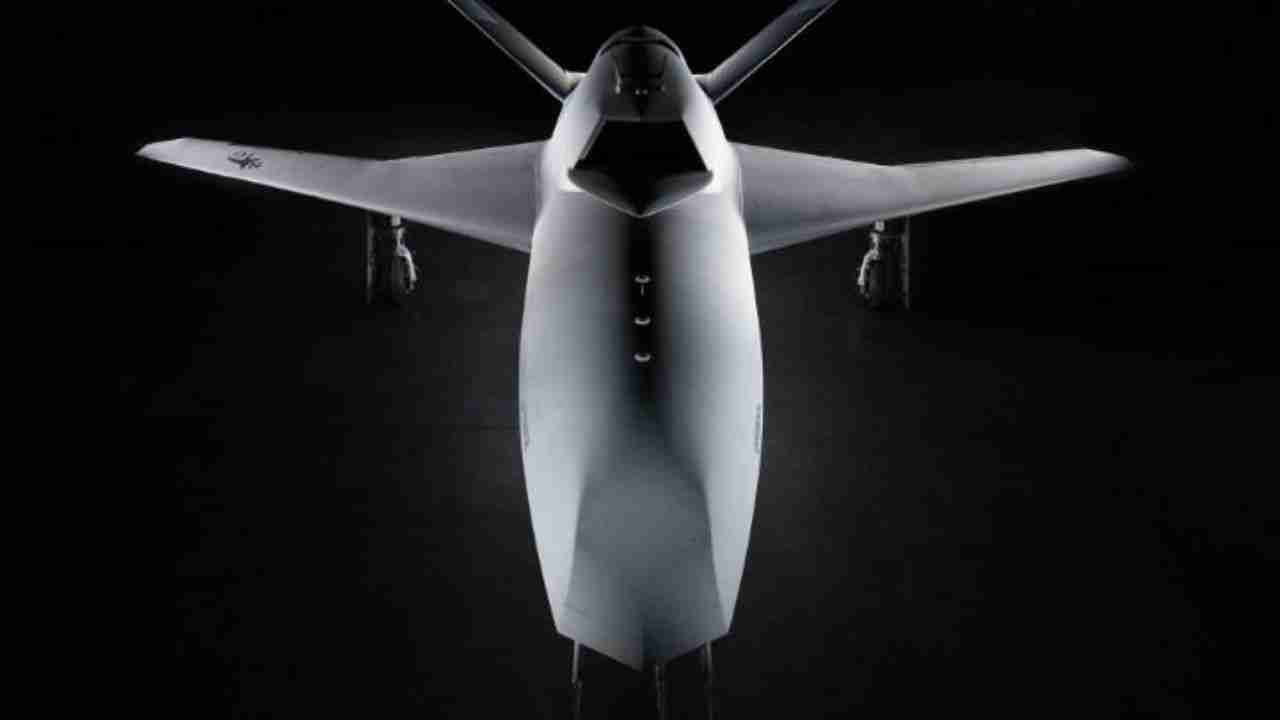
The United States Air Force has designated Project Talon from Northrop Grumman as YFQ-48A, recognizing the aircraft as one of the leading candidates for the Collaborative Combat Aircraft (CCA) program.
This designation represents a significant step forward as the service prepares to select projects for Increment 2 and strengthens the partnership between the Air Force and the company in developing semi-autonomous unmanned fighters. With this, the Talon joins the YFQ-42A and YFQ-44A models, which are already undergoing flight testing as part of “Increment 1”.
Officially revealed in December 2025, “Project Talon” was developed as a technology demonstrator focused on new, faster, and more cost-effective production methods for large unmanned platforms. The program emerged from the lessons learned from Northrop Grumman’s involvement in the first increment of the CCA program, where its proposal was considered technically sound but too expensive. The new project aimed to balance performance and cost, prioritizing a manufacturing philosophy with fewer parts, heavy use of composite materials, and faster assembly processes.
Although it is not yet a fully operational combat drone and has not yet flown, the Talon clearly reflects the company’s strategy for more accessible and rapid prototyping systems. The design focuses on performance, agility, and low observability features, with potential internal spaces for sensors or armaments, compatible with the CCA architecture.
According to Northrop Grumman, the main goal of the project is not only to compete in future increments but also to demonstrate a new way to develop and produce advanced aircraft in less time and at a reduced cost.
Source: The Aviationist | Photo: X @northropgrumman | This content was created with the help of AI and reviewed by the editorial team
Project Talon is here. This next-gen autonomous aircraft is made to adapt fast.
➡️ Modular by design
➡️ Mission-ready
➡️ Built for the challenges ahead pic.twitter.com/6UOhLSBHKn— Northrop Grumman (@northropgrumman) December 4, 2025
