
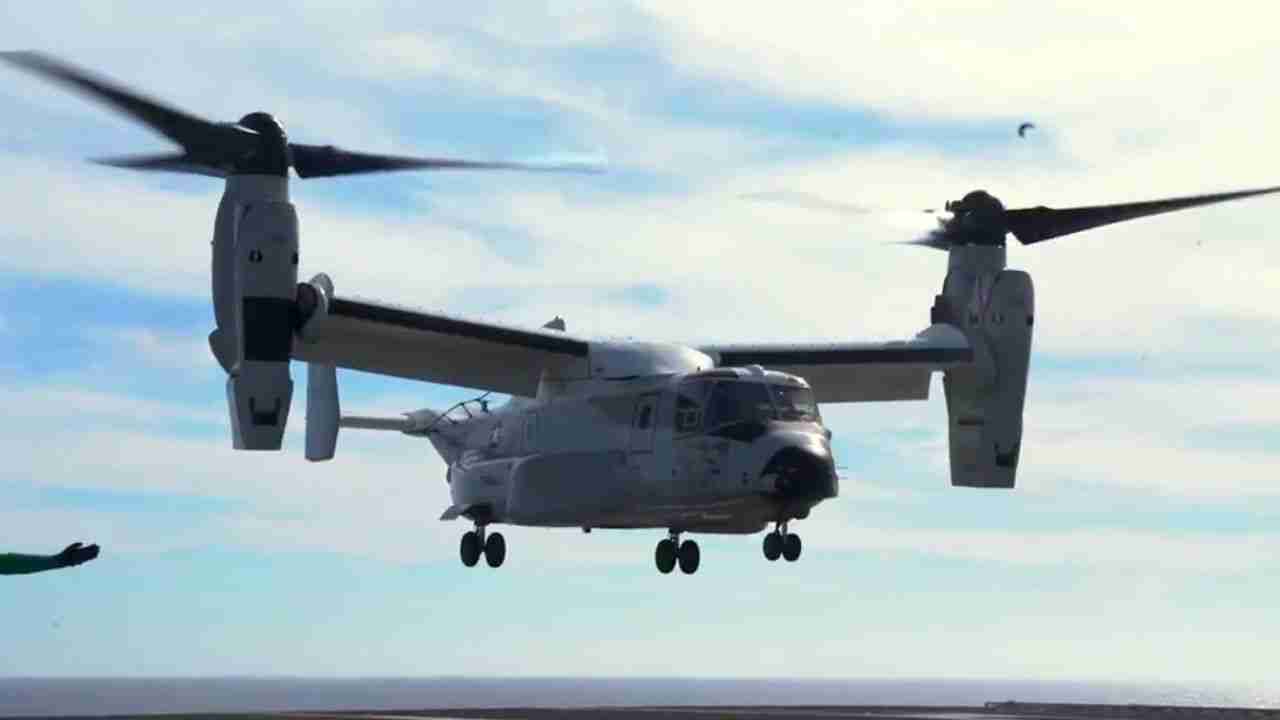
Recent reports from the Government Accountability Office (GAO) and the Naval Air Systems Command (NAVAIR) indicate that the V-22 Osprey continues to face serious safety problems, resulting from persistent technical failures, defective materials, and shortcomings in coordination among the U.S. Navy, Air Force, and Marine Corps.
According to the documents, even after years of operation and upgrades, critical risks related to the transmission, engines, flight control systems, and maintenance processes remain unresolved, with some fixes not expected until the 2030s.
Since 2022, the V-22’s operational record includes 12 Class A accidents, resulting in the deaths of 20 service members and the loss of four aircraft. Some of these incidents were attributed to material failures, especially in the proprotor gearbox (PRGB), including issues with metal alloys and catastrophic failures of critical components.
Other accidents had human error and noncompliance with maintenance and safety procedures as contributing factors, revealing weaknesses in the operational standards of the three services.
The reports also highlight low fleet readiness rates between 2020 and 2024, with levels close to 50% in the Navy and the Air Force and around 60% in the Marine Corps. In addition, audits identified dozens of critical components operating beyond their service life limits, while interim safety measures and operational restrictions were deemed insufficient to eliminate the structural causes of the problems.
Another critical issue is the lack of standardization among the services, which operate the same type of aircraft but adopt different safety, maintenance, and information-sharing procedures. According to the GAO and NAVAIR, inconsistent data sharing and the absence of joint routines hinder accident prevention.
Despite the challenges, military officials state that abandoning the V-22 is not under consideration, as the aircraft is still regarded as essential for troop transport, special operations, and logistical missions, even with part of the fleet remaining grounded until at least 2026.
Source: The Aviationist / Militarnyi | Photo: X @NAVAIRNews | This content was created with the help of AI and reviewed by the editorial team
#NAVAIR has released its comprehensive review of the V-22 Osprey, outlining 32 distinct recommendations for enhanced #Safety and #Readiness. The V-22 Osprey is essential to the @USMC, @USAF and @USNavy. #V22 #Osprey #NAVAIRhttps://t.co/jBresKvMbS pic.twitter.com/uEBWmI6pmF
— NAVAIR (@NAVAIRNews) December 12, 2025
US Navy sailors prepare to launch three CMV-22B Ospreys from aircraft carrier USS Theodore Roosevelt (CVN-71) on May 9. USS Theodore Roosevelt is conducting carrier qualifications in Pacific Ocean ahead of an upcoming deployment workup cycle. pic.twitter.com/pLNgNitAos
— Ryan Chan 陳家翹 (@ryankakiuchan) May 10, 2023
