

The experimental aircraft X-59, developed by Lockheed Martin under the Quiet SuperSonic Technology (QueSST) program, has taken off for the first time, marking a historic milestone in the research of quiet supersonic flight.
The inaugural flight took place from the U.S. Air Force base known as Plant 42, in Palmdale, California. According to data from FlightRadar24, the X-59 remained airborne for approximately one hour, reaching an average speed of around 400 km/h and a maximum altitude of 3,600 meters (12,000 feet).Australia receives new batch of UH-60M Black Hawk helicopters from the United States
+ Australia receives new batch of UH-60M Black Hawk helicopters from the United States
Supersonic without the boom
The QueSST program, launched in 2016, aims to demonstrate that it is possible to drastically reduce the noise of the sonic boom produced by aircraft exceeding the speed of sound. The goal is to collect data that could lead to a revision of international regulations that currently prohibit commercial supersonic flights over land.
During the project’s second phase, the X-59 will conduct a series of supersonic flights from Edwards Air Force Base, also in California, to validate the technological concept developed by the teams at Lockheed Martin and NASA.
Innovative design and advanced technology
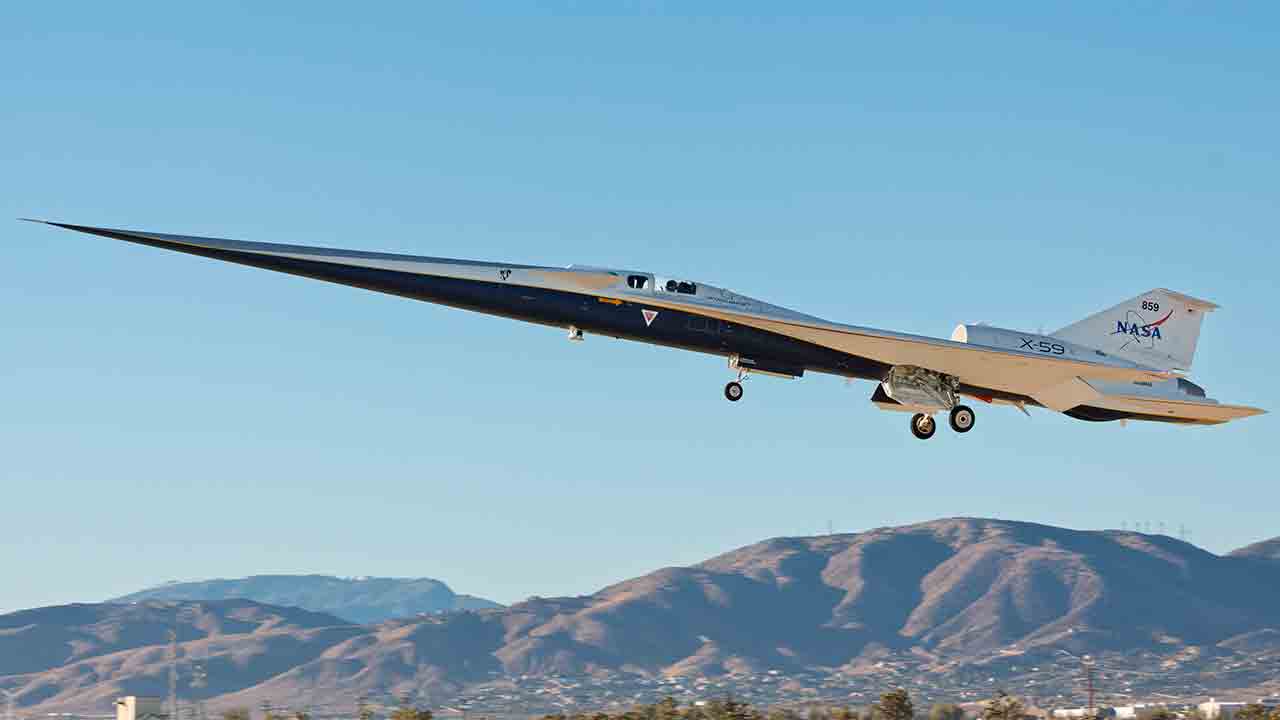
One of the most distinctive features of the X-59 is its long, slender nose, which accounts for nearly one-third of the aircraft’s total length — approximately 30.39 meters (99.7 feet). This special configuration helps “break up” the shock waves that typically generate the sonic boom.
As a result of this design, the cockpit is positioned almost in the middle of the fuselage, preventing the pilot from having a direct forward view. To compensate, the X-59 uses an external vision system called the eXternal Vision System, composed of high-resolution cameras that project images onto a 4K monitor in the cockpit.
A step toward the future of supersonic aviation
The success of the X-59’s first flight represents a significant step toward faster and more sustainable air travel. If the concept is validated, it could pave the way for the return of commercial supersonic flights — this time without the acoustic impact that limited the use of aircraft such as the Concorde in the past.
Source and images: Lockheed Martin Aeronautics | X @JarodMHamilton. This content was created with the help of AI and reviewed by the editorial team.
X-59 unrestricted climb! pic.twitter.com/8vzeMZJoqm
— jmh.creates (@JarodMHamilton) October 28, 2025
